
Decision Scorecards: Making Better Business Decisions

Decision Scorecards

Decision Scorecards

Decision Scorecards for Business Evaluation and Decision-Making

Choosing between alternative business strategies, investments, suppliers, or solutions is rarely straightforward. Each option may offer different benefits, costs, opportunities, and risks. The criteria that matter most often depend on the objectives of the decision and the people involved.
Decision scorecard illustrating how teams compare alternatives, discuss priorities and select business solutionsConsider a company evaluating different marketing strategies. One alternative may offer greater market reach, another better profitability, and a third lower implementation risk. Which should the company choose?

The challenge is to understand which alternative best supports the company’s objectives, priorities, and constraints, while considering the different perspectives of those involved in the decision.

Decision scorecards, including Weighted Decision Scorecards (Linear Models) and Pugh Matrices, help organizations structure these comparisons and develop well-supported recommendations.

These approaches, often referred to as decision matrices, provide a common framework for evaluating alternatives against agreed criteria, combining quantitative and qualitative factors, and making important trade-offs visible. They also create a rational environment for discussion, where different perspectives can be shared and challenged constructively.

Decision scorecards can be used independently to compare business alternatives or as part of broader decision-making methods. For example, a Market Attractiveness Matrix may use structured assessments to evaluate criteria contributing to market attractiveness or the ability to compete.

In these situations, the scorecard supports a specific stage of the analysis, helping teams assess criteria consistently and document the reasoning behind their evaluations. By making assumptions, priorities, and evaluation criteria explicit, decision scorecards help stakeholders understand, justify, and communicate decisions.

The objective is not simply to identify the alternative with the highest score. It is to make a better-informed decision that stakeholders can understand and support.
How Decision Scorecards Improve Business Decisions

Decision scorecards provide a structured approach to comparing alternatives using a common set of evaluation criteria. They can support a wide range of business decisions, from marketing strategy and sales channel selection to purchasing, supplier evaluation, investment prioritization, and solution selection.

Their value lies in helping teams clarify priorities, examine different perspectives, evaluate trade-offs, and make the reasoning behind their decisions visible and understandable.

Establishing Shared Evaluation Criteria

A decision scorecard starts with identifying the factors that matter most to the decision. These may include costs, profitability, strategic fit, customer value, implementation requirements, technical capabilities, or risks.

Teams should agree on the criteria and how each will be evaluated before comparing alternatives. Depending on the approach, criteria may also be weighted to reflect their relative importance.

This shared framework helps participants focus discussions on the agreed objectives and reduces the risk of repeatedly revisiting the same questions without making progress.

Combining Quantitative and Qualitative Factors

Business decisions rarely depend exclusively on measurable data. Financial returns, costs, and implementation times may be relatively straightforward to quantify, while strategic alignment, organizational readiness, customer acceptance, and technological capabilities may require qualitative assessments.

Decision scorecards allow teams to consider both types of factors within a common evaluation framework.

The objective is not to give every factor an artificial level of precision, but to make assessments sufficiently explicit and consistent to support meaningful comparisons.

Making Trade-Offs Visible

An alternative may perform particularly well against some criteria while presenting important weaknesses against others. A lower-cost solution may require more implementation effort, while a technologically advanced alternative may offer greater potential but involve additional risks.

Decision scorecards make these trade-offs visible, helping teams understand the factors contributing to an overall assessment rather than focusing exclusively on a final score.

This is especially important when a single weakness or constraint could significantly influence the decision.

Supporting Stakeholder Alignment

Important decisions often involve participants with different responsibilities, expertise, and priorities. Marketing, sales, finance, operations, and technical teams may assess the same alternatives from different perspectives.

A decision scorecard provides a shared basis for discussing these differences constructively. Assumptions can be challenged, missing information identified, and priorities clarified.

This collective approach helps build engagement and supports the acceptance of the final recommendation.

Stakeholder Analysis can help identify the participants whose contributions and support are important to the decision.

Choosing the Right Decision Scorecard

Decision scorecards can use different evaluation approaches, depending on the nature of the decision and the information needed to support it.

Two useful approaches are the Weighted Decision Scorecard (Linear Model) and the Pugh Matrix. Both support structured comparisons based on multiple criteria, but they present results differently and encourage different types of discussions.

Weighted Decision Scorecard (Linear Model)

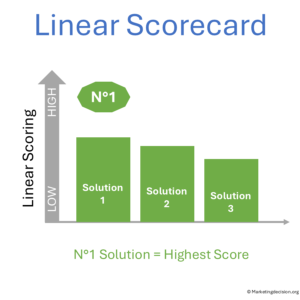
Weighted decision scorecard comparing alternative solutions using criteria, weights and overall scoresA Weighted Decision Scorecard evaluates alternatives against a common set of criteria using numerical assessments and weights that reflect their relative importance.

Each alternative receives an assessment for each criterion. The weighted results are then combined to calculate an overall score.

Criteria can also be organized into categories, making it possible to examine category-level results alongside the overall evaluation.

This approach is particularly useful when comparing suppliers, services, projects, business solutions, or other alternatives for which a consolidated ranking can support the decision.

The principal strength of the Linear Model is its ability to combine multiple assessments into an overall evaluation while retaining visibility into the individual criteria.
Pugh Matrix: Evaluating Strengths and Weaknesses

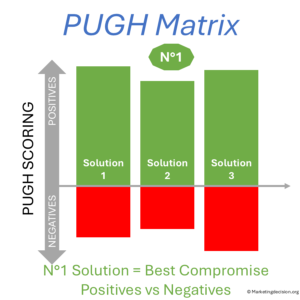
Pugh matrix comparing alternative solutions through positive and negative assessments to identify strengths and weaknessesThe Pugh Matrix emphasizes the relative strengths and weaknesses of alternatives.

In the five-level assessment approach used here, criteria are evaluated using double minus (- -), minus (-), similar (S), plus (+), and double plus (++).

This representation makes favorable and unfavorable assessments visible and helps teams understand where alternatives offer advantages or present limitations.

Rather than concentrating exclusively on a consolidated numerical ranking, the approach encourages discussion of the balance between positive and negative factors. It can also help identify potential showstoppers or weaknesses that require further investigation before a recommendation is made.

The principal strength of the Pugh Matrix is its ability to highlight important compromises and support discussions about which alternative offers the most appropriate balance of strengths and weaknesses.

Weighted Decision Scorecard vs Pugh Matrix


Weighted Decision Scorecard

Pugh Matrix

Main emphasis

Overall weighted performance

Strengths and weaknesses

Evaluation

Weighted numerical scores

Relative positive and negative assessments

Results

Aggregated scores and ranking

Visibility of favorable and unfavorable evaluations

Main benefit

Comparing overall performance

Identifying trade-offs and potential showstoppers

Particularly useful when

A consolidated ranking is important

Understanding compromises is essential

The Linear Model is well suited to evaluations requiring a consistent overall assessment and ranking. The Pugh Matrix is particularly valuable when understanding relative strengths, weaknesses, and compromises is central to the decision.

Both approaches contribute to better-informed business decisions by making evaluations, assumptions, and trade-offs explicit. They help teams combine available evidence, different perspectives, and professional expertise when developing recommendations.

How to Use Decision Scorecards Effectively

Decision scorecards can support both simple comparisons and complex business decisions. The approach should be adapted to the importance of the decision, the people involved, and the information required.

Start by consolidating the objectives, needs, and scope. Clarify the decision to be made, the alternatives to consider, and the main constraints. Depending on the project, this may involve discussions with sponsors and stakeholders to align expectations, responsibilities, and resources. The Frame In/Out approach can help clarify the boundaries of the evaluation.

Involve the right people. A simple comparison may require only one or two participants, while more complex decisions may benefit from a cross-functional team. The important point is to bring together the knowledge and perspectives needed for a meaningful evaluation. Stakeholder Analysis can help identify relevant participants.

Decision scorecard methodology illustrating the importance of defining success criteria before evaluating alternativesAgree on what success looks like. Before scoring alternatives, consider what the evaluation should achieve, which questions need answers, and what would make the results satisfactory. For complex projects, SMART objectives or formal deliverables may help. For simpler evaluations, a shared understanding of what is sufficient to move forward may be all that is needed.

Establish the evaluation criteria together. Identify the factors that matter, clarify their meaning, and agree on how alternatives will be assessed. Criteria that are difficult to measure deserve particular attention, as discussing them may reveal important uncertainties or assumptions.

Keep a record of the criteria, assumptions, and reasoning behind important assessments. Note questions that remain unresolved, information that could not be obtained, and factors that may still influence the final decision. These observations can be as valuable as the scores themselves when reviewing the results or revisiting the evaluation later.

Determine whether the analysis is complete. Return to the initial objectives and expectations. Have the important questions been answered? Are the remaining uncertainties acceptable? Do the participants agree on the conclusions and the next step? The evaluation is complete when its results provide a sufficient basis to move forward.Decision scorecard methodology illustrating how teams verify that evaluation objectives have been achieved
Allow time for discussion and reflection. As the evaluation progresses, teams may discover new criteria, challenge initial assumptions, or reconsider earlier assessments. Different perspectives need time to be understood and discussed, particularly when the scorecard involves many criteria and alternatives.

There is no need to complete every assessment in a single session. Teams should feel comfortable revisiting their evaluations and allowing time for reflection as their understanding develops. Periodically asking “Where are we?” and “What does success look like?” helps maintain a shared understanding of progress and determine what remains to be done.

The objective is not to complete the scorecard as quickly as possible, but to give the team the time needed to reach a well-supported decision.

In Summary: From Scorecards to Better Decisions

Decision scorecards help teams compare business alternatives, combine quantitative and qualitative considerations, and make important trade-offs visible. Whether using a Weighted Decision Scorecard or a Pugh Matrix, the objective is to develop recommendations that reflect business priorities and can be understood and supported by those involved.

The quality of the decision depends on the criteria selected, the assumptions made, and the discussions that take place throughout the evaluation. A high score does not necessarily identify the best solution, particularly when important risks, constraints, or weaknesses remain.

A successful evaluation provides sufficient understanding and confidence to agree on a recommendation and move forward. Decision scorecards support judgment, encourage constructive discussions, and help turn different perspectives into informed business decisions.

FAQ - Decision Scorecards

Why Use a Decision Scorecard for Business Decisions?

Business decisions often involve competing objectives, different perspectives, and alternatives that are difficult to compare directly.

Decision scorecards provide a common framework for evaluating these alternatives, clarifying priorities, and discussing trade-offs. They help participants understand the reasoning behind a recommendation and build agreement on how to move forward.

A Weighted Decision Scorecard uses numerical assessments and criterion weights to calculate an overall score for each alternative. It is particularly useful when a consolidated comparison and ranking are important.

A Pugh Matrix emphasizes relative strengths and weaknesses, making favorable and unfavorable assessments visible. It is especially useful for discussing compromises, limitations, and potential showstoppers.

Some important factors in business decisions are difficult to measure. Strategic fit, customer value, technological readiness, organizational capabilities, and implementation risks may all influence a decision without being easily expressed in numbers.

Identifying these difficulties is the first step toward resolving them.

Teams can clarify what each criterion means, divide complex criteria into simpler components, consult experts, and discuss assumptions with stakeholders. These discussions may also reveal new criteria or information that should be considered.

The team can then decide whether additional investigation is necessary, whether a qualitative assessment is sufficient, or whether the uncertainty can reasonably be addressed later.

The objective is not to eliminate every uncertainty, but to understand which uncertainties matter and whether the evaluation provides a sufficient basis for moving forward.

Not necessarily. Results depend on the criteria selected, their relative importance, and the assumptions used in the evaluation.

An alternative with the highest score may still present unacceptable risks, constraints, or weaknesses. The scorecard helps make these issues visible so that participants can discuss them and reach a well-supported recommendation.

Decision scorecards are not limited to comparing alternatives. The same principles of structured evaluation can support other business analysis methods, helping teams assess criteria, combine different perspectives, and make their reasoning explicit.

Examples include:

In these applications, structured scoring supports a broader analysis rather than serving as the final decision. It helps teams develop consistent assessments, identify important trade-offs, and reach better-informed business decisions.

© marketingdecision.org

Tools for Decision Scorecards

Effective decision evaluations often require more than a scorecard. Other methods and tools described on this site can help teams define their objectives, involve relevant stakeholders, develop evaluation criteria, and interpret the results.

Define the decision and its objectives

Frame In/Out – Clarify the decision scope, identify what is included or excluded, and establish a shared understanding of the evaluation boundaries.

Decision Mix – Explore the broader decision-making process and the importance of aligning objectives, participants, and recommendations.

Involve the right stakeholders

Stakeholder Analysis – Identify the people who should contribute to the evaluation and those whose support is important for implementing the decision.

Develop and assess business alternatives

Strategic Position Analysis – Compare market and business opportunities using Market Attractiveness and Ability to Win.

Price-Value Mapping – Explore price and perceived customer value when these factors influence the comparison of alternatives.

Apply a structured decision scorecard

Weighted Decision Scorecard Excel Tool – Compare alternatives using weighted criteria and consolidated results.

Pugh Matrix Excel Tool – Evaluate alternatives while highlighting strengths, weaknesses, and important compromises.

Weighted Decision Scorecard Excel Tool

Weighted Decision Scorecard showing overall results, weighted criteria and category-level scores in one Excel worksheetThe Weighted Decision Scorecard Excel Tool provides a practical way to compare business alternatives using weighted evaluation criteria.

Criteria can be organized into categories, and the tool calculates both overall weighted scores and results for individual categories. This helps teams compare alternatives, understand the factors contributing to their scores, and discuss differences in performance.

The Excel tool supports structured evaluations of suppliers, projects, services, marketing strategies, and business solutions.

Pugh Matrix Excel Tool

Pugh Matrix Excel Tool showing positive and negative weighted scores for five alternative solutionsThe Pugh Matrix Excel Tool provides a structured approach to comparing alternatives by making their strengths and weaknesses visible.

Using five assessment levels, from double minus to double plus, the tool helps teams identify favorable and unfavorable evaluations across multiple criteria. This representation makes it easier to recognize important compromises and potential weaknesses that deserve further investigation.

The tool is particularly useful when evaluating alternative solutions or projects where understanding their relative advantages and limitations is essential.

© marketingdecision.org

Explore Marketing Tools and Templates

marketing tools and templates

Explore practical methods and Excel tools designed to support business decisions, evaluate alternatives, and prioritize opportunities.

© 2026 MARKETING DECISION SOLUTIONS. All Rights Reserved.