
Solution Portfolio Management – Prioritizing and Investing Across Your Solution Landscape

Solution Portfolio Management

Solution Portfolio Management

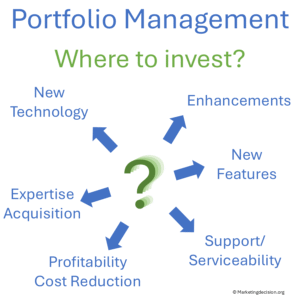
Solution Portfolio Management framework for deciding where to invest across the solution portfolio

Solution Portfolio Management involves steering company investments across the entire portfolio of solutions. It ensures that resources – whether financial, technical, or commercial – are allocated to the most promising solution and technology developments to create customer and business value.

Solution Portfolio Management helps teams decide where to invest, where to protect, and where to disengage.

This approach goes beyond product development. It includes investments in technology, sales and service infrastructures, particularly when entering or developing markets that require specific capabilities. All investments – material or immaterial – should be considered when assessing the resources required and the expected return on investment of a solution opportunity.

In the context of Value Creation, this process answers the first key question: “Where to invest within the solution portfolio to secure growth and profitability?” Each solution opportunity can then be articulated consistently to support comparison, discussion and investment decisions across the portfolio.
A Recurrent Process in Solution Portfolio Management

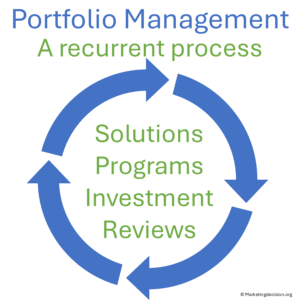
recurrent-process-reviewing-prioritizing-investment-strategySolution Portfolio Management is an ongoing decision process. Teams regularly present proposals that are reviewed, discussed, and, when validated, shape the next generation of solutions. This recurring review process allows teams to reorient investment budgets as priorities and opportunities evolve.

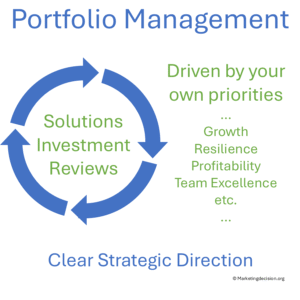
A clear strategic direction is therefore essential. Company priorities should be reflected in key decision criteria such as growth, profitability, innovation and risk management. Teams need to revisit these objectives regularly, maintain clarity on acceptable risk levels, and ensure that investment programs remain aligned with overall business goals.

In organizations with several business units or market segments, portfolio reviews may first take place within individual teams, but consolidation is necessary to align priorities and investment decisions across the organization.
aligning-solution-portfolio-with-strategic-priorities

Solution Portfolio Management relies on decision tools similar to those presented in the Decision chapter. In many ways, it also parallels marketing plan development, as both aim to align objectives and strategies across the organization.

While similar in purpose, Solution Portfolio Management focuses specifically on decisions about the solution portfolio and operates through shorter, recurring review cycles. These cycles are often linked to product and technology reviews, where progress is assessed through intermediate evaluations between major planning periods.
The Four-Step Solution Portfolio Management Process

solution-portfolio-management-4-steps-framework

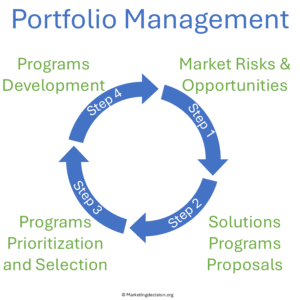
The process can be structured in four steps, much like a marketing plan.

Each company can adapt these steps to reflect its organization and governance structure.
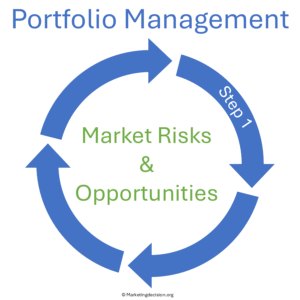
  1. Identification of Market Risks and Opportunities
  2. Gathering Solution Program Proposals
  3. Prioritization and Selection of Programs
  4. Program Development – Deploy, Control, and Sustain

Step 1: Identification of Market Risks and Opportunities

market-risks-and-opportunities-portfolio-management

A review of market risks and opportunities is the first step in identifying areas for growth – whether through new solution offerings, technology, or go-to-market strategies.

Supporting actions include market share analysis to determine which segments are expanding faster than others and where the company may have opportunities to strengthen its competitive position. Even modest differences in growth rates can yield significant long-term impact.

To remain competitive, it is essential to invest in solutions targeting high-growth, profitable segments, while maintaining presence in declining markets with limited investments.

Understanding competitors’ strengths and weaknesses is equally critical. A competitor’s weakness may open a unique opportunity to capture market share, while a strength may present a barrier that shapes your own development priorities. However, past performance alone cannot predict future success – customer needs and expectations must remain at the center of this analysis.

The objective of this first step is to decipher the market, identify opportunities and build a comprehensive view of customers and competitors. This market understanding provides the evidence needed to develop, compare and prioritize solution opportunities.

Market information will rarely be complete or fully validated. The analysis may therefore combine objective evidence with informed assumptions. These assumptions and uncertainties should remain visible, allowing management teams to understand not only the opportunity, but also the confidence behind the assessment.
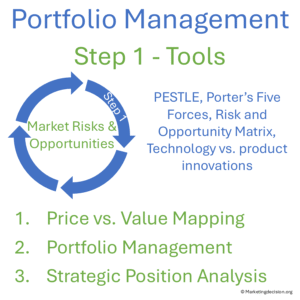
decision tools supporting solution portfolio management – price value map, portfolio graph, strategic position analysisMethods and tools from the Decision and Market chapters – such as PESTLE, Porter’s Five Forces, Risk and Opportunity Matrix, and Scenario Planning – are particularly valuable.

Additional tools that support this step include:

  • Price-Value Mapping – helps evaluate perceived value relative to price and competitive positioning.
  • Portfolio Graph – visualizes company and competitor solutions by relative value across market segments.
  • Strategic Position Analysis – maps solutions along “ability to win” and “market attractiveness” axes to highlight where to focus investments.

By adopting a 360° market view, teams can challenge assumptions, reassess growth opportunities, and align future developments with both customer expectations and company objectives.
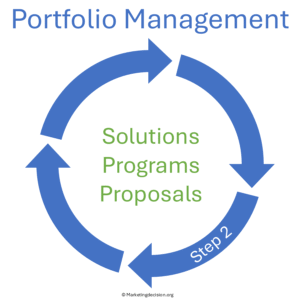
Step 2: Gathering Solution Program Proposals

structure for gathering and presenting solution program proposals

Once market opportunities have been identified, the next step is to gather and structure proposals for potential solution programs. Ideas may originate from customer feedback, sales teams, market analysis, technology developments, competitive intelligence, or internal expertise. The objective is to turn these ideas into sufficiently clear solution opportunities that management can understand, discuss and compare.

Each opportunity should therefore be articulated through a consistent proposal format. This does not replace the detailed market analyses, financial calculations, technical studies or development plans supporting the proposal. Instead, it provides management with a concise view of the information required for an initial portfolio discussion.

The Solution Opportunity Proposal provides this one-page summary, structured around Why – What – How:
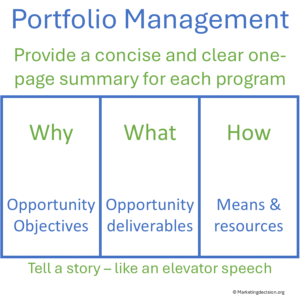
  • Why: Summarize the opportunity and objectives – including a concise description, ROI summary or key figures, strategic rationale and contribution to company objectives.
  • Product Portfolio management - concise and clear solution program summaryWhat: Summarize the marketing rationale and demonstrate the viability of the proposed solution. It should provide a clear view of the Market, Customer, Solution, Placement and Promotion dimensions, supported by the expected yearly ROI and key financial assumptions.
  • How: Summarize the roadmap required to make the opportunity happen – including development and validation steps, remaining challenges, budget, timeline, resources and specific competencies required.

Using the same structure for each opportunity gives management teams a consistent basis for discussion across the portfolio. ROI, strategic contribution, market rationale, investment requirements and major implementation challenges can be considered alongside those of other proposals, while the detailed supporting information remains available when required.

The one-page proposal therefore acts as an introduction to the complete opportunity case – concise enough to support portfolio discussion, but connected to the evidence and analyses required for an informed investment decision.

Step 3: Prioritization and Selection of Programs

Once solution proposals are gathered, they need to be compared and prioritized. This is where management decides which programs should receive investment and resources. The consistent structure established in Step 2 supports the discussion, while detailed analyses provide the evidence needed to challenge assumptions and understand differences between proposals.
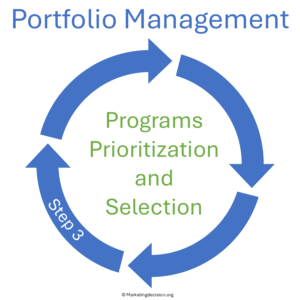
prioritization and selection of solution development programs

Prioritizing programs requires a balance between long-term initiatives and short-term opportunities. Prioritization may consider strategic alignment, expected customer and business value, ROI, market attractiveness, ability to compete, investment requirements, resources, timing and risk. The relevant criteria and their relative importance will depend on the company’s objectives and circumstances.

Decision-making tools from the Decision chapter – such as ease-of-implementation versus impact matrices – can facilitate structured discussion.

Programs can also be plotted on Technology vs Product Innovation Strategy axes to evaluate their potential contribution to company strategic investments.

Teams should explore “what if” scenarios to test different pathways under varying market or technology conditions.

Even when several opportunities are attractive, financial resources, competencies and development capacity are limited. Portfolio management therefore requires explicit choices about where to invest, what to postpone, what to protect and what not to pursue.

Quantitative comparisons and scorecards can support these decisions, but individual criteria are usually not additive and strengths do not necessarily compensate for critical weaknesses. The objective of decision tools is to structure and clarify the discussion – not replace management judgment.

Ongoing attention to emerging technologies, competitive entries, and customer experience is vital to ensure that selected programs deliver sustainable differentiation and contribute to stronger long-term customer relationships.

Selected programs can then move into development with a clear understanding of why they were prioritized and which assumptions, risks or conditions need to be monitored.
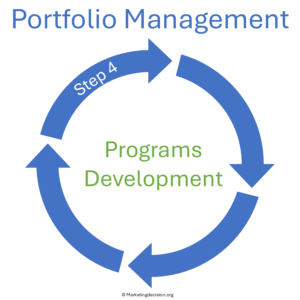
Step 4: Program Development – Deploy, Control, and Sustain

program deployment, control, and sustainment in solution portfolio management

Once a program is selected, the focus shifts from the investment decision to execution. The roadmap defined in the Solution Opportunity Proposal provides the initial reference for development, validation and deployment, including the expected budget, timeline, resources and competencies required.

Development should progress through clear milestones and validation steps. Technical feasibility, customer expectations, market assumptions and the business case may need to be tested as the solution develops. These reviews provide opportunities to confirm the program, adapt it when new information emerges, or reconsider the investment when important assumptions no longer hold.

This final step ensures that investment resources are effectively used. Program execution should be monitored regularly against objectives, milestones, budgets and expected outcomes, with lessons learned shared to reinforce best practices and avoid recurring issues.

Budget discipline is critical: both overestimated and underestimated budgets can create inefficiencies. Regular reviews help ensure funds are directed toward the highest-impact initiatives. They also provide visibility on resource requirements, emerging constraints and potential trade-offs with other programs in the portfolio.

Deployment is not the end of the portfolio decision process. Once a solution reaches the market, actual customer response, competitive developments, performance and profitability provide new evidence. These results should feed future portfolio reviews, helping management reassess priorities, adapt investments and identify new opportunities to strengthen or expand the solution.

In Summary

Solution Portfolio Management is a core activity in value creation, where companies assess and coordinate their solution development priorities and make both short- and long-term investment decisions.

By establishing consistent, transparent mechanisms, cross-functional teams stay aligned and make coordinated investment choices.

The four-step process connects market understanding with investment decisions: identify risks and opportunities, articulate solution proposals, prioritize investments, and develop, deploy and review the selected programs.

The objective is not simply to select individual solutions, but to manage the portfolio as a whole – balancing opportunities, resources, strategic priorities and different time horizons. As market evidence and business priorities evolve, portfolio decisions can be revisited and investments adapted accordingly.

This recurrent decision process helps companies maintain a solution portfolio aligned with customer expectations and business objectives, while directing resources toward opportunities that can strengthen competitiveness, growth and profitability.

FAQ – Solution Portfolio Management

How is solution portfolio management different from project portfolio management?

Solution Portfolio Management focuses on the portfolio of market-facing solutions and the investments required to develop and sustain them, while Project Portfolio Management focuses primarily on the planning, resources and execution of projects.

Solution Portfolio Management helps management decide where to invest across the solution portfolio; Project Portfolio Management helps ensure that selected projects are effectively managed and delivered.

Reviews should occur on a regular, recurring basis – often quarterly or bi-annually – and whenever significant changes affect market conditions, technologies, customer expectations or business priorities. The appropriate frequency depends on the company and the speed at which its markets evolve.

Typically, marketing, solution management, finance, engineering, and sales all contribute to ensuring alignment between market needs, technical feasibility, and business performance. Other functions may participate depending on the opportunity, required capabilities and investment involved.

Solution Portfolio Management brings together evidence and decisions developed through several Value Creation methods. Price-Value Mapping and the Portfolio Graph help compare solutions and competitive positioning, while Strategic Position Analysis supports decisions based on market attractiveness and the company’s ability to compete. Customer Segmentation, Customer Mix, Value Creation and Solution Mix provide additional foundations for understanding customers, value and the solutions being managed.

These methods support different parts of the portfolio decision process rather than replacing management judgment.

A Solution Opportunity Proposal is a concise one-page framework used to present a solution opportunity for management discussion. It summarizes Why the opportunity should be considered, What is proposed and its marketing rationale, and How it can be developed and deployed, including the roadmap, budget, timeline, resources and competencies required.

Detailed analyses remain available to support the proposal, while the one-page format makes opportunities easier to discuss and compare across the portfolio.

Solution opportunities can be compared using criteria such as strategic alignment, customer and business value, ROI, market attractiveness, ability to compete, investment requirements, resources, timing and risk. The relevant criteria depend on the company’s objectives and circumstances.

Quantitative tools and scorecards can structure the comparison, but criteria are usually not additive. Portfolio decisions should therefore combine structured evidence with management discussion and judgment.

© marketingdecision.org

Tools for Solution Portfolio Management

Solution Portfolio Management draws on different methods and tools to understand opportunities, structure proposals, compare alternatives and support investment decisions. The appropriate tools depend on the opportunity, the available evidence and the decisions to be made.

These tools do not replace management discussion and judgment. They provide a structured basis for bringing together market evidence, financial expectations, strategic priorities, resources, risks and implementation requirements.

Solution Opportunity Proposal

The Solution Opportunity Proposal provides a concise one-page format for presenting a solution opportunity to a management team. It brings together the essential elements required to understand the opportunity, discuss its viability and compare it with other potential investments.

The framework is organized around three complementary questions:

  • Why – Why should the company consider this opportunity? This includes its objectives, strategic contribution and headline ROI or key figures.
  • What – What is being proposed? The marketing rationale summarizes the relevant Market, Customer, Solution, Placement and Promotion dimensions, supported by the expected yearly ROI and key financial assumptions.
  • How – How can the opportunity be developed and brought to market? This includes the roadmap and key milestones, resources and competencies, investment requirements, key risks, remaining challenges and validation steps.

Solution Opportunity Proposal template for Solution Portfolio Management showing Why, What and How for investment decisions

The objective is not to compress the complete business case into one page. Detailed market analyses, financial calculations, technical studies and development plans can remain available to support the proposal and provide additional information when required.

Instead, the one-page proposal provides a common and consistent format that makes different opportunities easier to understand and compare. When several proposals are discussed together, management teams can rapidly identify their objectives, expected returns, strategic contribution, investment requirements and key challenges while retaining access to the evidence behind them.

The Solution Opportunity Proposal can therefore become the starting point for a focused management discussion: What is the opportunity? Why should we invest? What will it take? What still needs to be demonstrated?

Used consistently across the portfolio, it helps teams structure these discussions while keeping important assumptions, risks and uncertainties visible.

Supporting Tools and Methods

The Solution Opportunity Proposal consolidates information; it does not generate all the evidence required to complete it. Different tools and methodologies can therefore support the successive stages of Solution Portfolio Management.

Price-Value Mapping helps compare the perceived value and price positioning of company and competitor solutions, providing evidence on competitive positioning and potential opportunities.

Portfolio Graph provides a visual representation of company and competitor solutions across market segments, helping teams compare relative value and identify gaps or opportunities within the portfolio.

Strategic Position Analysis combines market attractiveness with the company’s ability to compete, helping teams compare opportunities and discuss where investment may create the strongest potential.

Market Presence Analysis helps teams understand their current presence across markets and segments, identify areas of strength and explore opportunities for further development.

Technology vs Product Innovation Strategy helps teams examine the balance between technology development and product or solution innovation when considering future investments.

Decision Market Opportunity Meeting provides a structured cross-functional approach for discussing market opportunities, challenging assumptions and supporting investment decisions.

Marketing Plan Creation supports the development of selected opportunities by translating strategic choices into coordinated market, customer, solution, placement and promotion actions.

Together, these methods provide different perspectives on the same portfolio decision. They can be selected and combined according to the questions being addressed, the evidence available and the importance of the investment under consideration.

© marketingdecision.org

Explore Marketing Tools and Templates

marketing tools and templates

Explore tools designed to support the topics covered in this section. Access the full collection or go directly to tools supporting solution development and management.

© 2026 MARKETING DECISION SOLUTIONS. All Rights Reserved.