
Companies often have numerous projects and initiatives under consideration. Marketing proposes new investments, sales identifies opportunities, and operational teams develop actions to improve efficiency or quality. Each team can explain why its projects are important and what needs to be done.
But resources are limited, and not every initiative can be undertaken at the same time.
How can management compare these projects, determine which deserve priority, and explain why?
In some situations, projects have already been identified through business planning, market analysis, or operational reviews. In others, management must first clarify where action is needed and which initiatives could contribute to business objectives.
A Project Prioritization Matrix helps provide a bird’s-eye view of proposed initiatives. By comparing expected impact, implementation complexity, and other relevant criteria such as ROI, teams can better understand their alternatives and discuss where resources should be concentrated.
The matrix supports the comparison. The methodology helps management establish priorities and understand the reasons behind its decisions.
There are multiple situations where projects or proposed solutions need to be compared.
When preparing marketing investments, for example, management may need to decide between developing a new customer segment, improving sales channels, or introducing a new service. Each initiative may offer attractive benefits, but the required resources, implementation complexity, and expected returns can be very different.

In the case of quality or operational improvement programs, proposed actions may have been identified through performance reviews or a Pareto analysis. Some actions may deliver immediate benefits with limited effort. Others may require substantial changes, new competencies, or a longer implementation period.
The challenge is not only to identify the most attractive projects. Management also needs to understand their contribution to business objectives, possible dependencies, and the resources available.
Teams may have already prepared detailed presentations explaining why their initiatives should proceed. This is precisely when a common view of all the projects becomes valuable.
A project prioritization framework helps organize these comparisons and creates a basis for discussions between teams that may have different perspectives and priorities.
Before comparing projects, it is important to clarify the objectives they are intended to support.
A company seeking profitable growth may favor initiatives that improve customer value or market coverage. Another company focusing on efficiency may give greater importance to cost reduction or productivity improvements.
The WHY comes before the project selection criteria.
Once business objectives and proposed initiatives are understood, teams can prepare the information needed for a fair comparison.
Several criteria can be used to evaluate projects:
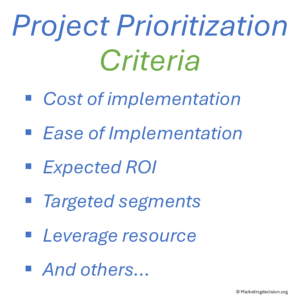
Expected impact: Contribution to business objectives, customer value, growth, profitability, or operational performance.The relevance of each criterion depends on the situation. Some projects can be evaluated using relatively precise financial information, while others require more qualitative assessments of their expected benefits.
Not every consideration needs to become another score. What matters is that the selected criteria are understood and applied consistently enough to make comparisons meaningful.
An Impact vs Complexity Matrix provides a practical way to display the initiatives together.
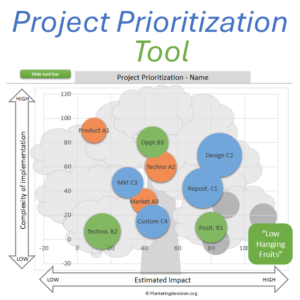
In the Low-Hanging Fruits Tree representation, the main dimensions are:
These dimensions create a visual representation that helps teams compare projects and identify different situations.
Projects with high impact and low implementation complexity, located in the bottom-right quadrant, are commonly called low-hanging fruits. They may offer attractive opportunities for early implementation.
Other projects may have substantial impact but require more resources or organizational changes. These should not automatically be considered less important. Some may be essential for developing future capabilities or achieving strategic objectives.
A project’s position in the matrix helps guide the discussion, but it does not determine the decision.
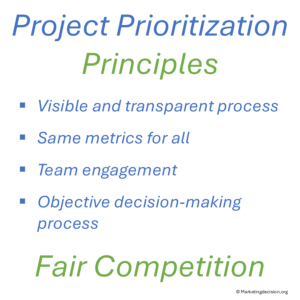
Teams often arrive at prioritization meetings with lists of projects and plenty of explanations about why each project is important.
The difficulty is to compare them fairly. Different departments may use different assumptions when estimating impact, costs, benefits, or implementation requirements.
A useful project prioritization process therefore involves two main steps.
The first step is to engage the teams responsible for the proposed initiatives.
Each team should describe its projects, clarify their objectives, and prepare assessments using the agreed selection criteria. Expected impact, implementation complexity, ROI, and other relevant considerations should be supported by information and assumptions that can be discussed.
This preparation may require exchanges between departments. A project that seems relatively simple to one team may depend on technical resources or organizational changes managed by another.
The objective is not to eliminate differences of opinion at this stage, but to prepare sufficiently consistent and credible assessments for comparing the initiatives.
For projects requiring a more detailed evaluation, Decision Scorecards may help structure the criteria and document assessments. Project boundaries can also be clarified using Project Scope Frame In/Out.
Once the project assessments are prepared, the initiatives can be consolidated into a common matrix.
This bird’s-eye view makes it easier to identify potentially attractive projects, compare different categories of initiatives, and examine where resources might be concentrated.
For a small number of projects, one discussion may be sufficient for a team to agree on priorities. The low-hanging fruits may be relatively easy to identify, provided their assessments are credible and consistent with business objectives.
For projects involving several departments, the discussion is often more complex. Some teams may be competing for resources, while others need to coordinate projects that depend on one another.
Management discussions may therefore require several sessions, similar to budget planning. Assessments can be challenged, assumptions reviewed, and project priorities reconsidered as additional information becomes available.
The value of the matrix is not simply to position projects on a graph. It is to make the alternatives visible and provide a common reference for productive discussions.
Not all projects can be considered independently.
A new customer management initiative may depend on improving customer data. A product launch may require technical development, channel preparation, and training before it can proceed.
Such dependencies can influence prioritization. A project with modest immediate benefits may be necessary to enable another initiative with greater expected impact.
This is where project prioritization and project sequencing are connected. Prioritization helps determine which projects deserve attention and resources. Sequencing considers the order in which selected projects should proceed.
Detailed implementation schedules and responsibilities belong to subsequent project planning.
Consider a B2B company seeking to improve profitable growth and customer satisfaction.
Management has received several proposals from its commercial and operational teams.
Initiative | Expected impact | Complexity |
Improve customer onboarding | High | Low |
Introduce advanced CRM analytics | High | High |
Redesign sales territories | Medium | Medium |
Update internal presentation templates | Low | Low |
Develop a new service offering | High | High |
An initial matrix would identify customer onboarding as a potential low-hanging fruit. It promises substantial benefits with relatively limited implementation complexity.
But the discussion may reveal other important considerations.
The new service offering could be critical for entering an attractive market, despite its complexity. Territory redesign might depend on improving customer information, while CRM analytics could provide capabilities needed by several commercial teams.
The priorities may therefore change during the discussions.
This is precisely the objective of the approach: help management understand the different projects, the reasons supporting them, and the trade-offs involved in deciding where to act.
The project prioritization matrix provides a common reference, but the final selection remains a management responsibility.
Some initiatives may be selected for immediate implementation. Others may require further analysis, additional resources, or coordination with projects already underway.
The objective is not to select only the easiest projects. Management may need to balance short-term improvements with longer-term developments that contribute to future competitiveness.
Recording the main reasons behind project priorities can also be useful. These explanations provide a reference when projects are reviewed, when business conditions change, or when new initiatives are proposed.
The matrix can therefore be used not only during initial prioritization discussions but also during subsequent management reviews.
The Project Prioritization Matrix provides a practical way to compare initiatives and support management decisions when projects compete for limited resources.
Its benefits include:
The matrix can introduce a project prioritization workshop, support discussions between departments, and provide a common reference during management reviews.
More than producing a ranking, the objective is to help teams agree on meaningful priorities, understand why they matter, and concentrate resources on the actions that can make a difference.
For the broader principles behind structured business decisions, explore Marketing Decision-Making.
Imagine several teams presenting projects they consider important. How can management compare them without spending hours reviewing one presentation after another?
A Project Prioritization Matrix helps put these initiatives into perspective. By comparing their expected impact, implementation complexity, and other relevant criteria, it provides a common view of the projects and helps organize the discussion.
Start by making sure the projects address relevant business objectives. Then ask the teams to prepare their assessments using agreed criteria.
Once the projects are represented in a common matrix, participants can compare them, challenge assumptions, and discuss priorities. Sometimes one meeting is enough. In other situations, particularly when several departments compete for resources, several discussions may be necessary.
There is no universal list. Expected impact, implementation complexity, cost, and ROI are common starting points.
But strategic relevance, customer benefits, available resources, and dependencies may be just as important. The criteria should reflect the decisions management needs to make, rather than simply what is easy to measure.
It is a visual way to identify projects that combine high expected impact with relatively low implementation complexity.
In our representation, these initiatives appear in the bottom-right quadrant of the matrix. They are often attractive candidates, but not necessarily the projects that deserve the highest priority.
A more complex initiative may sometimes be essential for achieving an important business objective.
Not necessarily. A strong expected ROI is attractive, but the calculation may not capture every benefit or constraint.
For example, a project may be necessary to strengthen customer relationships, reduce risks, or prepare a future development. Its immediate financial return may be limited, yet its strategic importance could be considerable.
ROI helps inform the discussion. It does not replace it.
© marketingdecision.org
Project prioritization benefits from combining financial analysis, business objectives, organizational capabilities, and management judgment.
Several established publications provide complementary perspectives.
McKinsey – Matching the Right Projects with the Right Resources (2017)
Examines how organizations can combine financial return, implementation considerations, strategic priorities, and resource allocation when selecting projects.
Gartner – Best Practices for Portfolio Prioritization (2024)
Discusses the importance of people, organizational culture, and prioritization practices alongside evaluation metrics. The publicly available research summary provides an overview of the approach.
View the Gartner research summary
Boston Consulting Group – The Power of Priorities: Why Less Is More in a Transformation (2026)
Explores how organizations can establish priorities while considering strategic objectives, constraints, and the sequencing of initiatives.
The Project Prioritization Matrix helps establish a shared view of competing initiatives. Additional methods can support more detailed evaluation and decision-making:
The Project Prioritization Excel Tool (Impact, Complexity and ROI) provides a practical visual implementation of the Low-Hanging Fruits Tree.
The workbook supports the comparison of 2 to 100 projects, with impact and complexity represented on the matrix axes and ROI displayed through bubble size.
Projects can be organized by category, filtered, and presented using customizable colors and chart settings.
The tool helps teams prepare assessments, visualize alternatives, and structure management discussions. It does not automatically establish strategic priorities, resolve project dependencies, or replace management judgment.
The methodology can be applied independently. The Excel tool is optional support for the assessment.
© marketingdecision.org
© 2026 MARKETING DECISION SOLUTIONS. All Rights Reserved.
We use cookies to improve your experience on our site. By using our site, you consent to cookies.
Manage your cookie preferences below:
Essential cookies enable basic functions and are necessary for the proper function of the website.
These cookies are needed for adding comments on this website.
Stripe is a payment processing platform that enables businesses to accept online payments securely and efficiently.
Service URL: stripe.com (opens in a new window)
Statistics cookies collect information anonymously. This information helps us understand how visitors use our website.
Google Analytics is a powerful tool that tracks and analyzes website traffic for informed marketing decisions.
Service URL: policies.google.com (opens in a new window)