

Customer segmentation is commonly described as a way to group customers with similar characteristics, needs, or purchasing behaviors. It helps companies understand their markets and develop relevant products, services, and marketing strategies.
But this definition leaves out an essential question: Why do we need to segment our customers in the first place?
A segmentation designed to improve sales coverage may be quite different from one intended to develop new products, improve pricing, or understand customer needs. Different customer segmentation models can therefore coexist, each addressing specific business objectives.
This is one of the most important customer segmentation principles: the business question should guide the segmentation strategy, the selection of segmentation criteria, and the methodology used.
The WHY, as discussed in Marketing Decision-Making, precedes and shapes the WHAT and HOW of segmentation.
Customer segmentation is much more than grouping customers into categories. Its benefits depend on the business objectives it is designed to support.
A useful segmentation can help companies understand customer needs, improve product positioning, identify opportunities for new solutions, and develop more effective marketing and sales strategies. Depending on the business question, segmentation may also support pricing decisions, customer retention, or the selection of distribution channels.

Consider a company trying to improve its distribution channels. It may need to distinguish customers according to purchasing behaviors, expectations for technical support, and preferred ways of interacting with suppliers.
The same company, when developing a new product, may need a different segmentation based on customer applications, unmet needs, or technological requirements.
Both approaches can be relevant, but they do not necessarily identify the same customer groups.
Multiple segmentation schemes can coexist because they address different business needs. Expecting one segmentation to answer every marketing question can lead to unnecessary redesigns, wasted resources, and missed opportunities.
It is also important to recognize that segmentation does not always require a large research project. A small-scale effort using existing company knowledge can already provide valuable insights, particularly when the business question is well defined.

A customer segmentation strategy should begin with the business objectives it is intended to support.
Several segmentation models may already exist within a company. Some may have been developed through external market research, while others emerged from internal analysis, sales experience, or specific operational needs.
Before launching a new segmentation project, it is worth examining what has already been done.
Why were previous segmentations created? Which business questions were they intended to answer? Are those questions still relevant?
Reviewing existing work can reveal that some segmentation models remain useful, even if they are not suitable for the current project. Replacing them automatically may mean losing valuable knowledge.

Aligning segmentation with business objectives offers several benefits:
The objective is not to develop the most sophisticated segmentation possible. It is to develop one that is sufficiently accurate, meaningful, and useful for the decisions management needs to make.
For a practical approach to organizing the work, see Customer Segmentation Design in 7 Steps.
Before starting a segmentation project, agree on its objectives and scope.
If several departments are involved, discuss their expectations early. When external consultants participate, stakeholder interviews may help clarify the objectives and identify possible differences in priorities.

Questions such as Who are our customers? What are their preferences, needs, and behaviors? are useful. But they do not yet explain why the company needs a segmentation.
More specific business questions might include:
These questions help determine which customer segmentation criteria are relevant.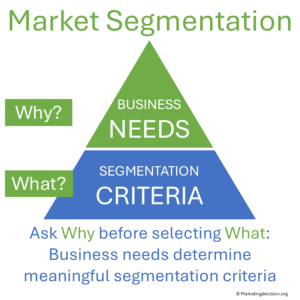
Firmographic characteristics, purchasing behaviors, customer needs, technological capabilities, and qualitative factors can all contribute to a segmentation. Their importance depends on the business question.
A company seeking to improve geographic sales coverage may find industry, location, and customer size particularly relevant.
For a company developing differentiated solutions, customer needs, applications, buying motivations, or perceived value may be much more informative.
Not everything important can be measured precisely. Qualitative assessments may reveal differences that are difficult to capture in a database but essential to understanding customers.
The challenge is to consider the information available, recognize its limitations, and identify the factors that help explain meaningful differences between customers.
Segmentation may also vary by country, product, or product group. This is another reason why several segmentation schemes can legitimately coexist.
Segmentation projects often encounter difficulties that have less to do with statistical methods than with the way the objectives are defined and the results are interpreted.

Customer segmentation is a powerful way to improve understanding of customers and markets, identify business opportunities, and develop relevant marketing actions.
But segmentation is not an objective in itself.

Its value comes from the decisions it helps management make: which customers to address, what solutions to develop, how to create value, which channels to use, and where to concentrate resources.
Different business objectives may justify different segmentation schemes. These can coexist, evolve, and complement one another.
And while quantitative research can provide important insights, qualitative knowledge and practical experience should not be ignored. The most sophisticated model is not necessarily the most useful one.
A good segmentation helps people understand differences that matter, agree on priorities, and take appropriate action.
Connecting Segmentation to Marketing Decisions
Customer segmentation contributes to several areas of marketing decision-making:
For a broader customer-centered view, see Customer-Centric Marketing Mix.
Getting Started with Customer Segmentation
You do not necessarily need a large budget or an extensive research project to begin.
Our free Customer Segmentation Guide PDF explains how a small team can conduct an initial segmentation exercise, starting with a business challenge and using the knowledge already available within the company.
The guide proposes seven practical steps, from defining objectives and segmentation axes to describing customer segments and identifying possible business actions.
 Our free Customer Segmentation Guide PDF explains how a small team can conduct an initial segmentation exercise, starting with a business challenge and using the knowledge already available within the company.
The guide proposes seven practical steps, from defining objectives and segmentation axes to describing customer segments and identifying possible business actions.

Explore practical tools and templates designed to support marketing analysis, business decisions, and strategy development. Discover our full collection of Excel tools and free resources to help turn marketing insights into actionable decisions.