
Economic Value Estimation (EVE) Model: Understand Customer Value

Economic Value Estimation (EVE)

EVE

The Economic Value Estimation (EVE) model is a practical approach for understanding customer-perceived value and the value drivers that differentiate solutions. By examining the customer benefits and economic impacts associated with meaningful differences between alternatives, EVE helps marketing and sales teams strengthen value propositions, financial arguments and value-based selling strategies.

Using individual, real customer cases grounds the analysis in actual customer situations. Teams can estimate how specific value drivers translate into positive or negative economic impacts for different customers within the same segment. Comparing these individual cases reveals not only a range of economic value estimates, but also why value differs between customers. Existing customer knowledge can provide a practical starting point, while Voice of the Customer (VoC) and other market research methods can validate and refine the analysis.
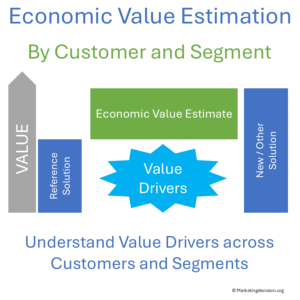
Economic Value Estimation showing how value drivers differ across customers and segments

EVE complements the Price Value Map (PVM). While both methods focus on value, they serve distinct purposes. PVM visualizes how customers perceive value relative to price across solutions. EVE, on the other hand, explores the economic rationale behind customer preferences by examining the benefits and constraints associated with different alternatives. Both perspectives are valuable and reinforce each other when positioning solutions and shaping commercial arguments.

Economic value provides valuable input to pricing decisions, but economic value, customer-perceived value and price are related rather than interchangeable. Understanding these distinctions helps teams use EVE more effectively and connects naturally with approaches such as Price Value Mapping.

Why Economic Value Estimation Matters

EVE helps teams understand what creates customer value and why one solution may be preferred over another. The comparison may involve a current solution and its future evolution, your solution and a competitor’s offering, or other alternatives a customer may realistically consider.

The central questions are:

  • What is the relative customer-perceived value of the alternatives?
  • Which features or capabilities contribute most to this perception, and why?
  • Which value drivers create meaningful benefits or disadvantages for the customer?
  • What are their economic consequences?
  • How can these insights strengthen value propositions, pricing discussions and sales arguments?

The objective is not simply to produce a monetary number. It is to understand why a solution creates more or less value for a particular customer and which differences are responsible.

How the EVE Model Compares Solutions

EVE is often used to evaluate enhancements between an existing solution and its successor, or to benchmark offerings from different companies. By examining customer-perceived value and financial benefits in parallel, teams can identify where differentiation truly lies.

Customer-perceived value walk comparing a reference solution with a new or alternative solutionStart with a reference solution or realistic alternative and identify the meaningful differences introduced by the other solution. Some differences create additional customer benefits; others may introduce costs, constraints or disadvantages.

The simplicity of this comparison is one of EVE’s strengths. Instead of discussing value in the abstract, teams can examine each meaningful difference and ask:

What would this actually change for the customer?

The answers help identify the value drivers behind customer preference and, where appropriate, translate them into measurable economic impacts.

This process is particularly valuable when marketing and sales teams work together to interpret results. Joint analysis leads to clearer positioning choices, better-prepared pricing discussions and sharper value communication. It can also help identify how future improvements could strengthen the solution’s competitive position.

Evaluating Customer Value and Financial Benefits

EVE analysis brings together marketing, sales and, where appropriate, customers to evaluate how solution differences influence both customer-perceived value and measurable financial benefits.
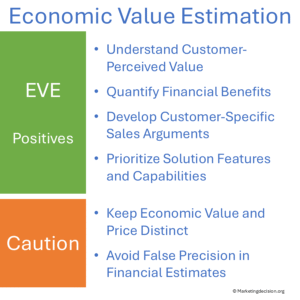
EVE benefits and cautions for customer value, financial estimates and pricing decisionsNot every benefit has the same importance for every customer. A capability that creates substantial economic benefit in one situation may provide little advantage in another. Customer volumes, processes, operating costs, installed solutions, resources and priorities can all influence the result.

This is why EVE should connect measurable economic effects with customer reality.

Economic benefit considers measurable financial consequences created by the solution – for example additional revenue, cost reduction, productivity gains, avoided investment or reduced financial exposure.

Customer-perceived value reflects how relevant, important and credible those benefits are to the customer.

Price determines how much the supplier asks the customer to exchange for the solution and how part of the value created may be captured.

These dimensions are connected, but they are not identical. Looking at them together provides a richer basis for value propositions, positioning, solution development, sales arguments and pricing discussions.

Estimating Economic Value Across Real Customers

One of the most useful ways to strengthen an EVE analysis is to apply it to individual, real customers within a defined segment.

Marketing and sales teams can select customers they know well and examine how the alternatives affect each customer’s situation. Customer volumes, processes, costs, revenues, investments, risks and constraints can all change the economic impact of the same value driver.

This does not necessarily require a formal market research project to get started. Sales and marketing teams often know their customers sufficiently well to develop initial estimates and, importantly, identify the assumptions that need further investigation. Customer interviews, Voice of the Customer (VoC), workshops, surveys or other market research methods can then validate and refine those assumptions.

Repeating the analysis for several customers within the same segment makes differences visible. The objective is not simply to calculate an average economic value, but to understand why value differs between customers.

One customer may have greater volumes, another may avoid an important investment, while another may face higher implementation costs. A capability that creates substantial value for one customer may therefore create much less for another.

These differences provide insight into the value drivers themselves. They help teams understand which drivers are consistently important, which depend on specific customer situations, and whether apparently similar customers really share the same value profile.

Economic value differs between customers, helping identify the value drivers behind the differences

Benefits of Using EVE in Marketing, Sales and Solution Development

The EVE model provides a structured way to connect customer insight, economic benefits and commercial reasoning.

For marketing teams, it helps identify and substantiate the value drivers behind stronger value propositions.

For sales teams, EVE provides a foundation for more customer-specific discussions. Rather than relying primarily on product features, salespeople can explain how meaningful differences affect the customer’s situation and economics.

For solution development teams, EVE can help identify which capabilities have the greatest potential customer impact and provide useful input when prioritizing future improvements.

For segmentation, comparing individual EVE analyses can reveal why customers within apparently similar groups may experience different economic value.

For pricing teams, EVE provides evidence for value-based pricing discussions without mechanically converting economic value into price.

Used collaboratively, EVE becomes more than a model. It provides a shared language for discussing value creation across the organization.

5 Steps to Develop an Economic Value Estimation

An Economic Value Estimation can be developed through five practical steps, starting with a defined customer or customer segment and the solutions or alternatives being considered.

  1. Identify differential features: Determine which meaningful differences positively or negatively affect customer-perceived value.
  2. Quantify customer impacts: Estimate the positive and negative economic consequences associated with these differences. Consider revenue, costs, productivity, investment, risk and other measurable effects.
  3. Build the value waterfall: Create a diagram showing value differences and associated economic impacts between the alternatives.
  4. Consolidate insights: Summarize the principal value drivers, financial benefits, disadvantages and assumptions influencing the result.
  5. Translate into action: Develop targeted sales arguments, refine sales scenarios, prioritize solution improvements and support marketing and pricing decisions.

Repeat the exercise across several real customers when possible. Comparing the results helps distinguish robust value drivers from those that depend strongly on individual customer situations.

These five steps provide a practical structure for moving from solution differences to customer value, economic impact and commercial action.

When to Apply the EVE Model

EVE can be applied in multiple contexts:

  • Comparing a current solution with its future evolution
  • Comparing your solution with a competitor or another customer alternative
  • Preparing product launches and identifying high-impact capabilities
  • Prioritizing development investments based on customer value
  • Investigating how economic value varies across customers within a segment
  • Refining value propositions and positioning
  • Preparing customer-specific sales arguments and financial discussions
  • Supporting value-based pricing decisions
  • Reassessing sales narratives as customer needs and solutions evolve

EVE’s versatility makes it particularly useful when decisions involve several functions. Marketing, sales, solution development and pricing teams can examine the same customer-value equation from different perspectives while working from a common framework.

Using EVE with Price Value Mapping

Economic Value Estimation and Price Value Mapping (PVM) both investigate value, but they answer different questions.

EVE asks: What economic benefits and disadvantages does one solution create compared with another in a customer’s situation?

Price Value Mapping asks: How are competing solutions positioned relative to one another in terms of customer-perceived value and price?

The distinction matters because economic value should not automatically be converted into price. Even when an economic benefit can be quantified for an individual customer, price can also depend on competitive alternatives, customer-perceived value, willingness to pay, market conditions and the share of created value the supplier can realistically capture.

Used together, EVE and Price Value Mapping provide complementary perspectives on value creation, value perception and value capture.

Further Reading and Expert Tips

An excellent external reference on EVE is Stephan Liozu’s Ten Golden Rules of EVE Models, published by the Professional Pricing Society. It includes many practical recommendations, among which two are particularly relevant:

  • “Never dollarize a product feature, but always dollarize a customer benefit.”
    This principle highlights an essential aspect of EVE: a feature does not have economic value by itself. Its value depends on what it changes for the customer and on the customer’s particular situation.
  • “Dollarize three to five value drivers, no more.”
    An EVE exercise may initially identify many differences between solutions, but customers tend to crystallize their decisions around a limited number of decisive factors. Focusing on these critical value drivers keeps financial arguments clear, relevant and credible.

These principles reinforce the practical logic of EVE: start from customer benefits, focus on what materially changes, and investigate those changes in the customer’s economic reality.

For complementary insights, see the Price Value Map section of this site.

In Summary

Economic Value Estimation provides a practical way to turn differences between solutions into a deeper understanding of customer value. By identifying positive and negative customer impacts, quantifying meaningful economic benefits and grounding the analysis in real customer situations, teams can develop more credible value propositions and commercial arguments.

Applying EVE across several customers within a segment adds another level of insight. It reveals not only a range of economic value estimates, but also why value varies – helping teams identify stronger value drivers, refine segmentation, prioritize solution improvements and prepare more relevant sales discussions.

EVE therefore supports much more than pricing. It creates a common framework for marketing, sales, solution development and pricing teams to understand how customer value is created and how it can be communicated and captured.

Combined with Price Value Mapping, it also helps maintain the distinction between economic value, customer-perceived value and price, while connecting all three to better commercial decisions.

Value estimation depends on understanding how customers perceive and evaluate benefits. For these underlying insights, explore our Customer Mix page.

Economic value assessments build directly on value creation principles. For a full understanding of these foundations, visit our Value Creation chapter.

EVE analysis is grounded in value-based pricing. For the broader framework supporting this method, see our Value Pricing chapter.

Economic value assessment relies on the structure and benefits defined within the Solution Mix. Explore our Solution Mix page for the foundational context.

Frequently Asked Questions

What is the main purpose of the Economic Value Estimation (EVE) model?

The EVE model helps marketing and sales teams understand customer-perceived value, economic benefits and the value drivers that differentiate solutions. It provides a structured framework for developing stronger value propositions, customer-specific sales arguments and value-based commercial discussions.

EVE and PVM are complementary. EVE examines the value drivers and economic impacts associated with differences between solutions in a customer’s situation. PVM focuses on market positioning by keeping customer-perceived value and price as separate dimensions. Together they provide complementary views of value creation, perception and capture.

Not directly. EVE provides valuable evidence for pricing decisions, but economic value is not the same as price or willingness to pay. Pricing decisions must also consider customer perception, competitive alternatives, market conditions and the proportion of created value the supplier can realistically capture.

Customers may have different volumes, processes, costs, installed solutions, investments, risks or usage patterns. The same value driver can therefore create different economic impacts. This variation is useful information: comparing individual cases helps teams understand why value differs and which value drivers are most important.

Sales and marketing teams can often develop an initial EVE using their existing knowledge of customers. Customer interviews, Voice of the Customer (VoC), workshops, surveys and other market research methods can then validate assumptions, fill knowledge gaps and improve the reliability of the analysis.

EVE is particularly useful when preparing product launches, comparing current and future solutions, assessing competitive alternatives, developing value propositions, refining sales arguments, prioritizing solution improvements or supporting value-based pricing discussions.

© marketingdecision.org

EVE: Workshop and Complementary Tools

The EVE model can be developed through structured discussions between marketing and sales teams. By focusing on the economic value created for customers, teams can identify and challenge value drivers, develop stronger sales arguments, and adapt them to different customer segments and sales situations.

Run an EVE Workshop

An EVE workshop can bring together teams of four or five participants to discuss individual, well-known customers and assess the economic value that a different or new solution could create for each one.

Starting from an existing or reference solution makes the discussion particularly practical. Participants can examine what would change for the customer, identify positive and negative impacts, and discuss the value drivers behind the differences.

This discussion can reveal important differences in perspective. One group may conclude that the economic value created is sufficient to support a significantly higher price, while another – often including sales representatives with direct customer experience – may consider that only part of this economic value can realistically translate into an incremental price.

This difference in perspective is particularly valuable and should be captured. It helps distinguish the economic value created for the customer from the share of that value that may potentially be captured through price.

The workshop can also be extended to participants from other functions, particularly engineering and solution development. Teams can then explore how future features and capabilities might translate into customer value and discuss trade-offs between alternative development paths.

For an effective workshop:

  • Clarify the objective first. Define the solution comparison, customer segment and decisions the workshop should support.
  • Select a few existing customers that participants know well. Discuss the incremental economic value for each customer, considering both positive and negative impacts.
  • Challenge the value drivers. Explore why a feature or capability creates value, for whom, and under which circumstances.
  • Separate economic value from price. Discuss both, but do not assume that the economic value created will translate directly into an equivalent price increase.
  • Capture assumptions and disagreements. They identify where further customer, financial or market evidence may be required.
  • Plan follow-up analysis. Detailed calculations may be difficult during a workshop. Follow-up sessions involving marketing, sales, finance or other specialists can help substantiate the most important economic-value arguments.

Economic Value Estimation workshop from known customers and solution changes to value drivers, economic value and sales arguments

Complementary Tools and Methods

Economic Value Estimation connects naturally with other methods supporting Value Creation and Value Pricing. Consider these complementary approaches:

Price-Value Mapping helps compare the perceived value and price positioning of company and competitor solutions, providing evidence on competitive positioning and potential opportunities.

Portfolio Graph provides a visual representation of company and competitor solutions across market segments, helping teams compare relative value and identify gaps or opportunities within the portfolio.

Strategic Position Analysis combines market attractiveness with the company’s ability to compete, helping teams compare opportunities and discuss where investment may create the strongest potential.

Technology vs Product Innovation Strategy helps teams examine the balance between technology development and product or solution innovation when considering future investments.

When teams clearly distinguish economic value – what the customer gains from using the solution – from price – what the supplier asks the customer to pay, EVE becomes a powerful approach for identifying value drivers, developing sales arguments and guiding solution choices across customer situations.

© marketingdecision.org

Explore Marketing Tools and Templates

marketing tools and templates

Explore tools designed to support the topics covered in this section. Access the full collection or go directly to tools supporting solution development and management.

© 2026 MARKETING DECISION SOLUTIONS. All Rights Reserved.