
Companies strive to identify opportunities by understanding markets, customer needs, technologies and competitive developments. Once opportunities have been identified, the challenge is to determine which deserve greater attention and where resources and investment can create the most value.
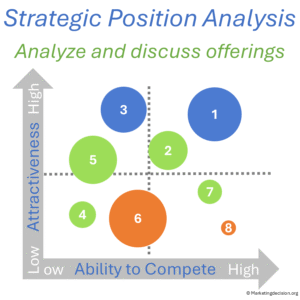
Strategic Position Analysis helps compare opportunities by considering Market Attractiveness and the organization’s Ability to Win.
Market Potential adds another perspective by showing how much an opportunity could matter.
Together, these dimensions help teams compare existing and future positions, identify promising opportunities, understand where capabilities may need strengthening, and determine where further investigation is worthwhile.
Within Value Creation, Strategic Position Analysis provides a practical perspective for prioritizing opportunities and supporting portfolio and investment discussions.
Strategic Position Analysis brings together three complementary perspectives: Market Attractiveness, Ability to Win and Market Potential.
Market Attractiveness considers the external potential of an opportunity. Relevant factors may include market size and growth, profitability, customer needs and trends, competitive intensity and technology development.
Market dynamics matter. A company can gain share in a declining segment while losing ground in the broader market. On the other hand, strengthening its position in growing segments can accelerate its overall growth.
This relationship can be explored further through Market Share & Winds, while broader market analysis provides the evidence needed to assess which segments and opportunities are becoming more or less attractive.
An attractive market does not offer the same opportunity to every company. Ability to Win considers the organization’s competitive position and the capabilities that can enable it to capture the opportunity.
Depending on the situation, relevant factors may include differentiation, customer value, technology, brand, cost position, market access, customer relationships and organizational capabilities.
Ability to Win is closely related to Competitive Strength in the GE-McKinsey portfolio approach. It also connects with Porter’s strategic positioning logic: competitive advantage depends on deliberate choices about where and how to compete, rather than simply pursuing attractive markets.
Market Presence Analysis can contribute useful evidence here by helping teams understand current strengths and weaknesses across markets and segments.
Market Potential provides another perspective on the relative importance of each opportunity.
Depending on the analysis, it can represent market or segment volume, revenue potential, profitability or another relevant measure. In the matrix, this dimension can be represented by the relative size of each bubble.
Combining Market Attractiveness and Ability to Win creates four broad strategic positions.
High Attractiveness / High Ability to Win
These opportunities combine favorable market conditions with a strong competitive position and may deserve particular attention for further development and investment analysis.
High Attractiveness / Low Ability to Win
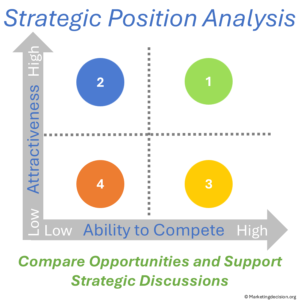
The market opportunity may be promising, while capabilities, differentiation, partnerships or market access may need to be strengthened to improve the company’s ability to capture it.
Low Attractiveness / High Ability to Win
The company may hold a strong position, while future priorities depend on market development, profitability and the strategic value of maintaining or developing that position.
Low Attractiveness / Low Ability to Win
These positions may justify greater selectivity, particularly when other opportunities combine stronger market prospects with a greater Ability to Win.
By comparing these strategic positions, teams can clarify priorities, align product roadmaps, anticipate risks and explore where capabilities should be strengthened. This can help build a more resilient development strategy.
A useful Strategic Position Analysis starts with a clear objective and scope. Teams should agree on which markets, segments, solutions or initiatives are being compared and what question the analysis is intended to support.
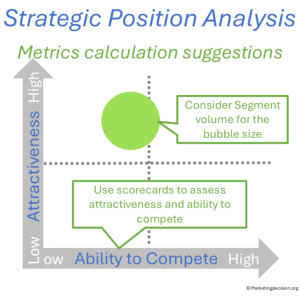
Assessments can begin relatively by comparing one opportunity with another, or they can use more structured criteria.
Different functions contribute different knowledge: Marketing may bring evidence about market development, Sales about customers and competitive positions, Product about differentiation and capabilities, while regional or business teams may bring another market perspective.
Differences in assessment can be valuable. They may reveal assumptions, missing evidence or alternative interpretations that deserve discussion before priorities are established.
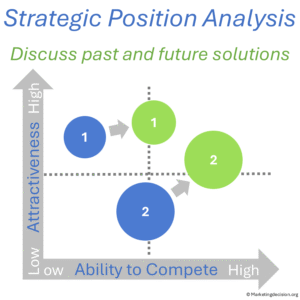
Strategic positions evolve. Markets grow or decline, competitors introduce new solutions, technologies develop and customer expectations change. At the same time, investment can strengthen capabilities and improve the organization’s Ability to Win.
Comparing current and future positions helps teams explore how opportunities may develop and makes assumptions about future Market Attractiveness and Competitive Strength explicit and open to discussion.
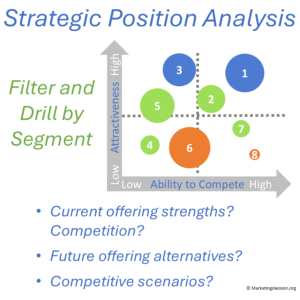
Strategic Position Analysis can move beyond a single portfolio view. Filtering by market segment, solution family, region or another relevant category can reveal differences that may disappear in an aggregated analysis.
Teams can examine current offering strengths, competitive positions, future solution alternatives and different competitive scenarios. Changing the scope or assumptions helps explore how the strategic picture may evolve and where alternative courses of action deserve further investigation.
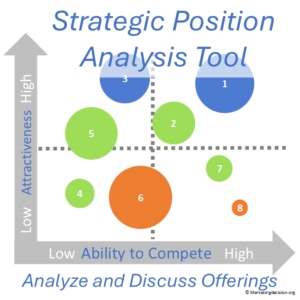
Strategic Position Analysis provides one perspective within a broader decision process.
An attractive strategic position can justify further investigation, but it does not determine an investment decision by itself. Expected returns, investment requirements, available budgets and resources, risks, technical feasibility, dependencies and stakeholder support may also need to be considered. Significant investments may require deeper financial analysis and a formal business case.
Strategic Position Analysis helps teams identify where deeper analysis and discussion are worth the effort, while making the assumptions behind strategic priorities clearer.
This connects the methodology directly with Value Creation: understanding where opportunities exist, where the organization is well positioned to capture them, and where resources may create greater value.
Strategic Position Analysis helps teams compare opportunities, understand their competitive position and decide where further attention and resources may create the most value.
By combining Market Attractiveness, Ability to Win and Market Potential, teams can compare markets, segments, solutions or strategic initiatives from a common perspective. The analysis can highlight attractive opportunities, positions where capabilities need strengthening, and situations where other alternatives may deserve greater attention.
The methodology also helps bring different perspectives together. Assessments can start with relative judgments or be supported by structured criteria, market evidence and scorecards. Comparing current and future positions makes it possible to explore how changing markets, capabilities and competitive scenarios could affect priorities.
Strategic Position Analysis does not replace the broader investment decision. It helps teams focus investigation and discussion where they matter most, providing a clearer basis for portfolio management, resource allocation and value creation.
The Portfolio Graph focuses on perceived value and competitive positioning in sales and marketing, whereas Strategic Position Analysis compares Market Attractiveness and Ability to Win to support prioritization, investment and portfolio decisions.
Strategic Position Analysis can be reviewed periodically and whenever significant changes affect the market or the organization’s Ability to Win. Market growth, new competitors, technology developments, changing customer expectations or new capabilities may all justify reassessing the strategic position.
Yes. Strategic Position Analysis can compare market segments, solutions, projects, initiatives or other business opportunities. The objective and scope of the analysis determine what is compared, while Market Attractiveness and Ability to Win provide a common basis for assessing the alternatives.
Both approaches consider Market Attractiveness and Competitive Strength to support portfolio and strategic analysis. Strategic Position Analysis uses Ability to Win to consider the organization’s competitive position and can be applied to markets, segments, solutions or other strategic opportunities.
No. The matrix helps compare opportunities and identify where further attention and analysis may be worthwhile. Investment decisions may also consider expected returns, resources, risks, technical feasibility and other strategic or financial factors.
Strategic Position Analysis brings together information and decisions from different parts of the marketing process. Other methods and tools described on this site can help develop the evidence behind the analysis or explore decisions that follow from it.
Understand the market and the opportunity
Market Mix – Explore the market forces and developments that influence Market Attractiveness.
Market Share & Winds – Understand how growth or decline across segments can affect overall performance and opportunity.
Understand customers and segments
Customer Segmentation Principles – Define meaningful customer segments and compare opportunities at the appropriate level.
Customer Mix – Explore customer needs, expectations and adoption factors that can influence opportunity potential.
Understand competitive strengths and value creation
Market Presence Analysis – Assess strengths and weaknesses that contribute to Ability to Win.
Value Creation – Connect opportunity prioritization with the broader question of where solutions can create value.
Develop and bring solutions to market
Solution Marketing – Explore how solutions create value and compete.
Value Pricing – Consider how pricing and value capture influence the attractiveness of an opportunity.
Place Mix Strategy – Explore how channels and market access can influence the organization’s Ability to Win.
Support the assessment
Linear Scorecard – Structure an assessment when several criteria need to be combined.
Market Attractiveness Matrix Excel Tool – Visualize and compare strategic opportunities interactively.
The Market Attractiveness Matrix Excel Tool provides an interactive visual representation of markets, solutions, projects or initiatives, helping teams compare Market Attractiveness, Ability to Win and Market Potential in one view.
The workbook can display multiple opportunities, organize them into categories and filter selected parts of the portfolio. Assessments can be updated as the discussion develops, allowing teams to see immediately how changes affect the relative position of opportunities.
The interactive matrix makes portfolio comparisons easier to visualize, discuss and refine.
© marketingdecision.org
© 2026 MARKETING DECISION SOLUTIONS. All Rights Reserved.
We use cookies to improve your experience on our site. By using our site, you consent to cookies.
Manage your cookie preferences below:
Essential cookies enable basic functions and are necessary for the proper function of the website.
These cookies are needed for adding comments on this website.
Stripe is a payment processing platform that enables businesses to accept online payments securely and efficiently.
Service URL: stripe.com (opens in a new window)
Statistics cookies collect information anonymously. This information helps us understand how visitors use our website.
Google Analytics is a powerful tool that tracks and analyzes website traffic for informed marketing decisions.
Service URL: policies.google.com (opens in a new window)