
A market forecast is more than a projection of future numbers. It provides a shared view of how a market may develop and creates a baseline for business decisions.
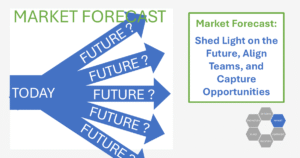 A useful market forecast should be documented, understandable and agreed upon. It can support decisions about investment, product development, marketing budgets, sales organization and resource allocation.
Building that forecast requires both analysis and judgment. Quantitative data can reveal measurable trends, while qualitative analysis can identify developments that are difficult to capture in historical numbers.
For this reason, market forecasting is not simply a calculation. It is a collective decision-making process that should be reviewed as markets and assumptions evolve.
No single source provides certainty about future market development.
 Economic indicators, industry forecasts, market research, internal data and expert knowledge can each provide a different perspective. They may support the same market-growth assumption, but they may also point in different directions.
A useful market forecast therefore requires more than collecting information. It requires evaluating different sources, understanding where they converge or diverge, and establishing assumptions that can be discussed and challenged.
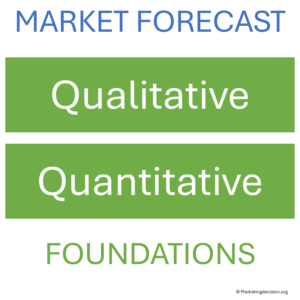
Two complementary approaches provide the foundations of the forecast:
Quantitative forecasting uses measurable data, indicators and external forecasts to assess possible market development.
Qualitative forecasting considers events and developments that may influence the market but are difficult to quantify reliably.
Together, they provide different perspectives on the same question: how is the market likely to develop?
Quantitative forecasting draws on measurable information that may help explain or anticipate market development.
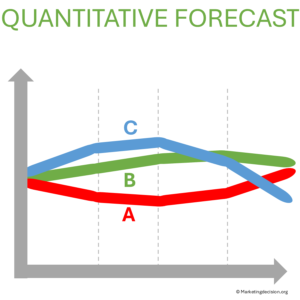 Relevant sources can include economic indicators, industry estimates, external market forecasts, market research and internal market data. Depending on the market, indicators such as GDP, inflation, consumer spending, industrial production or other sector-specific measures may provide useful perspectives on future growth.
Different sources do not necessarily tell the same story.
Comparing them side by side can help teams understand where trends converge or diverge, examine the assumptions behind individual forecasts and decide which information is most relevant to the market being analyzed.
This comparison can be particularly useful when several annual forecasts or indicators are available. Instead of immediately selecting one source as the forecast, teams can examine how the different trajectories evolve over time and use them to establish a market-growth assumption.
When sufficient historical data is available, statistical methods such as regression analysis can help examine relationships between past market growth and potential explanatory variables.
For example, an analyst may investigate whether historical changes in a market have been associated with changes in economic activity, consumer spending or another measurable indicator.
Such relationships can provide useful evidence, but they should not automatically be assumed to remain stable in the future. Technology, regulation, competitive developments, changing customer behaviour and other factors can alter the way a market develops.
Comparing relevant sources visually can therefore remain a useful starting point before more sophisticated statistical analysis is required.
Quantitative data should not be used simply because it is available.
Before including a source in a market forecast, understand what the data measures, how it was collected or estimated, the period and market it represents, and its limitations.
Two apparently similar indicators may use different definitions, geographic scopes or methodologies. A dataset can be accurate for its original purpose while being inappropriate for another.
The objective is therefore not only to collect reliable data, but to understand how each source can reasonably be used and what conclusions it can support.
Understanding historical data also requires understanding the market conditions in which it was produced. A strong Market Visibility perspective helps maintain a meaningful view of past and present market dynamics before assumptions are extended into the future.
Historical data can reveal trends and relationships. Statistical techniques can also be used to extrapolate these patterns and estimate future values.
These methods can be useful, but their apparent precision should not create false confidence. A forecast based on historical relationships assumes, explicitly or implicitly, that those relationships provide useful information about what comes next.
The rear-view mirror tells you where the road has been. It cannot tell you whether the road ahead turns left or right.
Markets can change because of technology, regulation, competition, customer behaviour, economic conditions or events that are not yet visible in historical data. A statistically robust extrapolation cannot eliminate this uncertainty.
Quantitative evidence should therefore inform the market forecast, not determine it.
Historical data cannot describe every development that may shape a future market.
A new technology may change customer behaviour. Regulation may alter market access. A competitor may introduce a new business model. Political or economic events may affect demand before their consequences can be measured reliably.
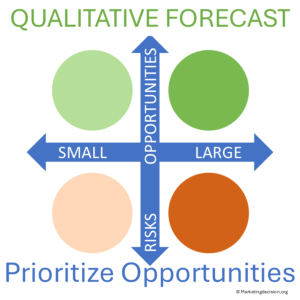 Qualitative forecasting helps identify and structure these developments.
Qualitative does not mean that an impact cannot be assessed. A government initiative, for example, may be difficult to translate immediately into a precise market-growth figure, but its potential impact can still be evaluated over the short, medium and long term.
Because qualitative assessments depend on judgment, discussions should be structured and involve people with different areas of market expertise. This helps teams challenge assumptions and consider different perspectives rather than simply reinforce a shared view.
This approach is particularly useful when historical data is incomplete or unavailable, a market is undergoing significant change, new technologies or regulations may affect future development, or expert knowledge provides information that is not yet reflected in quantitative data.
Qualitative forecasting does not replace quantitative analysis. It provides another perspective and helps challenge assumptions that may otherwise appear more certain than they really are.
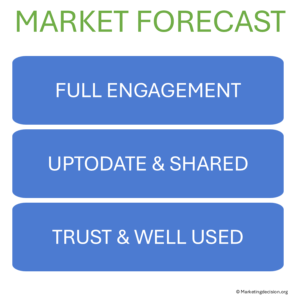 The quality of a forecast does not depend only on the quality of its calculations.
A forecast also needs to be understood and accepted by the people who will use it.
Important assumptions should therefore be documented, discussed and regularly reviewed. Market knowledge is often distributed across marketing, sales, product, finance, operations and other functions, making forecasting a useful cross-functional exercise.
Forecasting is also a learning process. Comparing previous assumptions with what subsequently happened can improve the way teams select evidence, challenge assumptions and construct future forecasts.
An up-to-date and shared forecast can build trust in the assumptions being used and encourage stronger engagement in the resulting business decisions.
Scenario Planning addresses a different question: what could happen if important assumptions or market conditions change?
 Rather than extrapolating one expected future, scenarios explore several plausible environments. They can incorporate developments identified through PESTLE analysis, competitive analysis, expert discussions and other sources of market knowledge.
Scenario Planning therefore does not replace quantitative or qualitative forecasting. It helps teams explore the uncertainty surrounding the central market forecast and test whether important decisions remain appropriate under different conditions.
The objective is not to predict which scenario will occur. It is to understand how important decisions could perform under different market conditions and to identify assumptions that deserve particular attention.
Scenario planning is particularly useful when uncertainty is high, several developments could interact, or strategic decisions would be difficult to reverse.
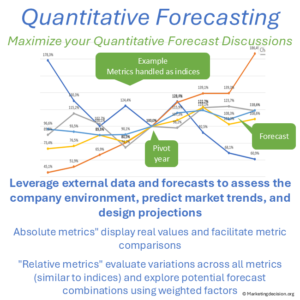
Different market indicators, external forecasts and internal data may suggest different paths for future market growth.
The Quantitative Forecasting Tool helps teams compare these annual data sources side by side, examine their absolute values and relative growth trajectories, and identify where they converge or diverge.
Relevant metrics can then be selected and weighted to build a consolidated market-growth assumption while keeping the underlying evidence visible.
Use the evidence you already have to build a market forecast you can understand, discuss and defend.
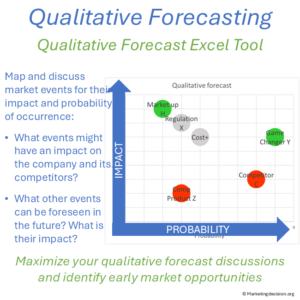
Some developments that may affect a market cannot yet be measured reliably. Changes in technology, regulation, competition, customer behaviour or other market events may nevertheless deserve attention.
The Qualitative Forecasting Tool helps teams identify these events, assess their probability and potential impact, and make different perspectives visible for discussion.
It provides a structured way to complement quantitative evidence with developments that may shape the market before their effects appear in historical data.

Explore tools designed to support the topics covered in this section. Access the full collection or go directly to tools supporting market analysis and forecasting.