Description
Why Use an Innovation Matrix for Strategy
Innovation decisions are often difficult because they involve trade-offs between market needs, technical feasibility, and investment constraints.
A structured innovation matrix helps teams:
- Clarify innovation priorities
- Compare different development paths
- Align product and technology strategy
- Support data-driven investment decisions
- Facilitate cross-functional discussions
Without a clear framework, innovation decisions often rely on partial information or short-term considerations. This tool helps bring structure, visibility, and alignment to these discussions. It is particularly useful for product managers, innovation teams, and strategy leaders who need to align decisions and prioritize investments.
Technology vs Product Innovation Matrix: How It Works
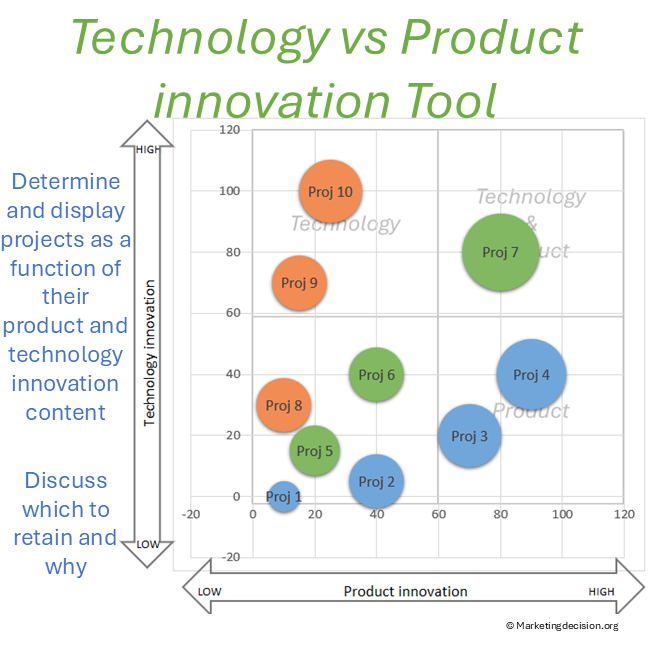
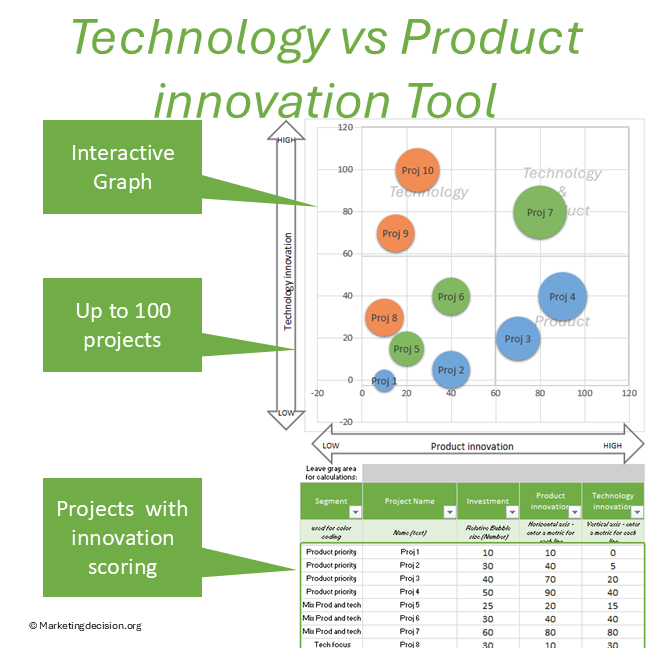
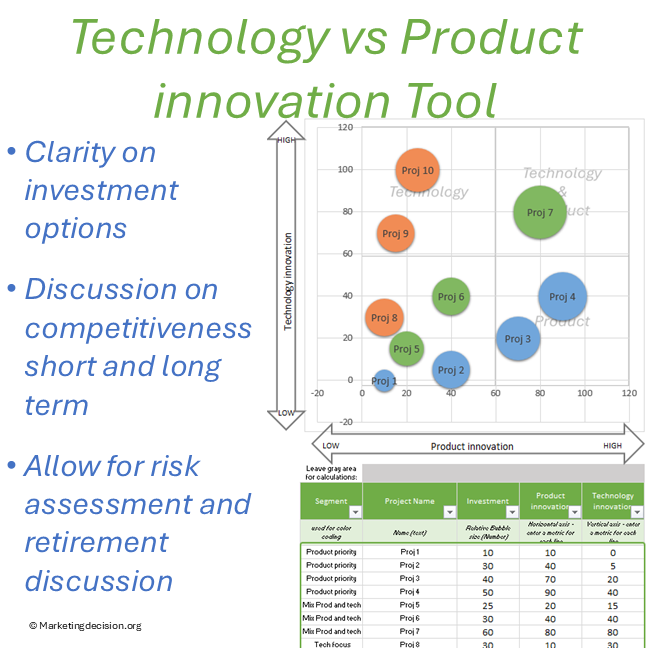
This innovation matrix tool is based on two axes representing the degree of change required in product features and in technology.
- The horizontal axis reflects the level of product innovation, focusing on new features, capabilities, and market positioning.
- The vertical axis reflects the level of technology innovation, focusing on new technologies, technical capabilities, or operational improvements.
Each project is positioned on the matrix based on these two dimensions.
This visualization helps teams:
- Identify the level of difficulty and risk
- Compare innovation paths
- Understand trade-offs between product and technology investments
In addition, each project is represented by a bubble, where size reflects the relative level of investment. This allows teams to visualize not only positioning but also resource allocation.
Key Features of the Innovation Matrix Tool
The technology vs product innovation matrix Excel tool includes the following features:
- A two-axis innovation matrix with bubbles representing projects
- Simultaneous comparison of multiple innovation initiatives
- A category filter to explore different development paths
- Visualization of investment levels through bubble size
- Flexible configuration of axes and project positioning
The horizontal axis represents changes in product features and capabilities. This dimension focuses on improving competitiveness through better product positioning, enhanced features, or faster time to market.
The vertical axis represents changes in technology. Investments in this dimension may improve cost efficiency, enable new capabilities, or create long-term competitive advantages.
Each project is positioned based on its level of product and technology innovation. Bubble size represents the relative level of investment. If investment is not yet defined, a uniform value can be used for comparison.
Important: The definition of both axes must be clearly established and shared among team members. A common understanding ensures consistent evaluation and meaningful discussions.
Understanding how projects are distributed across the matrix helps teams identify innovation strategies, potential development paths, and investment priorities over time.
How to Use the Innovation Matrix
The innovation matrix Excel template is designed to be simple and practical:
- Define the axes
Set the horizontal axis for product innovation and the vertical axis for technology innovation. - Input your projects
Add projects and position them based on their level of innovation. - Adjust bubble sizes
Reflect investment levels for each project. - Filter by category
Focus on specific innovation paths or project groups. - Analyze and discuss
Use the matrix to support structured discussions and decision-making.
This process helps teams align on priorities and make more informed innovation investment decisions.
Innovation Strategy and Investment Decisions Using a Matrix
This tool can be considered an innovation portfolio matrix that supports strategic decision-making.
It complements other decision-making frameworks by focusing specifically on the balance between product and technology innovation. By visualizing different options, teams can better understand how to allocate resources and manage risk.
Innovation choices are rarely isolated. A sequence of projects over time may define a broader innovation strategy, where product and technology investments interact to build sustainable competitive advantage.
Advanced Features
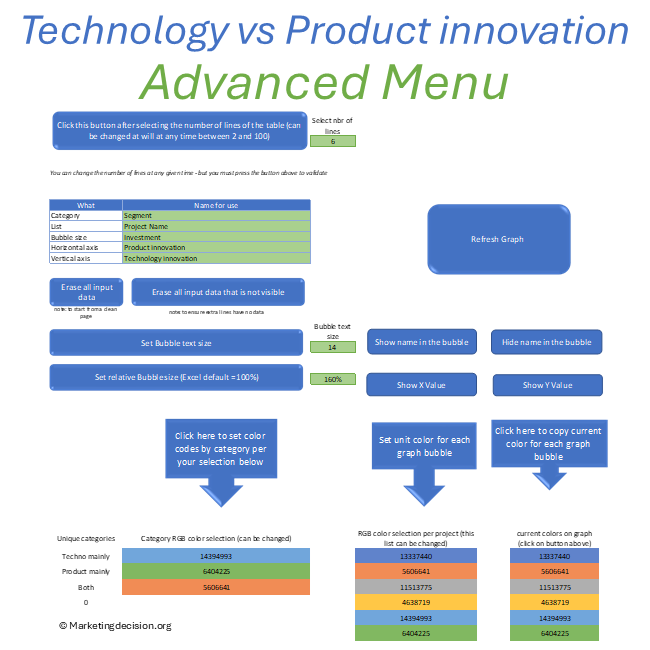
Select the green button “Show Toolbar” to display advanced features:
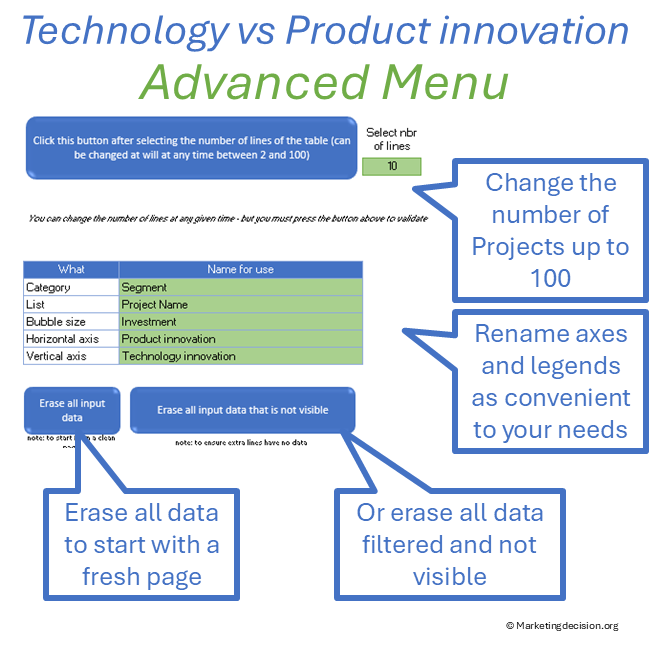
Data Selection
- Select the number of table rows (2 to 100)
- Erase all input data
- Erase non-visible data
- Update axis names and legends
- Filter projects by category
Legends and Display
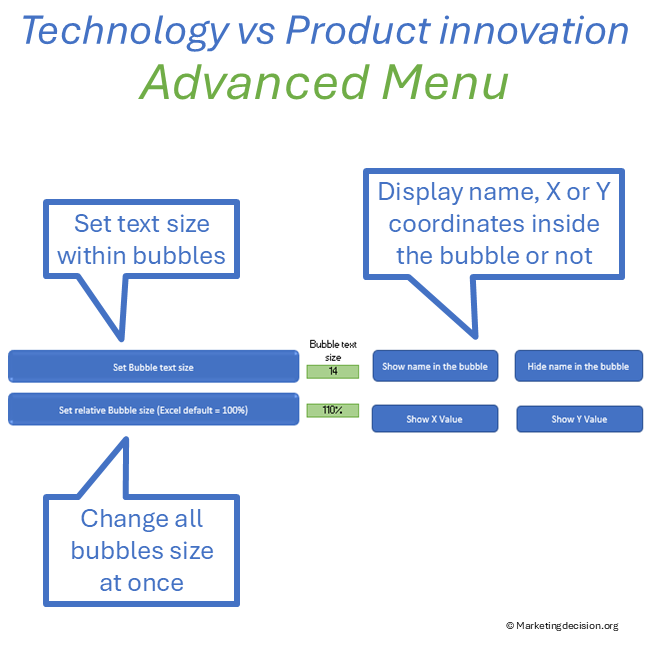
- Show or hide project names on bubbles
- Adjust text size
- Adjust relative bubble size
- Display axis values on bubbles
Color Customization
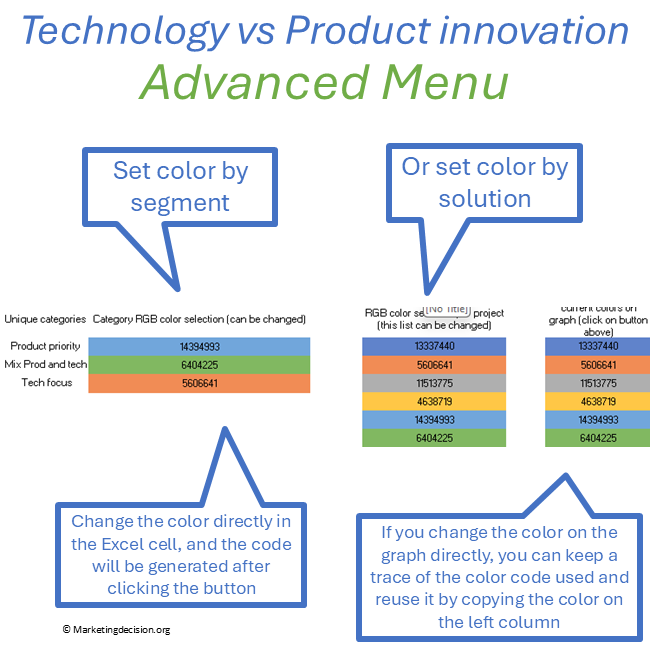
- Set colors by category
- Customize individual bubble colors
- Copy color codes from the graph to the table
Users have full access to macros and can adapt the tool to their needs.
Links and References
This innovation matrix tool builds on the principles described in our:
- Solution Mix (solution design and differentiation framework)
- Product vs Technology Innovation Strategy (innovation strategy framework)
- Decision Mix (structured decision-making framework)
Usage & Licensing
This product is intended for professional use only. Please review the Sales Conditions to fully understand your rights and usage limitations.
Licensed for a single business unit (up to 100 employees)
Additional licenses required beyond this scope
Download link valid for 2 months
Up to 10 downloads allowed
Users have full access to the application, including embedded macros, and may adapt it to their needs. However, all branding, trademarks, and references must remain visible and unchanged.
Ensure that you have Microsoft Excel and a PC running Windows before purchasing this application. This application uses advanced dynamic range calculations introduced by Microsoft. Please ensure that you are using a compatible version of Excel, such as Microsoft 365, or any version released after Excel 2019 which supports this feature.
We appreciate your feedback on how to improve this application. Feel free to share your suggestions with us at contact@marketingdecision.org