
Market Scenario Planning: Challenge Forecasts and Prepare for Change

Market Scenario Planning

Forecasting

A market forecast provides a view of how a market is expected to develop. It is an essential foundation for business planning, but it can also create a false sense of certainty.
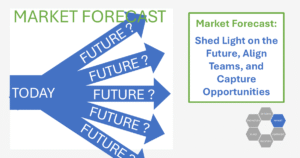
Market scenario planning showing alternative market futures around a central forecast

A forecast is built from the information and assumptions available today. Market conditions can change, assumptions can prove wrong, and events that appeared unlikely can become important.

Market Scenario Planning helps teams explore credible alternative market situations, understand how the market forecast could change, and determine what these changes would mean for the marketing or business plan.

The objective is not to predict every possible future. It is to challenge the expected future and prepare the company to respond when important market conditions change.

Why Use Market Scenario Planning?

The first question should not be which scenarios should we create? but what business need should Scenario Planning help address?

Scenario Planning may be used to challenge a market forecast, test an investment decision, evaluate the robustness of a marketing plan, prepare for a major competitive development, or understand how the business should respond to a significant change in its environment. The purpose of the exercise comes directly from this need and the decisions it may affect.

Without this focus, Scenario Planning can become an endless exercise. Two scenarios can be considered, or five, ten or hundreds, with no natural point at which the exercise is complete. The business need provides both the direction and the boundary.

Scenario Planning also benefits from cross-functional participation and appropriate management involvement. Different functions may see different implications of the same market development, making their perspectives valuable when scenarios and their consequences are discussed. For a significant exercise, a senior manager can help clarify why the work matters, what management expects to learn from it and which decisions it may support. The objective is to provide direction and motivation without influencing which scenarios the team considers credible or what conclusions it reaches.

With the business need and purpose clearly established, the team can determine which uncertainties deserve investigation, who should contribute, how far each scenario needs to be developed and, importantly, when the exercise has achieved its purpose.

This is why understanding what Scenario Planning is starts with understanding why it is being used.

From Market Forecast to Alternative Futures

A market forecast usually represents the expected market development used to support planning. But it remains one possible future.

Many developments may alter that path: a competitor may introduce a disruptive product, regulation may change, a technology may mature faster than expected, customer behaviour may shift, or an important input such as energy or raw-material prices may change significantly.

Scenario Planning challenges the assumption that the retained forecast will necessarily occur.

It asks what the market could look like under different but credible conditions and whether the current plan would remain appropriate.

This does not make forecasting less useful. On the contrary, Scenario Planning strengthens forecasting by making uncertainty explicit.

For the broader forecasting methodology, see Market Forecast.

Start With Important Market Uncertainties

Scenario Planning does not need to begin by inventing complete scenarios.

A useful starting point is to identify market developments that are uncertain enough to change the forecast or the resulting business decisions.
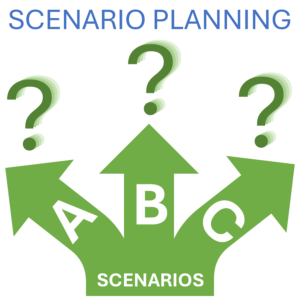
Identifying important market uncertainties and events for scenario planning

These developments may emerge from market research, customer discussions, competitive analysis, PESTLE, Porter’s Five Forces, internal expertise or weak signals observed across the organization.

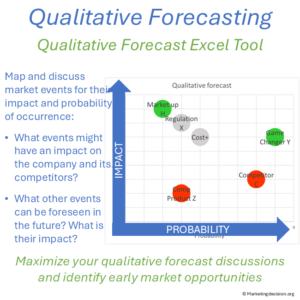
Qualitative Forecasting can also provide an important input. Potential market events can be identified and discussed according to their probability and potential impact before deciding which uncertainties deserve deeper investigation.

This first stage should take a broad 360° view of the market environment. The objective is not yet to develop scenarios. It is to avoid overlooking a development simply because it does not fit the current forecast.

Low-probability developments should not automatically be discarded when their potential impact is significant. They may be precisely the developments for which preparation creates the most value.

How to Build Market Scenarios

Step 1 - Select the Uncertainties That Matter

Not every uncertainty deserves a scenario.

Focus on developments that could materially alter the market forecast, require a different strategy, change an investment decision, affect resource allocation or create a significant risk or opportunity.
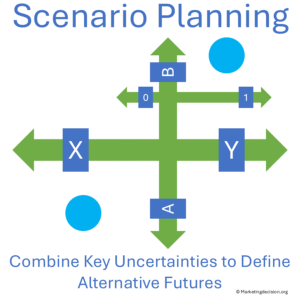
Combining key market uncertainties to define alternative futures for scenario planningFor example, imagine that the future price of oil is important to the market being analysed. Rather than attempting to predict one precise price, the team might consider two materially different conditions:

Oil price remains around X
Oil price increases toward Y

This creates one useful scenario axis.

A second important uncertainty can create another axis. In this example, combining the two produces four possible market situations, while a third axis can create additional scenarios.

The axes do not have to be independent. Some combinations may be more credible than others, and this should be considered when deciding which resulting scenarios deserve detailed analysis.

The objective is not to populate every theoretical combination. It is to identify credible and decision-relevant alternative futures.

Step 2 - Make Each Scenario Tangible

A scenario should be more than a position on a matrix.
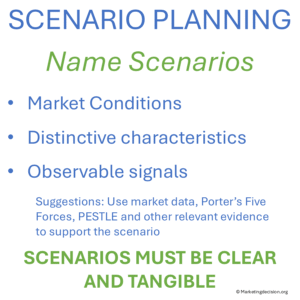
Building clear and tangible market scenarios using market conditions, distinctive characteristics and observable signals

What has happened? What market conditions characterize this situation? How are customers likely to respond? What happens to competitors? Which technologies, regulations or economic conditions have changed?

The more tangible the description becomes, the easier it is for a team to discuss its consequences.

This is similar to describing a market segment. Giving the scenario a meaningful name and a sufficiently precise narrative transforms an abstract possibility into a market situation that people can recognize and discuss.

A good scenario should also contain observable market facts or signals. If those signals begin to appear, the organization should be able to recognize that the market may be moving toward that scenario.
Step 3 - Determine the Market Forecast Under Each Scenario

Once a scenario is sufficiently clear, ask:

What would the market forecast look like under these conditions?

This is an important distinction.

Scenario Planning is not simply the production of several arbitrary forecasts. The scenario describes the market conditions; the forecast estimates how the market could develop if those conditions occurred.

Some implications may be qualitative. Others can be quantified.

Market size, growth, segment development, demand, prices or other relevant variables can be reconsidered according to the assumptions of the scenario.

Where measurable evidence is available, the Market Forecasting Excel Tool can help compare quantitative indicators and construct a transparent alternative forecast.

This gives the scenario a concrete connection to planning rather than leaving it as an interesting description of the future.

Step 4 - Ask the "So What?" Question

Once the alternative market situation and forecast are understood, the essential question becomes:

So what does this mean for our company, our customers, our competitors and our plan?

Would planned investments still make sense? Should pricing alternatives be prepared? Would resources need to move toward different segments? Could another distribution approach become necessary? Would the solution portfolio need to change? What should the company learn or investigate before making a decision?

The purpose is not necessarily to develop a complete business plan for every scenario.

The objective is to identify where the current plan is vulnerable, where opportunities could emerge, and which decisions or preparations could make the plan more robust.

Scenario Planning therefore connects alternative market conditions with practical marketing and business decisions.

Step 5 - Define What Should Be Monitored

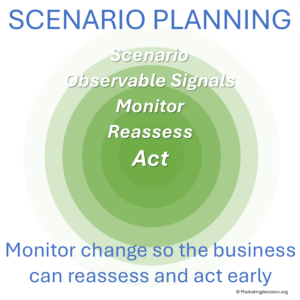
Scenario planning using observable signals to monitor change, reassess the plan and act earlyA scenario becomes much more useful when teams know what would indicate that it is beginning to occur.

Identify the signals, market facts or thresholds that should be monitored.

These might include a competitor announcement, regulatory decision, technology adoption rate, commodity price, customer behaviour, market-growth indicator or another observable development.

Monitoring turns Scenario Planning from a one-time workshop into a practical decision mechanism:

Scenario -> observable signals -> monitoring -> reassessment -> action

The company does not have to wait until a scenario is fully established. It can recognize changes earlier and reconsider its forecast and plan as evidence develops.
How Scenario Planning Fits Into Market Forecasting

Scenario Planning connects market uncertainty with forecasting and business decisions.

Qualitative Forecasting can help identify market developments that cannot yet be quantified reliably and assess their potential probability and impact.

Scenario Planning takes selected uncertainties and develops them into credible, tangible alternative market situations.

Quantitative Forecasting can then help determine how measurable market variables could develop under the assumptions associated with a selected scenario.

Together, they provide a practical progression:

Identify what could happen -> Build credible alternative market situations -> Estimate what those situations could mean for the market -> Determine what the company should do.

This does not mean that every scenario requires all three approaches. The level of analysis should remain proportional to the decision being supported.

Tools and Methods Supporting Scenario Planning

Different methods can contribute at different stages of the exercise.

Qualitative Forecasting helps capture market developments, weak signals and events that may not yet be quantifiable. The Qualitative Forecasting Tool provides a structured way to record events and assess probability and impact.

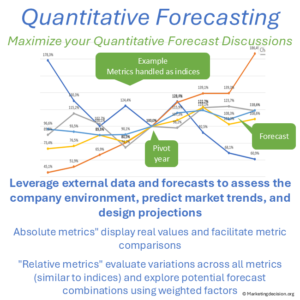
Quantitative Forecasting becomes useful when the implications of a scenario can be expressed through measurable market variables. The Market Forecasting Excel Tool can combine several indicators and assumptions into a transparent market forecast.

PESTLE Analysis can broaden the investigation of political, economic, social, technological, legal and environmental developments, while Porter’s Five Forces can help investigate changes in the competitive environment.

The Risk and Opportunity Matrix can support discussion of the consequences of selected developments and help teams distinguish between events requiring immediate attention and those that should primarily be monitored. See the Risk and Opportunity Matrix Excel Tool.

The methods do not need to be applied mechanically. Their purpose is to improve the quality of the discussion and the decisions that follow it.

Qualitative Forecasting Tool

Qualitative forecasting tool for identifying and assessing potential market events

Some developments that may affect a market cannot yet be quantified reliably. Changes in technology, regulation, competition, customer behaviour or other market events may nevertheless deserve attention.

The Qualitative Forecasting Tool helps teams identify these events, assess their probability and potential impact, and make different perspectives visible for discussion.

For Scenario Planning, this can help identify the uncertainties and market developments that deserve to be explored through alternative scenarios.
Quantitative Forecasting Tool

Quantitative forecasting tool comparing market indicators and growth assumptions

Once a scenario has been clearly described, the next question is how the market might develop under those conditions.

The Quantitative Forecasting Tool helps teams compare market indicators, external forecasts and internal data, examine their absolute values and relative growth trajectories, and identify where they converge or diverge.

Relevant metrics can then be selected and weighted to build a consolidated market-growth assumption while keeping the underlying evidence visible.

Use quantitative evidence to translate a credible scenario into an alternative market forecast that can be understood, discussed and challenged.

When Should Scenario Planning Be Used?

Scenario Planning can be useful at different stages of market forecasting and business planning. The appropriate timing depends on the business need and the decision the exercise is intended to support.

Used during market forecasting, Scenario Planning can help explore important uncertainties before a central forecast is selected. Alternative market situations can be considered, compared and refined while assumptions are still being developed.

Used after a market forecast has been established, it can challenge the retained forecast and its underlying assumptions. Teams can assess how important changes in market conditions would affect the forecast and whether the resulting marketing or business plan would remain appropriate.

Scenario Planning can also be used when a significant new market development appears. A competitor announcement, regulatory change, technological development or other important event may justify revisiting existing assumptions and asking whether the current forecast and plan still provide an appropriate direction.

Scenario Planning is therefore not a stage that must occur at one fixed point in the planning process. It can help build the forecast, challenge the forecast, or reconsider it when important market conditions change.

Scenario Planning Is Not About Producing as Many Scenarios as Possible

There is no intrinsic value in multiplying scenarios.

Two carefully selected scenarios can be more useful than ten superficial ones. A simple “what if?” discussion may sometimes be sufficient. A major investment decision may justify much deeper analysis and alternative forecasts or business-plan assumptions.

The appropriate level of effort depends on the original purpose.

This creates a useful stopping rule:

Scenario Planning is sufficiently developed when the team has enough understanding to challenge the relevant forecast or decision, identify the consequences, determine appropriate responses and establish what should be monitored.

The exercise has then produced something actionable.

Benefits of Scenario Planning - Building Resilience and Adaptability

Scenario Planning can improve the robustness of forecasts and plans, make important assumptions more visible, and help teams prepare for market developments before decisions become urgent. It can also improve alignment across functions by creating a shared understanding of important uncertainties and their possible consequences.
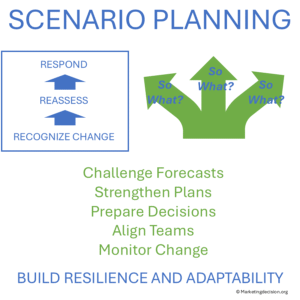
Scenario planning helping teams recognize change, reassess plans and respond to build resilience and adaptabilityIts most important benefit, however, may extend beyond the scenarios themselves. Teams become accustomed to questioning market assumptions, interpreting change and translating external developments into possible actions.

When an important market event occurs, a company that regularly practices Scenario Planning does not necessarily need to have predicted that exact event. Its teams have already practiced the process of evaluating change, understanding consequences and reconsidering decisions.

A forecast can sometimes feel like a line on the floor guiding an organization toward an expected destination. As long as conditions remain consistent with the forecast, that line provides direction.

But the real test comes when the line disappears.

Markets change. An assumption fails. A competitor behaves differently. Regulation moves. Technology accelerates.

Scenario Planning develops the organization’s ability to recreate that line when circumstances change – to understand the new environment, reconsider the forecast, determine appropriate actions and give teams a new direction.

Resilience therefore comes not only from scenarios that have already been considered, but from the team’s ability to evaluate and respond to situations that were not anticipated.

In Summary

Market Scenario Planning does not attempt to predict every possible future.

It starts with a practical question: why are we doing this exercise, and what decision do we want it to support?

Teams can then identify important uncertainties, construct credible alternative market situations, make them tangible, determine their implications for the market forecast and ask what those changes would mean for the marketing or business plan.

The value is not in producing scenarios. The value is in being better prepared to recognize change, challenge assumptions and make appropriate decisions when the expected future changes.

Used regularly, Scenario Planning strengthens both the business plan and the organization’s capacity to recognize, interpret and adapt to market change.

Frequently Asked Questions About Market Scenario Planning

What is Market Scenario Planning?

Market Scenario Planning is a structured approach for exploring credible alternative market situations and understanding how they could affect a market forecast and the resulting marketing or business plan. Its purpose is not to predict every possible future, but to help teams prepare for important changes in market conditions.

Scenario Planning helps challenge a market forecast and its underlying assumptions, test the robustness of important decisions, and prepare appropriate responses to significant market changes. The objective of the exercise should determine which scenarios are investigated and how far the analysis needs to go.

A market forecast describes how the market is expected to develop. A scenario describes an alternative set of market conditions that could occur. Scenario Planning explores these conditions and can then be used to determine how the market forecast might change under each relevant scenario.

Start by identifying important market uncertainties. Select those capable of materially changing the forecast or affecting important business decisions, combine relevant uncertainties where appropriate, and develop credible alternative situations.

Each selected scenario should then be described sufficiently clearly to understand its market consequences and recognize the signals indicating that it may be developing.

A what-if question tests the consequences of a particular change. Scenario Planning can take this further by developing a coherent market situation around one or several uncertainties, assessing how the market could develop under those conditions, and considering the implications for the company’s plan.

Scenario Planning helps teams practice recognizing market change, questioning assumptions, evaluating consequences and identifying appropriate responses. Its value therefore comes both from preparing for specific scenarios and from strengthening the organization’s ability to respond to developments that were not anticipated.

Common mistakes include treating Scenario Planning as a separate exercise rather than connecting it to forecasting and planning, developing more scenarios than the business need requires, losing sight of why the exercise was started, and failing to translate conclusions into decisions, actions or monitoring.

Scenario Planning should remain connected to the business need throughout the exercise – from selecting uncertainties and developing scenarios to deciding what should change and what should be monitored.

© marketingdecision.org

Explore Marketing Tools and Templates

marketing tools and templates

Explore tools designed to support the topics covered in this section. Access the full collection or go directly to tools supporting market analysis and forecasting.

© 2026 MARKETING DECISION SOLUTIONS. All Rights Reserved.