
Understanding perceived value in B2B solutions is essential for designing relevant offerings, setting the right price, and aligning marketing and sales strategies around customer expectations.
Solutions in B2B markets are offered with a price that customers are willing to pay only when the perceived value aligns with the cost, effort, and expected benefits of purchasing. When multiple alternatives are available, customers evaluate which solution best meets their needs and constraints, searching for the most fitting compromise.
This section clarifies the concept of Perceived Value in its many dimensions and explains how it informs solution design, pricing, segmentation, and sales. “Value” is often used in different ways in marketing and sales; here, it is anchored in what matters most to customers before price even enters the discussion. Because each customer—whether an individual, a company, or a committee—has unique expectations, the value they assign to a solution is always subjective and time-dependent.
This uniqueness makes the work of marketing and sales both demanding and rewarding. Understanding customer needs, expectations, and motivations is essential to determining whether your solution—or a competitor’s—better fits their requirements.
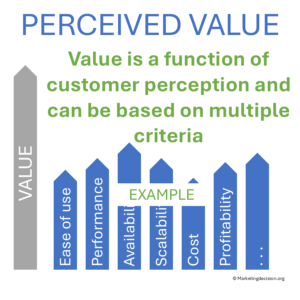 Perceived value is central to customer decision-making and plays a pivotal role in solution design, pricing models, sales strategy, and value-based selling. This customer perceived value is formed gradually as buyers compare options and interpret value perception signals from the marketplace. This perception is highly variable and can shift rapidly as customer priorities evolve.
Customers rely on many sources when assessing value. Beyond solution features—such as performance, availability, or technical characteristics—they also look for signals related to reliability, service quality, customer experience, and reputation. The more complex the solution, the more attention customers will give to these additional factors.
Price also influences value perception. A higher price may signal higher performance, quality, or residual value, especially when the solution may later be resold or used in long-term projects.
For complex B2B decisions, evaluations often begin with large spreadsheets comparing dozens of parameters. Yet buyers frequently report that only two or three criteria ultimately shaped their final choice. Identifying these key criteria early is a major objective for sales teams, who aim to anchor discussions around what truly matters.
Perceived value is therefore essential—and inherently subjective.
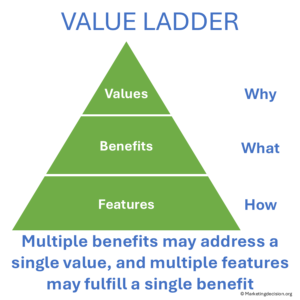 When customers select among competing solutions, they assess several options and choose the one that most closely matches their needs and expectations.
For marketers, this is where the “why” question becomes indispensable. It uncovers the reasoning behind customer decisions, explained in their own words. Asking “why” repeatedly helps reveal the deeper motivations that define their values.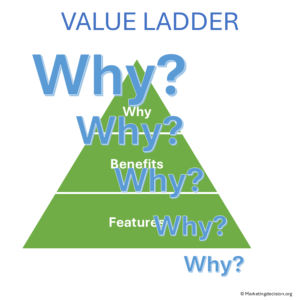 If customers initially respond with a feature or characteristic, it is important to continue probing until the underlying benefit or expectation becomes clear. This iterative questioning—often several layers deep—clarifies what customers genuinely value. It also reveals the value drivers that differentiate one solution from another.
The Value Ladder illustrates this progression:
Features explain what a solution offers.
Benefits explain what it does for the customer.
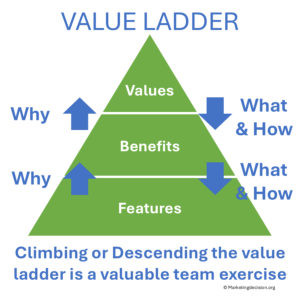
Values explain why it matters.
The Value Ladder tool (value-ladder-features-benefits-tool-pdf) supports this process and can be applied in both marketing and sales activities. Customers are often most receptive to these discussions either early in their journey—when defining purchase criteria and expectations—or after the decision is made, when reflecting on their motivations.
During the later stages of an active sales process, customers may be less open to exploratory discussions, as solution providers are expected to present their arguments clearly and efficiently.
 “Value” and “Values” are often used interchangeably, yet they refer to very different concepts in marketing and sales. This distinction is essential for understanding how customers judge solutions and why they make certain decisions.
Values represent the highest level of the Value Ladder. They include fundamental motivations such as: safety, reliability, ease of use, efficiency, peace of mind, profitability or financial performance, environmental or social considerations. These drivers emerge when the “why” question is asked repeatedly during customer interviews. Because several motivations often influence a decision, the term appears in the plural — Values. They reflect what customers genuinely care about before price, features, or specifications.
By contrast, Value is used when comparing alternative solutions. It is the customer’s overall perception of how well each option meets their needs relative to cost. It is what teams measure when positioning solutions on a value axis, or when assessing whether a solution brings enough performance, reliability, or benefits to justify its price.
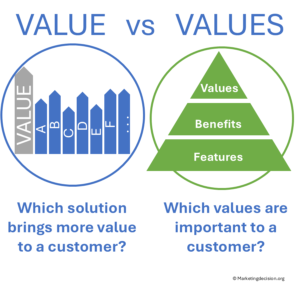
Purchasing decisions become complex because customers do not weigh criteria equally. As discussed in the chapter on decision tools (see Scorecards and Pugh Matrix), one criterion may dominate for certain customers, immediately eliminating some options from consideration. Others may focus on a small set of trade-offs and tolerate weaknesses when certain key benefits strongly match their priorities.
In summary:
Values help understand customer motivations and segment behaviors.
Value is used to compare solutions within or across segments. See also Portfolio Graph and Strategic Position Analysis methods
Recognizing this difference is critical when designing solutions, setting prices, and tailoring communication to different customer groups.
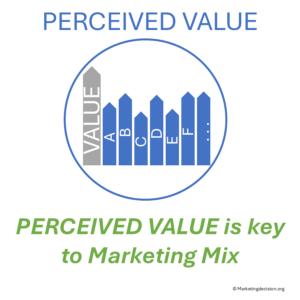 Understanding perceived value raises several essential questions for marketing and sales. These influence solution design, go-to-market strategies, pricing, segmentation, and communication. They apply to both your own products and competitor offerings:
What are the perceived benefits of each solution for the customer?
Do groups of customers share similar needs, expectations, and purchasing behaviors?
How do customers evaluate alternative solutions? Which factors matter most?
How should solutions be positioned for different customer groups?
Which sales approaches and channels are most effective for each segment?
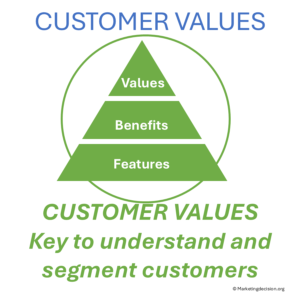 What communication strategies support customers early in their search and later in decision phases?
How can the company differentiate its solutions from competitors?
How can value be sold effectively and commoditization avoided?
Which sales tactics increase the likelihood of winning?
How can companies avoid or mitigate destructive price wars?
These questions help teams develop a deeper sensitivity to customer challenges and reinforce why understanding the “why” is more important than the “what” or the “how.”
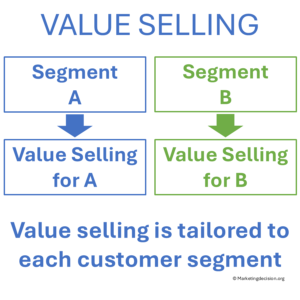 Customers evaluate solution performance and benefits based on their needs, past experiences, and expectations. Segmentation helps identify groups of customers who share similar decision patterns and value priorities.
Customers often vary in how they assess factors such as:
performance and technical capabilities
ease of use or integration
reliability and service agreements
reputation and long-term support
lifecycle costs and total cost of ownership
implementation requirements
risk tolerance or innovation readiness
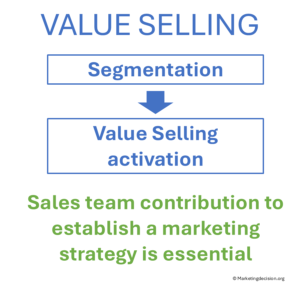
Effective segmentation provides essential guidance to sales teams. It helps them understand which arguments matter most, which features resonate with each group, and what price–value trade-offs customers are willing to consider. Without segmentation, each salesperson may rely solely on individual experience and personal judgment, which can result in inconsistent messages, misaligned expectations, and missed opportunities.
Segmentation does not give a definitive answer, but it provides a structured way to interpret customer needs. It also highlights risks—such as presenting a high-performance solution when the customer prioritizes low integration costs—and suggests corrective sales tactics. Ultimately, segmentation strengthens alignment between marketing and sales by ensuring both teams anchor their strategies around what customers truly value.
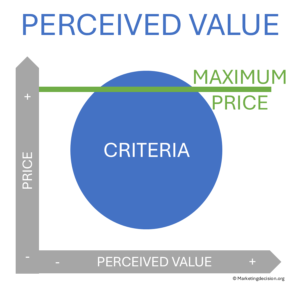 The instinct to quantify value often starts with ROI, payback time, or cost savings. While useful, these financial metrics rarely capture the complete picture. Important qualitative elements—such as usability, reliability, scalability, or organizational impact—remain outside traditional calculations but strongly influence perceived value.
When comparing solutions, quantification helps structure decision criteria. Tools such as weighted scorecards, decision matrices, and value assessments can be extremely helpful. Yet even the most careful evaluation includes subjectivity. Teams may forget that the importance of each criterion differs for every customer, and even within customer organizations, each stakeholder may evaluate the same factor from a different viewpoint.

Large B2B decisions often involve committees. Engineers, financial officers, end users, and executives each interpret benefits differently. Even with a structured process, decisions tend to reflect a blend of measurements, opinions, priorities, and compromise. This is why a solution with the highest calculated value may still lose if it fails to meet a budget limit or a critical priority criterion.
Thus, while value can be quantified for comparison, the final decision remains highly subjective. Quantification should support—not replace—the understanding of customer needs, expectations, and values.
For complex solutions, companies often offer options. Customers assess whether these options increase, decrease, or do not affect perceived value.
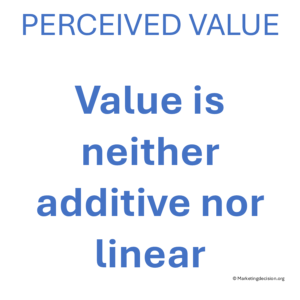
A common misconception is that options have an additive value. In practice, perceived value depends entirely on customer needs. An option that is irrelevant or creates inconveniences may reduce total perceived value. For example, adding a heavyweight graphics card to a portable computer may decrease value for customers who prioritize mobility.
Because price tends to be additive but perceived value does not, companies use solution packaging, bundles, or configurations to align better with segment needs. This is a cornerstone of segmentation and solution design.
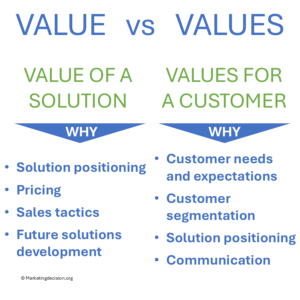 Value and Values carry different meanings, and both are crucial for effective marketing. Values represent what motivates customers in their needs and preferences when considering solutions. Perceived Value refers to the subjective evaluation by customers of how well a solution meets their needs, including factors such as acquisition price, running costs, and usage benefits.
These concepts are essential for companies when designing new solutions, creating value, and setting prices for different customer groups. Segmentation is vital for targeting sales strategies, promoting value propositions, and developing a successful approach.
Finally, the “Value Ladder” is an effective framework for assessing the values that characterize customer intentions and purposes. These values highlight the benefits expected from the solution, and solution features help anchor sales arguments. Understanding what motivates customers is key to developing meaningful solutions.
Value perception emerges from customer motivations, expectations, and buying behaviors. For these underlying dimensions, consult our Customer Mix foundations.
Perceived value is shaped by how solutions create benefits for customers. For a broader understanding of how value is built, you may also review our Value Creation page.
Pricing decisions rely on understanding how customers perceive value. For a broader perspective on value-based pricing principles, see our Value Pricing chapter.
Translating perceived value into customer conversations is a central challenge. For methods that help anchor these perceptions in sales interactions, see our Value Selling chapter.
Promotion works best when it amplifies the value customers perceive. For how promotion shapes this interpretation, see Promotion Strategy.
Understanding perceived value is essential for solution development. For a structured view of how solutions are defined and positioned, visit our Solution Mix chapter.
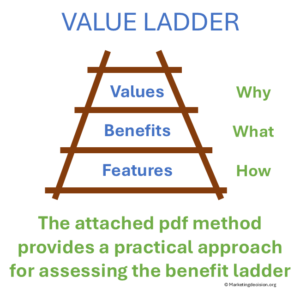 The Value Ladder bridges the gap between customer values and solution features. It is essential for assessing and comparing solutions across different customer segments. Moreover, it helps you compare solutions against each other while considering customer needs and behaviors. This makes it a critical tool for future solution development.
A valuable exercise for marketing teams is to consider the Value Ladder for different segments. Divide a large team into smaller groups of about five people, and have them discuss the Value Ladder for a specific segment. Make sure the segment is well-defined and provide examples of customers. Involving salespeople to bring their own examples is also useful. This exercise has many benefits, such as identifying customers who fit into certain segments, describing potential pitfalls, and suggesting sales strategies to better align with customer needs.
The Value Ladder is a key tool for mapping customer values to benefits and features. It is an effective method for understanding why certain solutions meet customer needs and how to develop new features and capabilities to boost competitiveness by optimizing solution offerings.

Explore tools related to the topics covered in this section. For a wider selection, visit our webshop using the link below, or continue browsing our marketing mix pages for additional insights and solutions.