The Value Ladder Tool helps teams connect customer values to benefits and features, compare solutions across segments, and define what truly drives customer choice.
The Value Ladder Tool bridges the gap between customer values and solution features, making it essential for assessing and comparing solutions across different customer segments and understanding how customer needs and behaviors influence solution selection and future development.
The Value Ladder is a key tool for mapping customer values to benefits and features, supporting structured discussions that help teams understand why certain solutions meet customer needs and how to develop new features and capabilities to improve competitiveness and optimize solution offerings.
The product proposed is the method described in a PDF file. Designed for professional use, it is available in English for companies and professionals.
To view images, click the magnifying glass icon in the top right corner of the image, or browse through the image carousel below.
© marketingdecision.org
€0.00 Exc. VAT
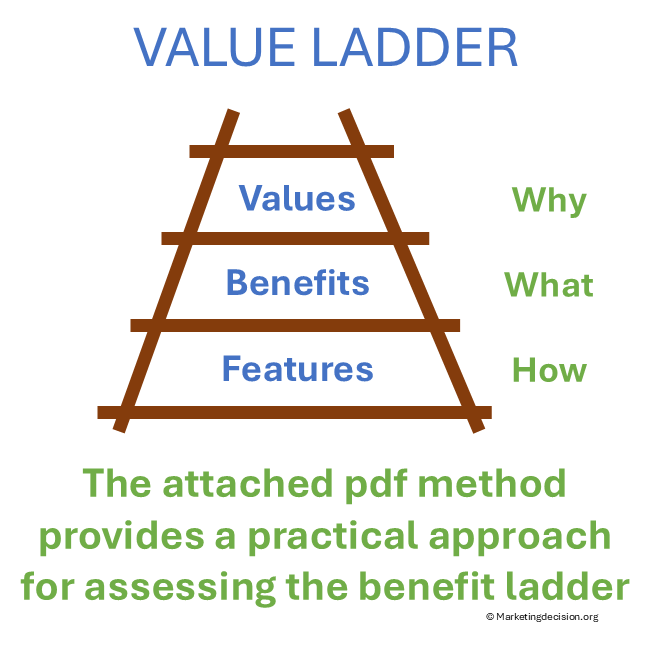
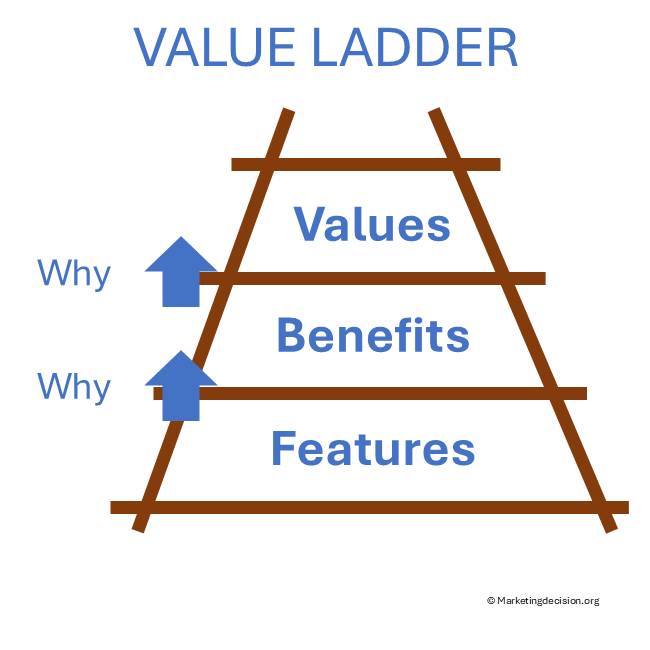
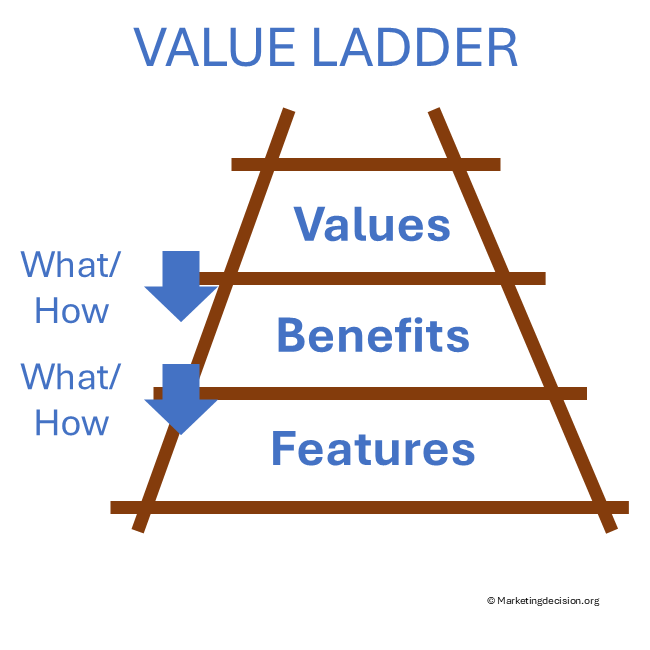
This product offers a method for engaging teams and assessing the benefit ladder. The method is described in detail within a PDF document.
The Value Ladder, also known as the Benefit Ladder, is a tool that can be described in various ways online. Some descriptions focus more on communication, while others emphasize value creation and solution positioning. The latter are the main objectives discussed here.
The Value Ladder is part of a broader framework explaining how customer needs translate into perceived value. For a deeper explanation, see the Solution Perceived Value framework.
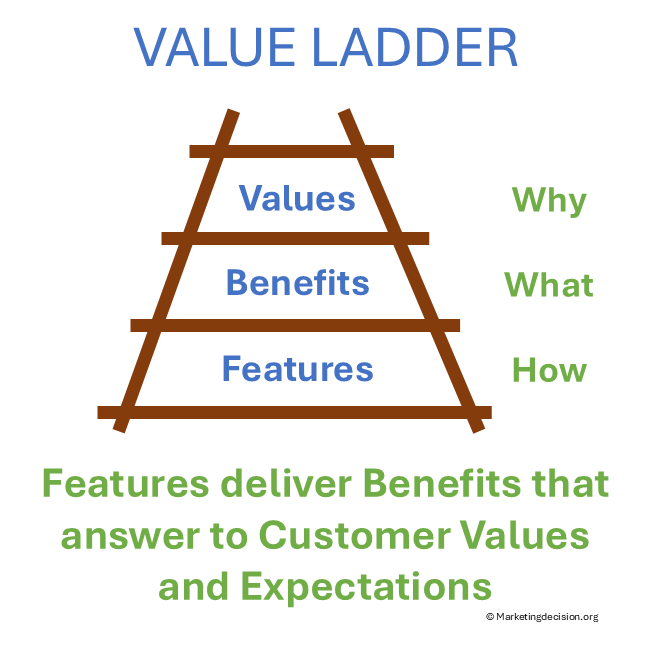
In sales and marketing, a key practice is asking what is important to a customer and why. Answers will vary from person to person and can generally be divided into three categories:
To connect these categories, the key is asking “why.” When you ask why a feature is important, you uncover the benefits. Similarly, asking why those benefits matter reveals the values important to your customers. This process allows you to climb the ladder. Conversely, by asking “what” and “how,” you can descend the ladder.
This tool effectively connects features and values in both directions. For example, when considering a customer market segment with known values, it helps identify the features required to deliver the desired benefits. Likewise, starting from features, you can link them to benefits and values to see which customer segments are best addressed by those features.
The Value Ladder bridges the gap between customer values and solution features. It is essential for assessing and comparing solutions across different customer segments. Moreover, it helps you compare solutions against each other while considering customer needs and behaviors. This makes it a critical tool for future solution development.
Starting with an existing solution and climbing the ladder is a great way to build it for the first time. This approach is natural and intuitive because asking “why” is straightforward. Since values are typically not numerous, features can often be grouped by their benefit impacts, which simplifies the process of climbing the ladder.
By developing the ladder for your company’s solutions and also analyzing competitors’ offerings, you can better understand how well solutions align with customer segments. You might find that certain features are unnecessary for specific segments, adding unnecessary costs or complications. On the other hand, you may also identify features that are critical for addressing certain market segments.
Developing the Value Ladder for each customer segment helps you identify features that will differentiate your solution and optimize it for specific segments. Many believe that what works for the most demanding segments will work for all. However, this approach can lead teams to focus too much on a few high-demand segments while overlooking the broader customer base.
Instead, developing a range of solutions, possibly with optional features, can address various target segments more effectively.
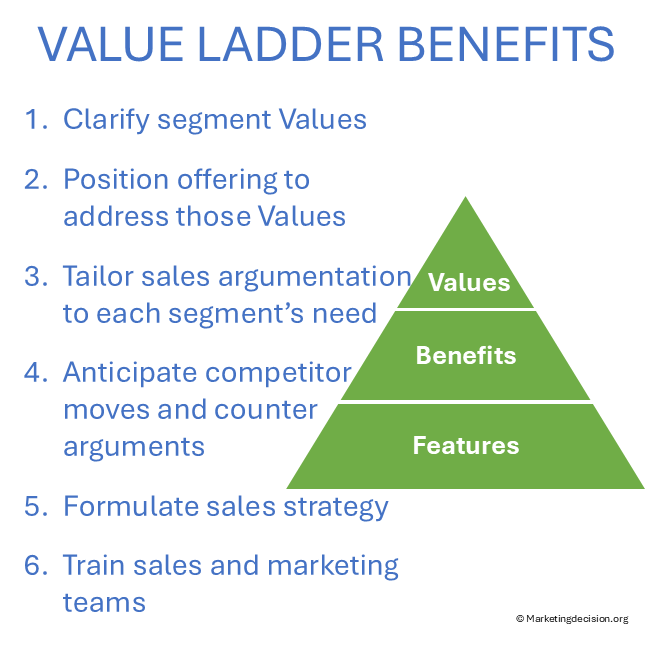
There are several key benefits to using the Value Ladder:
This approach is similar to the Quality Function Deployment (QFD) methodology, which connects customer needs to product characteristics. Conjoint analysis also identifies value from product characteristics and how they are perceived by different customer segments. For more information, you can refer to the Wikipedia article on QFD here.
When searching for the Benefit Ladder online, you may find that the top level is often labeled “emotional benefits.” Translating values into emotions is a useful way to understand customer perspectives during key moments, such as during a purchase or when using a solution. This approach can improve communication and branding while maintaining a focus on values. You can read more about this in the article here.
However, it is important not to focus solely on communication or branding when using the Benefit Ladder. There is much more to this tool than just considering customer emotions.
When mapping customer segment values to solution benefits and features, it is recommended to use a single page to map the three categories: Values, Benefits, and Features. This process can be done by customer segment or by solution. For customer segments, the outcome will list benefits and features that align with the values of that segment. It also compares solutions (both company and competitor) that best meet these objectives, and identifies which features impact product positioning the most. In short, this helps determine the ideal future solution for each market segment.
The Value Ladder is a key tool for mapping customer values to benefits and features. It is an effective method for understanding why certain solutions meet customer needs and how to develop new features and capabilities to boost competitiveness by optimizing solution offerings.
Value ladders differ across customer segments. For segmentation foundations, visit Customer Segmentation Principles.
The Value Ladder supports value-based pricing by clarifying the link between values, benefits, and features. For a full view of pricing principles, refer to our Value Pricing page.
The Value Ladder helps sales teams structure their value arguments. For broader principles supporting value-driven conversations, see our Value Selling chapter.
Purchase and use of the application are subject to the applicable General Sales Conditions.
General Sales Conditions — English
Conditions Générales de Vente — Français
We use cookies to improve your experience on our site. By using our site, you consent to cookies.
Manage your cookie preferences below:
Essential cookies enable basic functions and are necessary for the proper function of the website.
These cookies are needed for adding comments on this website.
Stripe is a payment processing platform that enables businesses to accept online payments securely and efficiently.
Service URL: stripe.com (opens in a new window)
Statistics cookies collect information anonymously. This information helps us understand how visitors use our website.
Google Analytics is a powerful tool that tracks and analyzes website traffic for informed marketing decisions.
Service URL: policies.google.com (opens in a new window)