Pugh Matrix Excel Tool for Structured Solution Comparison

Pugh Matrix Scorecard – Excel Tool for Strengths & Weaknesses Analysis

The Pugh Matrix Excel tool helps teams compare alternative solutions using structured evaluation criteria to support sound decision-making.

The Pugh Matrix, also known as a decision matrix for comparing alternatives, is widely used in engineering design, product development, and project evaluation. It helps teams systematically compare solutions across multiple criteria in order to identify the most balanced option.

The Pugh decision matrix highlights strengths and weaknesses across options, making it easier to support collaborative decision-making. Scorecards are powerful tools for comparing solutions or projects, and they facilitate important discussions where multiple viewpoints are typically shared. They provide a rational environment for stakeholders to make, justify, and communicate decisions more effectively, particularly when trade-offs and potential showstoppers must be discussed.

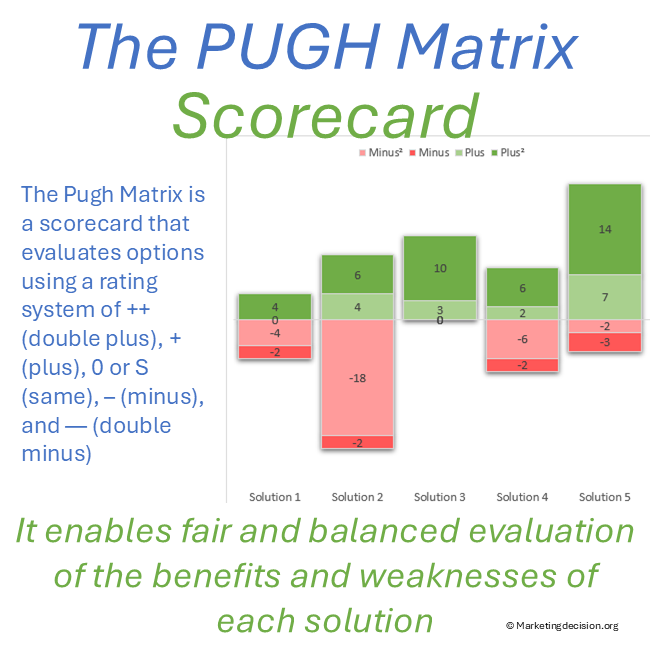
The PUGH matrix, named after its inventor Stuart Pugh, is a decision scorecard that uses discrete levels such as — (double minus), –, 0 or S (same), +, and ++ (double plus) to compare solutions. The Excel tool applies this methodology to identify strengths and weaknesses, highlight significant advantages or disadvantages, and support structured comparisons across multiple criteria and solutions.

Designed for professional use, this application is provided as an Excel file and is available in English for companies and professionals.

To view images, click the magnifying glass icon in the top right corner of the image, or browse through the image carousel below.

© marketingdecision.org

27.00 excl. tax

SKU DT-PMS-01 Category

Description

This Pugh Matrix Excel tool allows teams to compare solutions or projects using the PUGH matrix methodology. Both strengths and weaknesses can be identified clearly during the evaluation process.

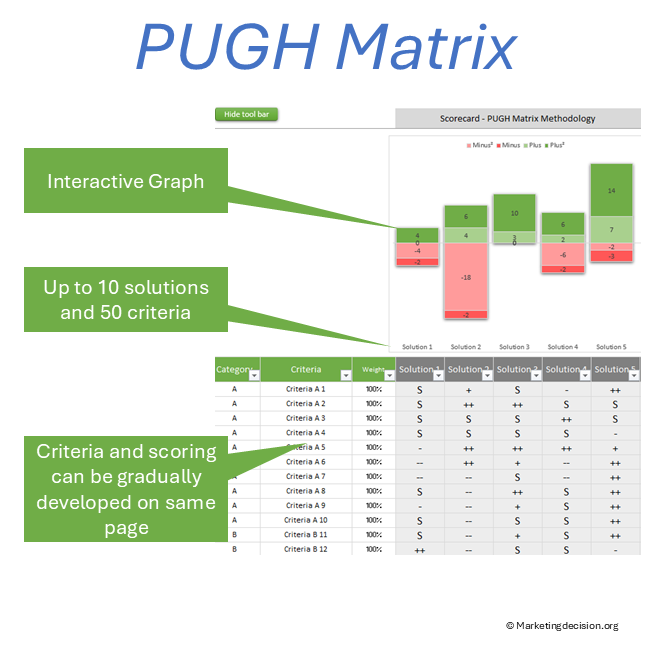
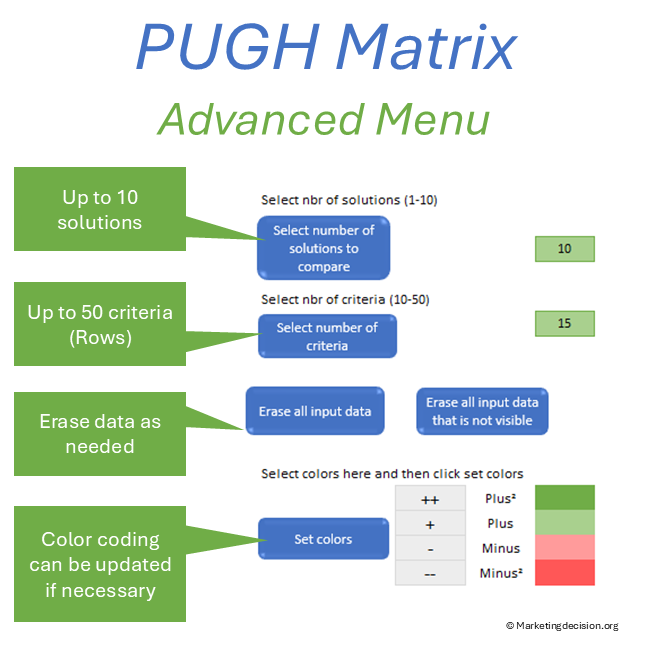
The number of solutions for comparison can be set from 1 up to 10, while the number of evaluation criteria can be adjusted from 10 up to 50. Color coding can be customized through the toolbar, allowing teams to visualize results more effectively and adapt the display to their preferences.

Why Use the Pugh Matrix to Compare Solutions?

Traditional scorecards usually combine weighted scores into a single final result. The PUGH matrix, by contrast, counts the number of positive and negative evaluations across criteria.

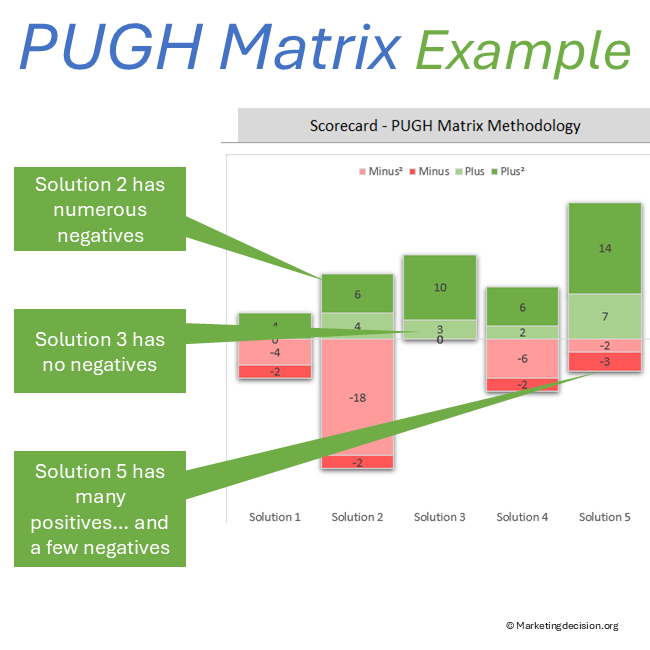
A solution with multiple “++” advantages may perform well overall, but the “—” levels will also clearly highlight potential weaknesses. The real advantage of the PUGH matrix is that it allows teams to identify strengths as well as weaknesses across solutions, rather than hiding these differences within a single numerical score.

A decision must consider both strengths and weaknesses. A solution that performs extremely well on several criteria but very poorly on others may ultimately be less valuable than a solution that is better balanced across criteria. In practice, some criteria may represent critical constraints or showstoppers.

By clearly presenting double pluses and double minuses, the PUGH matrix facilitates discussions among team members regarding the benefits and limitations of each solution. This structured debate is one of the key reasons why the PUGH matrix is widely used in many decision-making situations.

Key Features of the Decision PUGH Matrix Scorecard

  • Compare up to 10 solutions across up to 50 criteria

  • Graphics display strengths and weaknesses with customizable color coding

  • Weight factors can be adjusted for each criterion (default set at 100%)

  • An advanced “Results” page provides additional calculations and rankings across criteria

  • Usage recommendations help ensure optimal application of the comparison methodology

PUGH Matrix Methodology

The PUGH matrix can be implemented in a few simple steps and revisited during stakeholder meetings. This facilitates discussion of the arguments supporting different solutions and helps teams evaluate criteria sensitivity.

Building a decision scorecard involves more than simply preparing a spreadsheet and entering data. It requires engaging the relevant individuals, ensuring effective communication, and validating results collaboratively as the scorecard evolves.

For complex scorecards or decisions with significant impact, multiple meetings are often required. Efficient communication and teamwork are essential to ensure that the results are understood and accepted.

Step 1: Determine Project Scope and Deliverables with Stakeholders

This step is crucial to ensure that the decision question is clearly defined. Stakeholders often have different needs and priorities, so they should be involved early in the process.

Ensure that there is a project sponsor and that the team’s recommendations can be properly reported. Discussions at this stage often reveal new considerations as individuals learn more about the needs and constraints of others.

List objectives, scope, and team members to ensure the project remains aligned with priorities. If necessary, return to this step later in the process; refining the scope can improve the quality of subsequent analysis.

Step 2: Determine the List of Criteria for Comparison

The list of evaluation criteria may include many dimensions, some technical and others strategic or operational.

Develop the criteria list by identifying the factors that are critical for selecting between solutions. Gathering input from the team helps ensure that all relevant criteria are considered.

Questions such as “What does success look like?” or “What issues must be resolved?” can help identify Critical-to-Quality (CTQ) criteria.

For example, when selecting a CRM system, criteria might include:

  • features and capabilities

  • ease of implementation

  • ease of deployment and training

  • cost and service

  • vendor support

Weight factors can be used to adjust the relative importance of criteria. Starting with a default weight of 100% is often sufficient before making further adjustments.

Step 3: Add Solutions and Their Evaluation

Once the criteria list is established, the next step is to populate the comparison table.

List the solutions and evaluate them using the comparison indicators:
— —, –, S (same), +, ++

If one of the solutions represents the current solution, assign “S” (same) across the column as the baseline reference. If no solution currently exists, select one option as the reference solution and adjust the evaluations accordingly.

The comparison can be performed:

  • criterion by criterion

  • solution by solution

Color coding can help identify criteria that require additional analysis or clarification.

Step 4: Review Results and Consolidate Findings

After completing the comparison table, stakeholders should take time to review and interpret the results.

Consider testing hypothetical scenarios to evaluate how different weight factors might influence the comparison.

Discuss the strengths and weaknesses of each solution, which is the true strength of the PUGH matrix. Positive and negative evaluations remain visible rather than being merged into a single score.

Once the team is confident with the results and criteria weights, the final question becomes clear:

What conclusions can be drawn from the comparison?

Features

After downloading the tool, save a copy for future use. A new copy should be created each time the tool is used, in accordance with the terms of use.

On the “Comparison” page, select “Show Toolbar” to access multiple parameters:

  • Select number of solutions (maximum 10, although 5–6 is often optimal)

  • Select number of criteria (maximum 50)

  • Buttons to erase the entire table or hidden cells

  • Set colors to customize visual comparison

  • Option to hide the toolbar once configuration is complete

You have full access to the macros, allowing you to adapt or extend the tool as needed. Suggestions for future improvements are welcome.

Links and References

Campaign prioritization becomes clearer when tied to promotion objectives. Refer to the Promotion Strategy framework for alignment with communication goals.

Comparison frameworks depend on shared evaluation criteria. Visit the Decision Mix to explore the foundations behind structured comparison.

Usage & Licensing

Please review the Sales Conditions published on this website to fully understand your rights and the restrictions regarding the use of this product. Our products are intended for professional use only and are not designed for consumer purposes.

The products provided under this agreement are exclusively for the individual buyer or members of the same business unit. Sharing, distributing, or making them available to individuals or teams outside the designated user or relevant business unit is strictly prohibited. For software licensing purposes, a business unit is limited to a maximum of 100 employees, including full-time, part-time, and temporary staff. Additional licenses must be purchased in multiples of 100 if this limit is exceeded.

The provided download link is valid for two months and allows up to 10 downloads. Be sure to save a copy before the link expires or the download limit is reached. Users have full access to the application product, including any embedded macros, and may make necessary adjustments to suit their needs. However, all branding, trademarks, and references to marketingdecision.org must remain visible and intact within the application.

Ensure that you have Microsoft Excel and a PC running Windows before purchasing this application. This application uses advanced dynamic range calculations introduced by Microsoft. Please ensure that you are using a compatible version of Excel, such as Microsoft 365, or any version released after Excel 2019 which supports this feature.

We appreciate your feedback on how to improve this application. Feel free to share your suggestions with us at contact@marketingdecision.org
Additional information

Brand

marketingdecision

General Sales Conditions (ENG)

  1. Purpose

These General Sales Conditions (GSC) govern all transactions made on our online store, accessible at: [insert URL]. By confirming an order, the customer fully accepts these terms without reservation.

  1. Products and Prices
  • Product Description: The products displayed on our site are described as accurately as possible. However, minor differences may exist (non-contractual photos).
  • Prices: Prices are displayed in Euros (EUR) and include all applicable taxes (VAT). Shipping costs are calculated and displayed during checkout.
  • Price Changes: We reserve the right to modify prices at any time. Products will be billed based on the rates in effect at the time of the order.
  1. Orders
  • Process: Orders are placed exclusively through our website. The customer must provide accurate information when placing the order.
  • Confirmation: An order confirmation email is sent once payment is validated.
  • Order Refusal: We reserve the right to refuse an order for legitimate reasons, such as product unavailability or payment issues.
  1. Payment
  • Accepted Methods: Payments can be made via [list accepted methods, e.g., credit card, PayPal, etc.].
  • Security: Payments are securely processed through a third-party provider compliant with PCI DSS standards.
  • Electronic Billing: By confirming the order, the customer agrees to receive an electronic invoice.
  1. Shipping
  • Timeframe: Products are shipped to the address provided during checkout within a maximum of 30 days, unless stated otherwise.
  • Delays: In case of delay, the customer will be promptly informed and may cancel the order if the delay exceeds 7 days.
  • Shipping Costs: Costs are indicated at the time of order validation.
  1. Right of Withdrawal

In accordance with Article L221-18 of the French Consumer Code, the customer has 14 days to exercise their right of withdrawal without providing a reason.

  • How to Exercise: To exercise this right, the customer must notify us by email or postal mail at: [address].
  • Returns: Products must be returned in their original packaging, unused, and in perfect condition. Return shipping costs are the responsibility of the customer unless the product is non-compliant.
  • Withdrawal Form: A withdrawal form is available here: [link to form].
  1. Warranties
  • Legal Warranty of Conformity: Products are covered by a 2-year warranty from the delivery date (Articles L217-4 to L217-14 of the French Consumer Code).
  • Hidden Defects Warranty: Under Article 1641 of the French Civil Code, the customer may invoke a warranty for hidden defects rendering the product unsuitable for its intended use.

For claims, please contact us at [email address].

  1. Liability
  • We are not responsible for indirect or consequential damages arising from product use.
  • Our liability is limited to the total order amount.
  1. Data Protection
  • Personal data collected during orders is processed in accordance with GDPR. See our [Privacy Policy] for more details.
  • User Rights: Access, correction, deletion, and objection can be requested at any time via email at [email address].
  1. Dispute Resolution
  • Mediation: In case of a dispute, the customer may contact a consumer mediation service. Contact [mediator name and details].
  • Applicable Law: These GSC are governed by French law. The competent courts are those of the company’s registered office location.
  1. Contact

For any questions related to these GSC, please contact us:

  • Email: [email address]
  • Address: [physical address]
  • Phone: [phone number]


Conditions Générales de Vente (FR)

  1. Objet

Les présentes Conditions Générales de Vente (CGV) régissent l’ensemble des transactions effectuées sur notre boutique en ligne accessible à l’adresse : [insérer l’URL]. En validant une commande, le client accepte sans réserve les présentes conditions.

  1. Produits et Prix
  • Description des produits : Les produits présentés sur notre site sont décrits avec la plus grande exactitude possible. Toutefois, des différences mineures peuvent exister (photos non contractuelles).
  • Prix : Les prix sont affichés en euros (EUR) et incluent toutes les taxes applicables (TTC). Les frais de livraison sont calculés et affichés lors du passage en caisse.
  • Modification des prix : Nous nous réservons le droit de modifier les prix à tout moment. Les produits seront facturés sur la base des tarifs en vigueur au moment de la commande.
  1. Commandes
  • Processus : Les commandes sont effectuées exclusivement sur notre site web. Le client doit fournir des informations exactes lors de la validation.
  • Confirmation : Une confirmation de commande est envoyée par e-mail une fois le paiement validé.
  • Refus de commande : Nous nous réservons le droit de refuser une commande pour des motifs légitimes, tels qu’un produit indisponible ou un problème de paiement.
  1. Paiement
  • Moyens acceptés : Les paiements s’effectuent par [indiquer les méthodes, e.g., carte bancaire, PayPal, etc.].
  • Sécurité : Les paiements sont traités de manière sécurisée par un prestataire tiers conforme aux normes de sécurité (PCI DSS).
  • Facturation électronique : En validant la commande, le client accepte de recevoir une facture sous format électronique.
  1. Livraison
  • Délais : Les produits sont expédiés à l’adresse indiquée lors de la commande dans un délai maximum de 30 jours, sauf indication contraire.
  • Retards : En cas de retard, le client sera informé rapidement et pourra annuler sa commande si le retard excède 7 jours.
  • Frais de livraison : Les frais sont indiqués au moment de la validation de la commande.
  1. Droit de Rétractation

Conformément à l’Article L221-18 du Code de la consommation, le client dispose de 14 jours pour exercer son droit de rétractation sans avoir à justifier de motif.

  • Exercice du droit : Pour exercer ce droit, le client doit nous informer par e-mail ou courrier postal à : [adresse].
  • Retours : Les produits doivent être renvoyés dans leur emballage d’origine, non utilisés, et en parfait état. Les frais de retour sont à la charge du client, sauf en cas de non-conformité.
  • Formulaire de rétractation : Un formulaire de rétractation est disponible ici : [lien vers le formulaire].
  1. Garanties
  • Garantie légale de conformité : Les produits bénéficient d’une garantie de 2 ans à compter de leur livraison (Articles L217-4 à L217-14 du Code de la consommation).
  • Garantie contre les vices cachés : Conformément à l’Article 1641 du Code civil, le client peut invoquer une garantie contre les défauts cachés rendant le produit impropre à son usage.

Pour toute réclamation, veuillez nous contacter à [adresse e-mail].

  1. Responsabilité
  • Nous ne sommes pas responsables des dommages indirects ou consécutifs pouvant survenir à la suite de l’utilisation des produits.
  • Notre responsabilité est limitée au montant total de la commande.
  1. Protection des Données
  • Les données personnelles collectées lors des commandes sont traitées conformément au RGPD. Consultez notre [Politique de Confidentialité] pour plus d’informations.
  • Droits des utilisateurs : Accès, rectification, suppression, opposition à tout moment par e-mail à [adresse e-mail].
  1. Résolution des Litiges
  • Médiation : En cas de litige, le client peut recourir à un service de médiation à la consommation. Contactez [nom et contact du médiateur].
  • Droit applicable : Les présentes CGV sont régies par le droit français. Les tribunaux compétents sont ceux du lieu de siège social de la société.
  1. Contact

Pour toute question relative aux présentes CGV, veuillez nous contacter :

  • E-mail : [adresse e-mail]
  • Adresse : [adresse physique]
  • Téléphone : [numéro de téléphone]