

Description
What Is Market Share Analysis?
Market share analysis helps companies understand how their performance compares with the overall market and with competitors. By measuring the proportion of total market volume captured by a company, teams can assess whether growth results from stronger competitive positioning or from broader market dynamics.
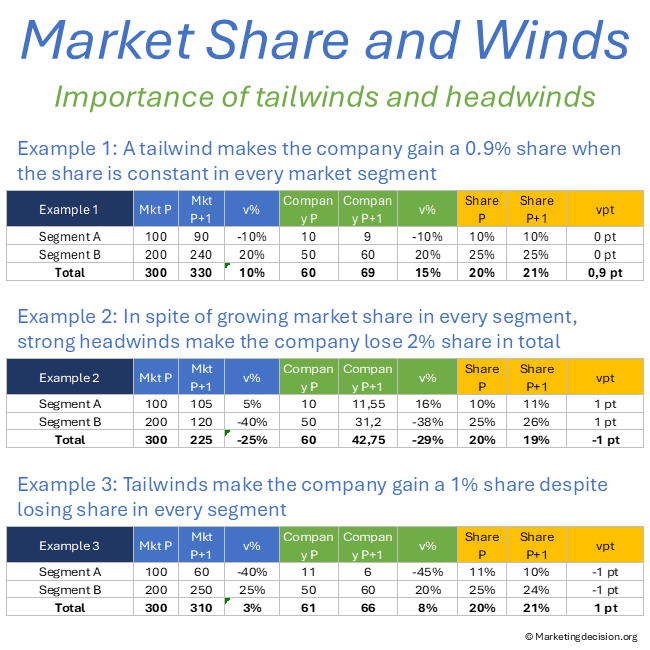
However, market share alone does not always explain performance. Markets evolve continuously: some segments grow rapidly while others stagnate or decline. These structural changes create tailwinds and headwinds that influence overall market share development.
Analyzing these dynamics allows organizations to better understand where growth originates, which segments drive performance, and how market evolution affects strategic positioning.
Why Market Share Analysis Matters for Strategy
Market share is often used as a simple indicator of competitive strength. Yet this indicator can sometimes hide important structural effects.
A company may gain market share simply because the segments where it is strongest are expanding faster than others. Conversely, a company can execute well and still lose share if it operates in segments that are shrinking.
Analyzing tailwinds and headwinds helps distinguish these situations. By comparing market growth across segments with company positioning, teams can determine whether performance is driven by competitive strength or by favorable market structure.
These insights are particularly valuable when evaluating investment priorities, portfolio choices, and long-term market opportunities.
Key Features of the Market Share Analysis Tool
Dynamic Excel Slicers for Market Data
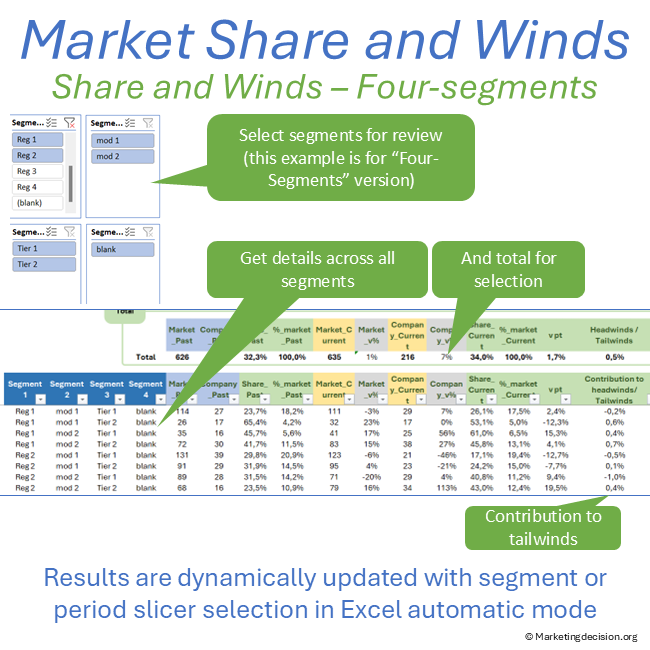
Analyze the market by date (year, quarter, month) and by segments using Excel slicers.
Filter data dynamically to focus on specific market segments or time periods.
Tailwinds and Headwinds Calculations
Calculate tailwinds and headwinds for any segment configuration.
Understand the impact of market growth or decline on your market share.
Market Share Visualization
Visualize market share trends and growth drivers with customizable graphs.
Compare market share across segments to identify opportunities and risks.
Multiple Versions for Flexibility
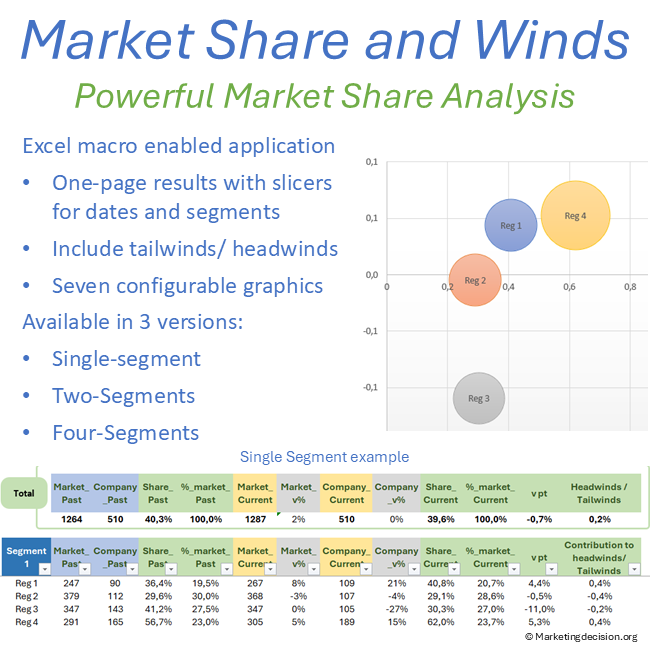
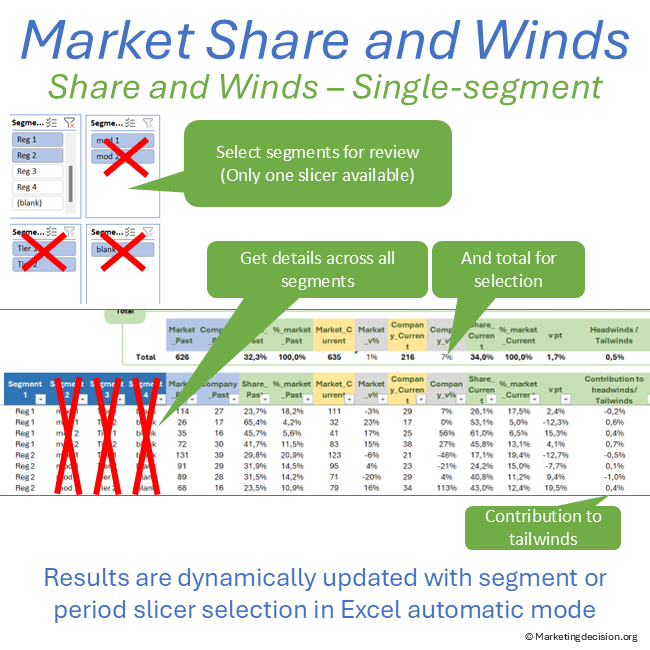
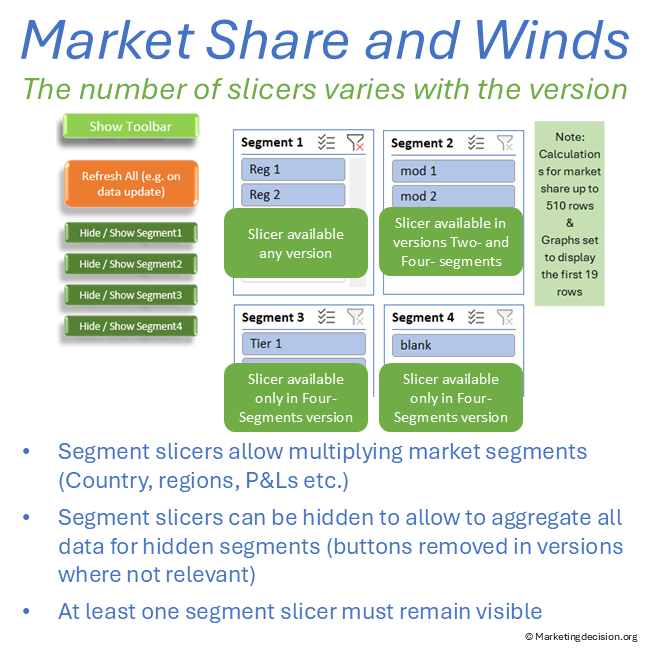
Single-Segment Version: Filter data along a single axis.
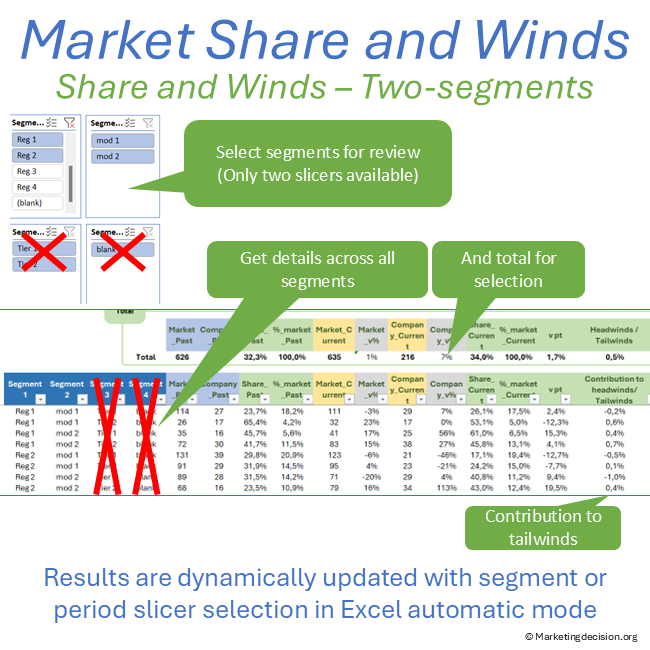
Two-Segments Version: Select segments across two dimensions (for example regions and P&L).
Four-Segments Version: Analyze data across four dimensions (for example region, countries, P&L, sub-modalities).
How to Use the Tool
Enter Your Data
Use the dedicated data entry tab to input market and company data.
Select Segments and Dates
Use Excel slicers to filter data by segments and time periods.
Analyze Tailwinds and Headwinds
Review the calculated tailwinds and headwinds for each segment.
Visualize Results
Use the graphs to visualize market share trends and growth drivers.
Use Cases
Market Share Growth Analysis
Analyze market share trends to identify growth opportunities and risks.
Use tailwinds and headwinds calculations to understand market dynamics.
Segment-Level Insights
Compare market share across different segments to identify strengths and weaknesses.
Use the tool to guide investment decisions and strategic planning.
Advanced Features
Data Selection
Select the number of lines for the table between 2 and 100.
Erase all input data or only non-visible data as needed.
Update names for axes and table legends.
Graph Customization
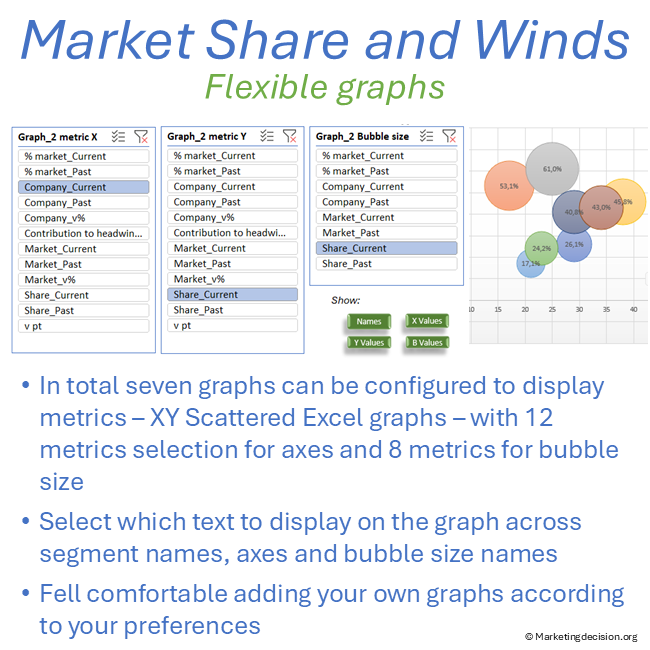
Show or hide names on graph bubbles.
Adjust bubble text size and relative bubble size.
Display horizontal and vertical axis values on graph bubbles.
Color Schemes
Set colors for bubbles by category or individually.
Copy and save bubble color codes for consistency.
Metrics Display
For the selection of dates and segments, the table is created dynamically by simply changing slicer selections (or pressing F9 if the tool is set to manual calculations).
For each segment and the two selected time periods, the following metrics are displayed:
- Segment: list of selected segments per slicer
- Market Past: market total for the segment in the past period
- Company Past: company total for the segment in the past period
- Share Past: market share percentage in the past period
- % Market Past: share of the total market represented by the segment
- Market Current: market total for the segment in the current period
- Market Growth %: market growth between periods
- Company Current: company total in the current period
- Company Growth %: company growth between periods
- Share Current: market share percentage in the current period
- % Market Current: segment share of the total market
- Share Gain/Loss: change in market share between periods
- Contribution to Headwinds/Tailwinds: segment impact on total market share change
The total for selected segments is displayed above the table. The table can accommodate up to 510 lines of segment metrics, summing all displayed segments and calculating total tailwinds and headwinds.
When rows are filtered, totals automatically adjust and graphs display only visible lines from the first 19 rows of results.
Headwinds and Tailwinds in Market Share Analysis
This metric represents the market share gain or loss resulting from market growth or decline across segments.
Positive value: indicates tailwinds supporting total market share growth.
Negative value: indicates headwinds due to market mix effects negatively impacting total market share gain.
Tailwinds and headwinds are calculated by determining what the total market share would be if the company maintained the same share in each segment as in the past period while market volumes change to their current levels.
This approach reveals whether a company is positioned more strongly in faster-growing segments or in segments experiencing slower growth or decline.
Graphs
Seven graphs are available, each configurable to display different metrics.
One graph is located on the Results tab, while six additional graphs are located in a dedicated Graphs tab.
The graphs use two-axis XY bubble charts, providing flexibility for visual analysis.
Users can dynamically select:
- X-axis values from twelve metrics
- Y-axis values from twelve metrics
- Bubble size from eight metrics
Buttons allow toggling information such as names, axis values, and bubble values.
These graphs support different storytelling perspectives, for example:
- Market segments as a function of growth or decline
- Company positioning relative to segment growth
- Company share gain or loss across segments
Metrics Calculation Details
Two periods can be selected to compare data. Each period is defined using three slicers, allowing flexible definitions such as year, quarter, or month.
Additional slicers enable the selection of market segments.
The three versions of the tool differ only by segmentation capabilities:
Single-Segment Version: One slicer selecting all segments defined in the dataset.
Two-Segments Version: Two slicers allowing combinations such as region and product line.
Four-Segments Version: Four slicers enabling hierarchical segmentation such as region, country, P&L, and modality.
In multi-segment versions, slicers can be hidden except for one, allowing aggregation of all underlying segments.
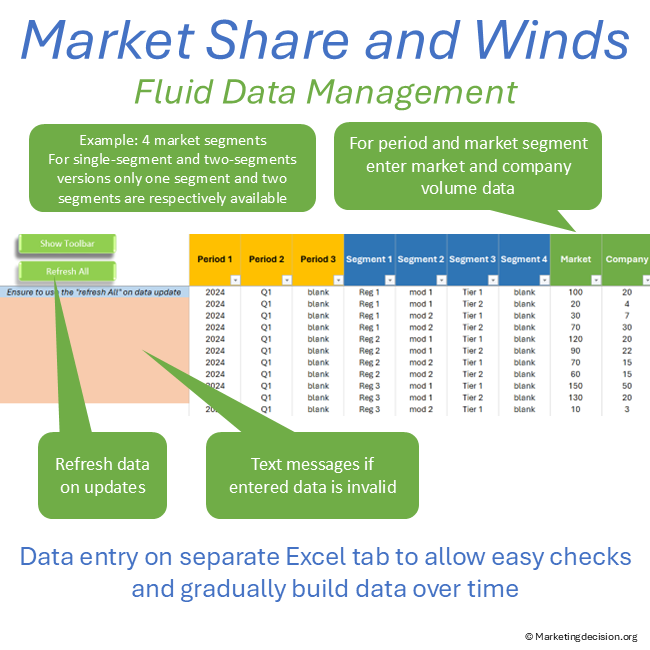
Data Entry
Data is entered through a dedicated tab to prevent accidental modification while exploring results and graphs.
Data can be progressively added over time, and results refresh automatically using the Refresh All button.
Dates are entered using three slicers (year, quarter, month). Multiple fields may be used within a slicer, allowing different period definitions.
Market and company fields must contain numeric values representing market volume. Market share is calculated as the ratio of company volume over market volume.
If descriptions are missing or non-numeric values are entered, an error message prompts correction.
Additional Information
For users who wish to display both orders and sales data in the same file, one segment slicer may be used to separate orders from sales. However, comparing orders and sales is often better addressed using waterfall analysis.
Comparing competitors on the same graph is generally not recommended because data quality for one’s own company is typically much more accurate than for competitors. When competitor analysis is needed, a segment slicer can be used to select competitors individually.
Maintaining separate versions of the file for competitor analysis and internal segmentation analysis is often advisable.
The mathematical demonstration of tailwinds and headwinds can be understood by introducing an intermediary scenario where market volumes correspond to the current period while segment shares remain identical to those of the past period.
Links and References
Tailwinds and headwinds analysis depends on a clear understanding of market structure and segmentation. See the Market Mix framework for the foundation behind these dynamics.
Understanding where growth and decline occur across segments also helps guide solution investment and portfolio decisions. To place these insights in context, refer to the Solution Mix page.
Usage & Licensing
Please review the Sales Conditions published on this website to fully understand your rights and the restrictions regarding the use of this product. Our products are intended for professional use only and are not designed for consumer purposes.
The products provided under this agreement are exclusively for the individual buyer or members of the same business unit. Sharing, distributing, or making them available to individuals or teams outside the designated user or relevant business unit is strictly prohibited. For software licensing purposes, a business unit is limited to a maximum of 100 employees, including full-time, part-time, and temporary staff. Additional licenses must be purchased in multiples of 100 if this limit is exceeded.
The provided download link is valid for two months and allows up to 10 downloads. Be sure to save a copy before the link expires or the download limit is reached. Users have full access to the application product, including any embedded macros, and may make necessary adjustments to suit their needs. However, all branding, trademarks, and references to marketingdecision.org must remain visible and intact within the application.
Ensure that you have Microsoft Excel and a PC running Windows before purchasing this application. This application uses advanced dynamic range calculations introduced by Microsoft. Please ensure that you are using a compatible version of Excel, such as Microsoft 365, or any version released after Excel 2019 which supports this feature.
We appreciate your feedback on how to improve this application. Feel free to share your suggestions with us at contact@marketingdecision.org