
 The success of sales enablement begins with an accurate understanding of what drives individual and team performance. A company’s results reflect the quality of its people and how effectively they apply their skills and knowledge in the field.
Skills and competencies therefore form the foundation of all enablement efforts.
Sales enablement links these human capabilities to market performance. It ensures that individual strengths are recognized and developed, that teams complement one another, and that collective intelligence grows over time. In doing so, it transforms human potential into a measurable business asset.
To grow effectively, it’s essential to distinguish among skills, competencies, and behaviors, since each plays a distinct role in performance.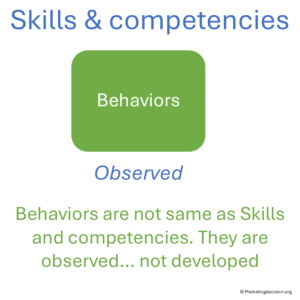
Together, these three dimensions form the backbone of sales force effectiveness.
When distinguishing between hard and soft skills, hard skills usually refer to technical knowledge (products, markets, customers, competition, tools) and fit within the category of competencies. Soft skills relate to personal interaction and emotional intelligence, supporting the application of technical expertise.
Once these distinctions are clear, the next step is to strengthen them. Building a high-performing sales organization begins with shared learning. Regular sales meetings offer valuable opportunities for experienced professionals to discuss tactics, analyze competition, and exchange best practices.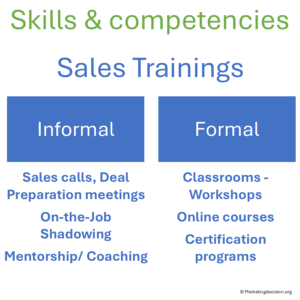
Even informal discussions often serve as training moments. When sales opportunities are reviewed collectively, they generate enthusiasm, build team spirit, and deepen understanding of customer challenges. Although such exchanges are rarely labeled as “training,” they often provide the most meaningful learning experiences.
At the same time, structured programs remain essential. Topics can range from negotiation and solution selling to financial analysis or CRM use. What matters most is that sessions are practical, relevant, and easily applied in the field.
Without adequate training, salespeople often rely on trial and error — a costly approach that leads to lost opportunities. Identifying training needs early improves win rates and profitability.  While measuring the financial benefits of training may be difficult, estimating the cost of poor training can be revealing.
Analyzing win–loss data exposes the impact of insufficient product knowledge, weak messaging, inaccurate positioning, ineffective pricing, or failure to engage decision-makers. The cumulative cost of these missed deals often represents a significant share of potential revenue — underlining the value of continuous learning.
Successful sales teams treat every interaction as an opportunity to learn. Short, focused meetings — weekly or biweekly — help review opportunities, share lessons, and discuss competitive actions. These sessions promote alignment, discipline, and faster progress.
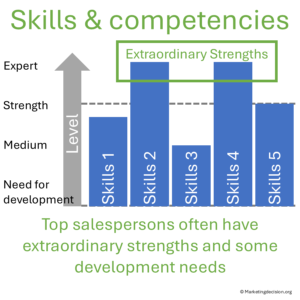 Recognizing where learning gaps exist naturally leads to structured development. The best salespeople are not those who perform equally across all competencies but those who excel in some areas and know how to compensate in others.
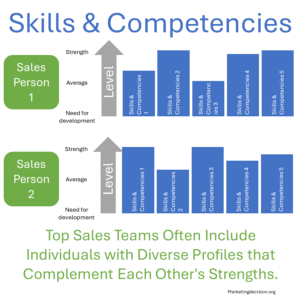 Rather than labeling shortcomings as weaknesses, a more constructive term is “needs for development.” By addressing both strengths and needs for development, individuals can grow all their competencies while avoiding overreliance on a single strength.
Sales teams often combine diverse profiles, and their collective strength comes from balancing complementary skills. A high-performing team recognizes, values, and uses the best competencies of its members to achieve stronger results together.
True sales excellence rarely comes from smoothing every skill to the average. It comes from amplifying strengths while addressing needs for development with intention. Some strengths, when overused or applied in the wrong setting, can even work against performance — for example, an assertive negotiation style used too early in a trust-building discussion. The role of the manager is to help salespeople recognize these patterns, understand when a strength supports performance and when it risks undermining it, and adjust their approach accordingly.
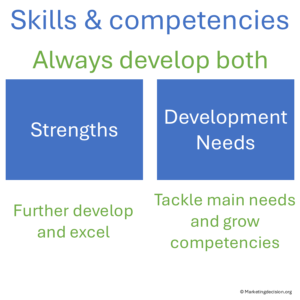
Developing strengths further is not about perfection; it is about using what already works well, more effectively, and more consciously.
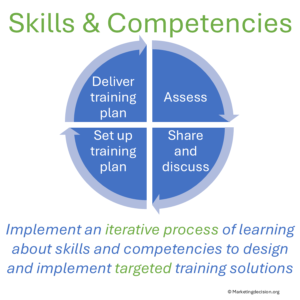 Managers play a decisive role in strengthening their teams. Their ability to observe, listen, and guide each salesperson individually determines how well the team develops its competencies over time. A structured yet flexible approach helps ensure fairness, progress, and trust.
For each step, here are key recommendations:
 Take time to consolidate your assessment for each salesperson. When possible, gather input from others who may offer complementary perspectives, such as mentors or peers. Include examples of observable behaviors — be concrete, balanced, and specific. Focus on both strengths and needs for development.
This preparation will make future discussions clearer and more constructive.
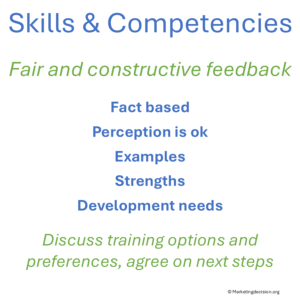 During your one-to-one meeting, deliver feedback as part of a conversation, not a verdict. Share your perceptions openly and explain why certain practices appear more effective.
The goal is not immediate agreement but mutual understanding. Importantly, there is no issue with having a need for development. Research and experience show that the best salespeople are not those proficient in every area but those who excel in some dimensions and know how to manage areas where they are less strong.
For that reason, strengths must also be nurtured — not just weaknesses corrected. The best managers help people amplify what they do well while supporting them where development is needed.
During the same meeting or in a follow-up session, suggest the most suitable learning approach — whether structured training, coaching, or mentoring. Ensure that the proposal is practical and mutually agreed upon. Training should be progressive, focusing first on the capabilities that have the strongest impact on daily sales effectiveness. Hard skills may require immediate attention, while soft skills often develop through sustained observation and peer feedback.
Mentoring is one of the simplest and most effective solutions. Pair a salesperson recognized for a specific strength with another who wishes to develop in that area. Encourage informal discussions and short feedback loops. After a few weeks, review together what was learned and how it influenced performance.
Finally, ensure training delivery and feedback continue beyond initial sessions. Regular one-to-one reviews help evaluate the impact of training and maintain motivation.
Use these moments to celebrate progress as much as to identify next steps. When multiple development areas are identified, prioritize training efforts rather than overloading individuals.
Steady, focused improvement produces stronger results than broad, fragmented initiatives.
Sales enablement and training practices are widely documented, offering a wealth of perspectives on how individuals and teams develop their commercial capabilities. For readers wishing to explore additional research and practical viewpoints on skills development, competency building, and sales training approaches, the following sources are especially relevant:
These resources help deepen understanding of how sales competencies evolve, how training enhances performance, and how continuous learning contributes to stronger enablement and profitability.

Explore tools related to the topics covered in this section. For a wider selection, visit our webshop using the link below, or continue browsing our marketing mix pages for additional insights and solutions.