Marketing operates in an increasingly complex environment. Many teams—sales, finance, design, manufacturing, service, operations, and others—contribute to identifying opportunities, shaping solutions, and bringing these solutions to the market. In this context, marketing cannot remain isolated. It becomes a shared engine that supports decision-making across the company.
This site was created to help companies meet that challenge. The goal is practical: to make marketing easier to navigate, more inclusive across functions, and more aligned with business priorities. It is designed for marketing professionals, but also for everyone who influences the company’s direction, regardless of their role.
In an age where artificial intelligence delivers quick and impressive syntheses, human intelligence remains essential for making sound decisions that benefit the company. This is one of the reasons behind the introduction of the Decision-making chapter in the marketing mix. It reasserts the importance of asking “why” before acting and ensuring alignment with objectives.
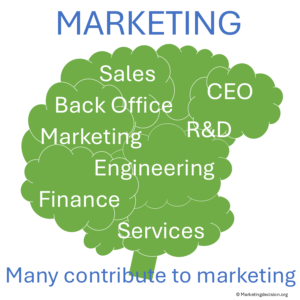
 Marketing is often perceived as a single function, yet in reality, many functions contribute to marketing work. Identifying opportunities, developing solutions, and delivering them to customers requires the combined efforts of multiple teams.
That is why marketing must coordinate contributions from across the company. It supports teams by aligning resources, clarifying priorities, and helping everyone work toward shared goals. Learning about the market, developing a shared understanding about customer needs, aligning to develop optimal solutions, Organizing to place solutions, and promoting those are the responsibility of multiple indivuduals.
This site is built to make this approach easier. It offers clear methods and tools that help individuals and teams coordinate more effectively. For marketing professionals, it provides ways to structure their work so they can support the company as a unified team.
 At the core of this approach is a simple idea: the “why” matters most.
Marketing becomes more effective when it begins with a clear understanding of the business needs and priorities that guide decisions. This emphasis on purpose led to the introduction of the Decision chapter within the marketing mix.
This chapter helps teams define key business questions, establish scope, and clarify objectives before they engage resources. By grounding all marketing actions in a clear “why,” teams can align more easily, share ownership, and avoid misunderstandings.
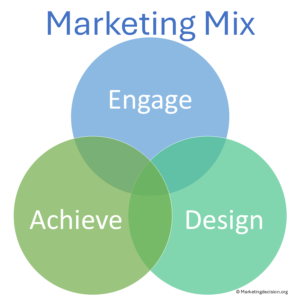
Effective marketing decision-making follows a natural sequence. Before any solution is developed—or any action is launched—teams must take the time to clarify scope, align on mission, and decide to collaborate.
This is the purpose of the Engage phase.
Teams align on mission, clarify objectives, define scope, and agree to collaborate.
Teams create the solution that meets the needs defined in the Engage step. This is where marketing tools help analyze, compare options, and prepare a recommended approach.
The actions and solutions developed in step 2 are executed, validated, and adjusted. This is the moment where decisions turn into tangible results.
This model supports the Decision chapter and anchors the entire Marketing Decision Framework. It helps teams work with clarity and follow a logical progression from alignment to design to execution.
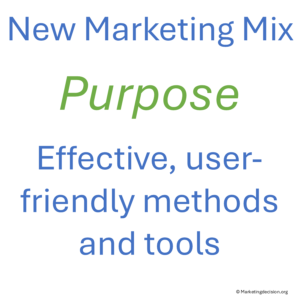 The early marketing mix introduced the 4Ps—Product, Price, Place, and Promotion (source: Wikipedia – Marketing Mix). Over time, the mix evolved to include Market and Customer, making it more externally focused and customer-centered.
The strength of the marketing mix lies in its ability to organize complex questions into manageable parts, a practical “divide and conquer” method.
Yet knowing which tools to use, and in what order, is not always straightforward.
This site emphasizes simplicity and relevance. It helps you:
Define your objectives
Break down complex challenges
Select the right tools
Engage the right teams at the right time
Rather than overwhelm you, it guides you toward practical tools—many of them free—that fit logically into a sequence of business questions.
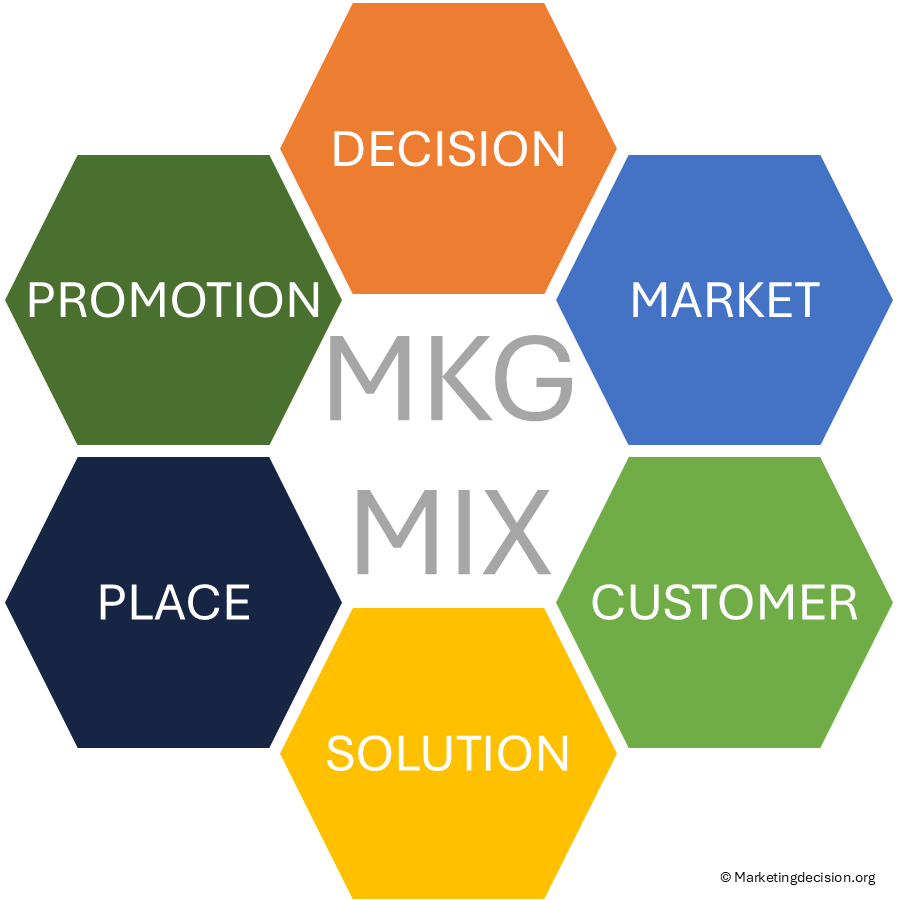
The site presents a structure organized around six chapters of the marketing mix. The objective is not to add complexity, but to help you navigate efficiently across them and choose the most effective path.
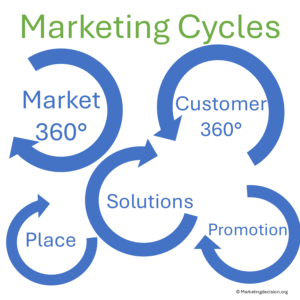
Marketing is cyclical. Companies regularly revisit their market position, strengths, weaknesses, and opportunities. These reviews require coordination across functions, with marketing organizing both long-term plans and short-cycle adjustments.
The Decision mix chapter plays a key role in this coordination by helping teams identify and prioritize their needs. Together, the six chapters Decision mix, Market Mix, Customer Mix, Solution Mix, Place Mix, Promotion Mix follow the classic sequence of business questions: why, where, who, what, how, and when.
Beyond this structure, the site offers a library of user-friendly marketing tools designed to support all types of activities—from developing a marketing plan to launching a new offering or aligning sales teams.