
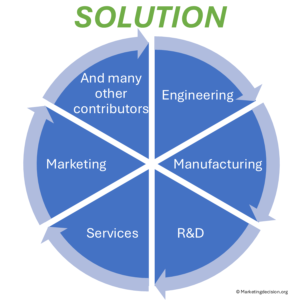
 Today’s company offerings emerge from coordinated efforts across multiple teams that work together to understand the market, uncover opportunities, and develop solutions that stand out from competitors.
Solution Marketing aligns engineering, manufacturing, R&D, services, distribution, and marketing resources toward a shared objective: creating solutions that deliver meaningful value to targeted customers.
This section – originally linked to the traditional “Product” element – now focuses on designing, introducing, and delivering solutions that resonate with specific market segments. To succeed, organizations must coordinate diverse competencies and maintain strong engagement to overcome the many challenges of solution development.
 As customer expectations changed, companies gradually shifted from product-centric approaches toward Solution Marketing, where solutions are defined by the problems they solve and the value they generate.
The well-known quote by Theodore Levitt captures this evolution:
“People don’t want to buy a quarter-inch drill. They want a quarter-inch hole.”
This expanded interpretation of what is being delivered includes: service programs, financing options, digital features, training and support, integration capabilities and all other components shaping the customer experience.
Solution Marketing therefore strengthens differentiation, improves customer satisfaction, and supports long-term value creation.
In Solution Marketing, the customer remains central to development, pricing, and investment decisions.
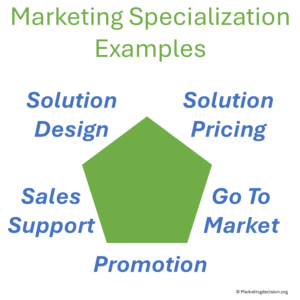
Products still matter, but they represent just one part of a broader solution. Companies consider:
How expectations influence perceived value,
How service, support, and reliability affect long-term loyalty,
Which attributes lead to preference for one solution over another.
This holistic view guides how solutions are conceived, assessed, and prepared for market introduction.
Designing solutions requires examining long-term business priorities and market opportunities. Solution Marketing helps answer essential strategic questions:
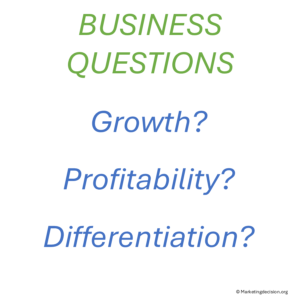
How can the company grow its market presence while improving revenue and profitability?
What strategic direction will help the company outperform competitors?
Which new solutions should be introduced to seize emerging opportunities?
These questions, typically addressed in the marketing plan, clarify the company’s mission, values, ambitions, and constraints. They guide investment decisions that influence all branches involved in creating, delivering, and servicing solutions.
Such decisions often have significant long-term impact and must remain aligned with both customer expectations and the company’s vision.
Solution design and portfolio choices increasingly benefit from AI-assisted exploration – from synthesizing customer signals and competitive moves to generating alternative concepts and testing scenarios. These capabilities can expand the range of options and reveal implications faster. However, deciding what to build, what to prioritize, and what to stop remains a Human responsibility, because it requires arbitration between trade-offs: customer value, feasibility, risk, time, and long-term strategic intent. This page supports that arbitration by structuring solution decisions around value creation, pricing, and selling within a coherent decision framework.
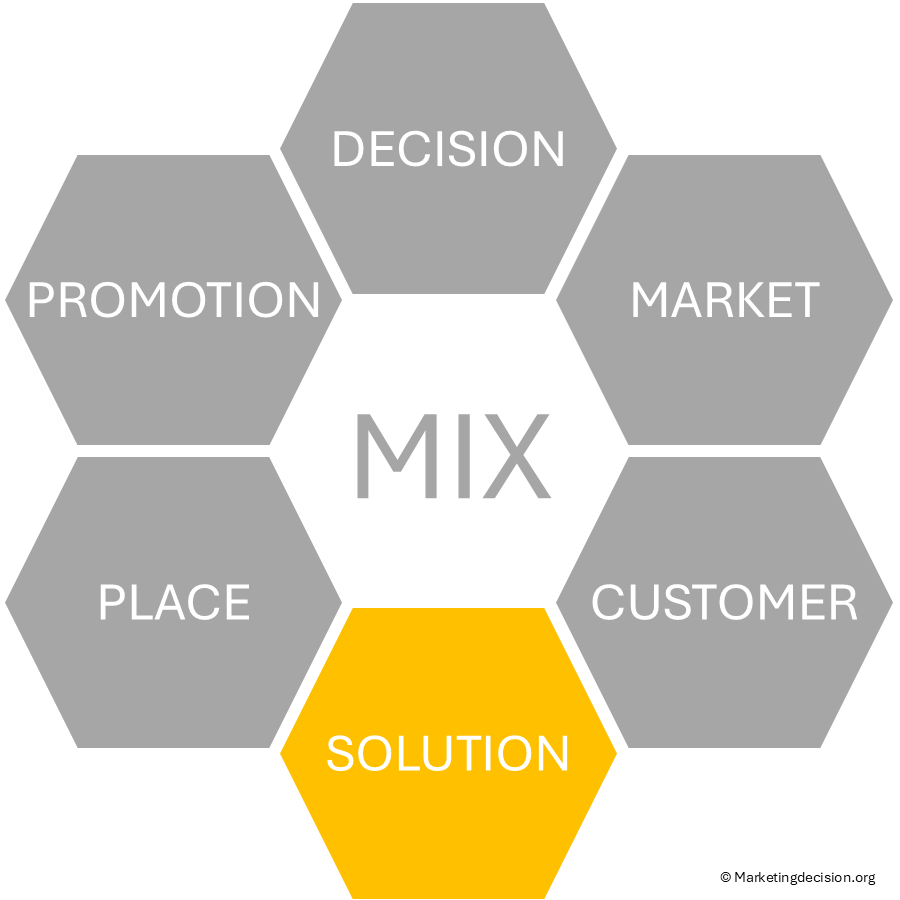
 The Solution Marketing mix is built around four areas that structure how companies design, position, price, and communicate the value of their solutions. Together, these areas help organizations make the right investment choices, shape compelling offerings, and support customers throughout their decision-making process.
Each area plays a distinct role, and all four are explored in dedicated chapters immediately following this section.
Solution Value describes how customers perceive a solution compared with competing alternatives.
It influences preferences, willingness to pay, and the relative positioning of each offering in the market.
Understanding perceived value is therefore essential for explaining why customers choose one solution over another and how companies can strengthen their competitive advantage.
Value Creation guides the design of solutions and the development of the overall solution portfolio.
It helps companies determine: where to invest, how to prioritize development projects, which actions reinforce future competitiveness, and how each solution will deliver measurable value.
Value Creation is a recurrent and structured process, where some projects are initiated, others refined or continued, and some discontinued when no longer aligned with priorities.
Value Pricing translates perceived value into an effective pricing strategy.
Setting the right price is essential for adoption, market positioning, and profitability.
A price that is too high limits acceptance.
A price that is too low reduces margins and may create unhealthy competitive pressure.
Value Pricing ensures alignment between customer expectations, business objectives, and the broader market context.
Value Selling links marketing and sales by helping customers understand how a solution addresses their needs and why it represents the right choice.
This approach highlights benefits, clarifies relevance, and supports each step of the purchase process.
Over time, marketing and sales have become increasingly collaborative, working together to demonstrate value and guide customers throughout their decision-making journey.
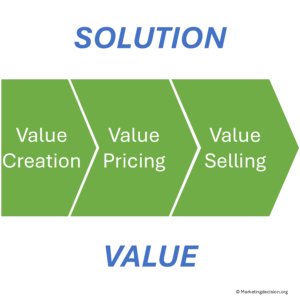 Solution Marketing plays a central role in the modern marketing mix.
It provides the structure for defining solutions aligned with customer needs, market opportunities, and long-term business priorities.
By bringing together value creation, pricing, and selling within a unified approach, companies reinforce competitive differentiation and improve the customer experience.
The four areas of the solution marketing mix – Solution Value, Value Creation, Value Pricing, and Value Selling – offer a comprehensive framework for understanding and managing solution decisions across the company.
Solutions align better with customer needs when decisions are structured. Refer to the Marketing Decision Mix for foundations that guide solution choices.
Communicating solution value effectively requires clear value selling practices. For a dedicated view on how to articulate and justify value in customer discussions, visit our Value Selling page.
In an AI-assisted environment, these frameworks help ensure that solution choices remain Human-led, defensible, and aligned with long-term priorities.
Your feedback and specific needs are greatly valued. For questions or recommendations, please contact us at contact@marketingdecision.org.
 Solutions proposed in the marketplace come with a price that customers are willing to pay only when the perceived value matches the cost and effort of purchasing. When faced with multiple options, customers evaluate which solution best fits their needs and constraints, seeking the optimal compromise. This is where value is assessed and ultimately determined.
Evaluating and measuring value remains a complex task. This chapter clarifies the concept of “Value” in its various dimensions, and its practical application in marketing and sales. Value exists before a price is set, and is shaped by customer needs, expectations, motivations, and the competitive context.
Because each customer – whether an individual, a company, or a group – has unique needs, the value they assign to any solution will also be unique. This uniqueness makes the work of marketing and sales professionals especially engaging: by understanding customer needs and preferences, they can determine which solution – either their own or a competitor’s – best meets those needs.
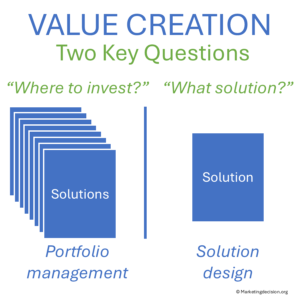
Value Creation stands at the center of Solution Marketing. It is where the motivations of the company and the needs of customers intersect. It is essential to invest time and effort in developing solutions capable of delighting customers and building long-term success.
Value Creation requires:
a continuous assessment of the full portfolio,
identification of growth opportunities,
prioritization of development actions,
and consolidation of plans to bring the right solutions to market.
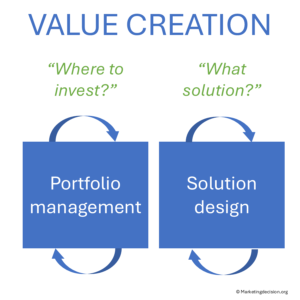
These activities shape the broader portfolio strategy, which raises two essential questions:
How should the portfolio of solutions be managed?
This includes determining where to invest and which solutions offer the most promising path to market.
How is value actually created and demonstrated?
This covers development steps, value justification, and solution refinement.
Value Creation is a recurrent process. New projects may be initiated, others reassessed, continued, or stopped. Each investment decision influences all branches of the company, shaping how solutions are designed, delivered, and supported.
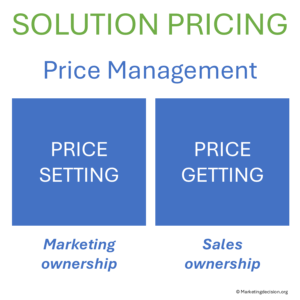
Setting the right price for a solution is essential. A price that is too high can reduce customer adoption and weaken market positioning. A price that is too low may create pressure on competitors, leading to a less profitable environment for all market participants.
This chapter explores how companies manage pricing to:
meet commercial and profitability objectives,
maintain customer satisfaction,
and encourage repeat purchases during renewals or new acquisitions.
Value Pricing links customer perceived value, market dynamics, and business priorities to provide a solid foundation for pricing decisions.
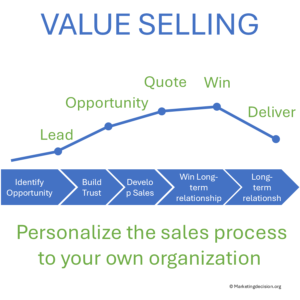 Sales is fundamentally about building a mutually beneficial relationship between a buyer and a seller. Historically, this relationship was often unbalanced, with sellers trying to push products onto customers by any means necessary.
Over time, this evolved into a more balanced and collaborative approach, where customers choose the solution that best meets their needs. Value Selling naturally follows Value Creation and Value Pricing, helping customers understand how a solution addresses their requirements and why it is the right choice.
Marketing and Sales have gradually evolved together, and today both disciplines use complementary techniques. Sales teams must demonstrate the value of their solution and increasingly rely on marketing insights to help customers articulate their actual needs.
As a result, salespeople operate less as isolated individuals and more as integrated members of collaborative sales teams.
This chapter does not aim to describe the latest sales techniques but to highlight how marketing and sales learn from each other and jointly support customer decision-making.

Explore tools designed to support solution design, positioning, and value creation across the marketing mix