
Companies strive to identify opportunities by understanding markets, customer needs, technologies and competitive developments. Once opportunities have been identified, the challenge is to determine which deserve greater attention and where resources and investment can create the most value.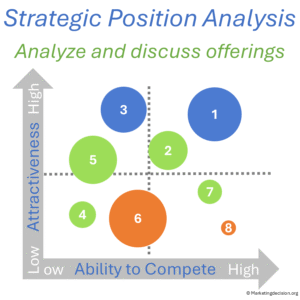
Strategic Position Analysis helps compare opportunities by considering Market Attractiveness and the organization’s Ability to Win.
Market Potential adds another perspective by showing how much an opportunity could matter.
Together, these dimensions help teams compare existing and future positions, identify promising opportunities, understand where capabilities may need strengthening, and determine where further investigation is worthwhile.
Within Value Creation, Strategic Position Analysis provides a practical perspective for prioritizing opportunities and supporting portfolio and investment discussions.
Combining Market Attractiveness and Ability to Win creates four broad strategic positions.
High Attractiveness / High Ability to Win
These opportunities combine favorable market conditions with a strong competitive position and may deserve particular attention for further development and investment analysis.
High Attractiveness / Low Ability to Win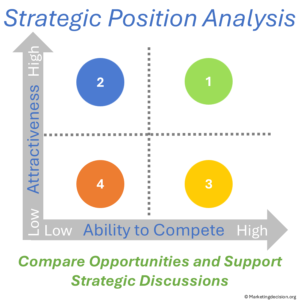
The market opportunity may be promising, while capabilities, differentiation, partnerships or market access may need to be strengthened to improve the company’s ability to capture it.
Low Attractiveness / High Ability to Win
The company may hold a strong position, while future priorities depend on market development, profitability and the strategic value of maintaining or developing that position.
Low Attractiveness / Low Ability to Win
These positions may justify greater selectivity, particularly when other opportunities combine stronger market prospects with a greater Ability to Win.
By comparing these strategic positions, teams can clarify priorities, align product roadmaps, anticipate risks and explore where capabilities should be strengthened. This can help build a more resilient development strategy.
A useful Strategic Position Analysis starts with a clear objective and scope. Teams should agree on which markets, segments, solutions or initiatives are being compared and what question the analysis is intended to support.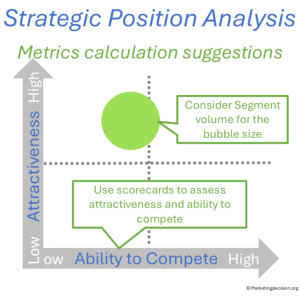
Assessments can begin relatively by comparing one opportunity with another, or they can use more structured criteria.
Different functions contribute different knowledge: Marketing may bring evidence about market development, Sales about customers and competitive positions, Product about differentiation and capabilities, while regional or business teams may bring another market perspective.
Differences in assessment can be valuable. They may reveal assumptions, missing evidence or alternative interpretations that deserve discussion before priorities are established.
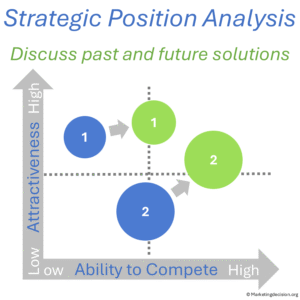 Strategic positions evolve. Markets grow or decline, competitors introduce new solutions, technologies develop and customer expectations change. At the same time, investment can strengthen capabilities and improve the organization’s Ability to Win.
Comparing current and future positions helps teams explore how opportunities may develop and makes assumptions about future Market Attractiveness and Competitive Strength explicit and open to discussion.
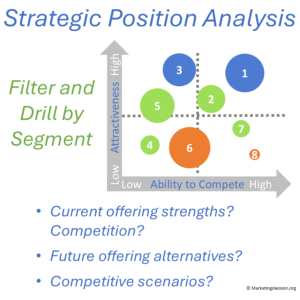 Strategic Position Analysis can move beyond a single portfolio view. Filtering by market segment, solution family, region or another relevant category can reveal differences that may disappear in an aggregated analysis.
Teams can examine current offering strengths, competitive positions, future solution alternatives and different competitive scenarios. Changing the scope or assumptions helps explore how the strategic picture may evolve and where alternative courses of action deserve further investigation.
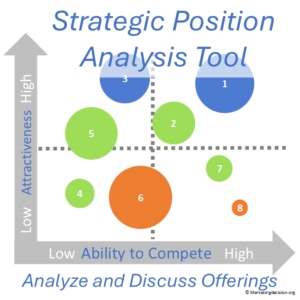 The Market Attractiveness Matrix Excel Tool provides an interactive visual representation of markets, solutions, projects or initiatives, helping teams compare Market Attractiveness, Ability to Win and Market Potential in one view.
The workbook can display multiple opportunities, organize them into categories and filter selected parts of the portfolio. Assessments can be updated as the discussion develops, allowing teams to see immediately how changes affect the relative position of opportunities.
The interactive matrix makes portfolio comparisons easier to visualize, discuss and refine.

Explore tools designed to support the topics covered in this section. Access the full collection or go directly to tools supporting solution decisions.