
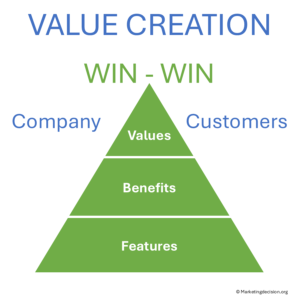
 The centerpiece of solution marketing – or product marketing for some – is value creation. It represents the intersection between the company’s ambitions and customer needs, where both parties benefit.
Creating value means investing time and effort in developing the right solutions – those that truly delight customers while strengthening company performance. This continuous effort involves assessing and maximizing the portfolio of solutions, identifying growth opportunities, and defining action plans to develop, prioritize, and launch solutions that win customers – both now and in the future.
 Rather than viewing the market as an adversarial environment, where both customers and competitors are obstacles, value creation encourages a win-with-customers mindset. Companies succeed when customers perceive their solutions as the best means to achieve their own objectives.
This win-win relationship relies on alignment between customer needs, perceived benefits, and solution features – as described in the Value Ladder. When those elements fit together, customers recognize superior value and willingly choose your solutions.
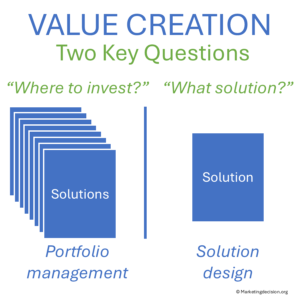
Two major questions drive this process:
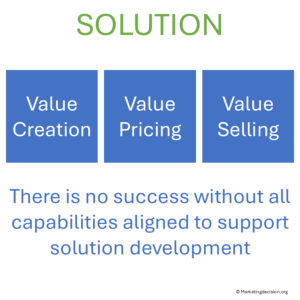 Value creation does not occur in isolation. It requires alignment across functions – marketing, engineering, manufacturing, finance, and beyond. The outcome of this collaboration determines the company’s future solution offering and its competitiveness in each market.
There is no viable solution until value creation, value pricing, and value selling are fully aligned. Price positioning and sales approaches must consistently reflect the value that the designed solution delivers to its targeted customer segments.
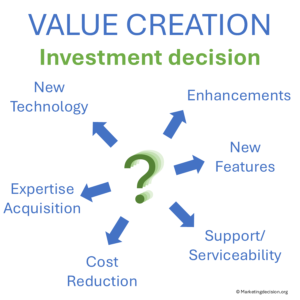 Companies have several strategic options when deciding where to invest in future solution development.
Portfolio management must encourage cohesion and collaboration across teams so that all these initiatives contribute to a shared direction.
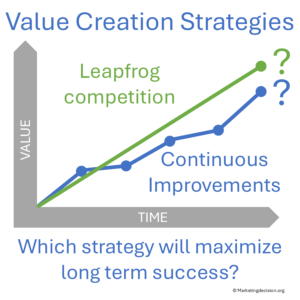 One approach involves continuous improvement, where solutions are regularly upgraded with new capabilities or minor technological evolutions. Another approach is leapfrogging, where companies aim to create entirely new solutions that redefine markets.
Both have advantages and risks. Continuous improvement allows regular market communication and brand reinforcement but keeps competitors visible and customers comparing options. Leapfrogging may deliver breakthroughs, yet it demands heavy investment and long development cycles, during which competitors may close the gap.
An intermediate strategy often works best – combining ongoing solution improvements with long-term technology development, releasing new generations when ready. In every case, decisions rely on investment priorities and finite resources.
Sound investment decisions begin with the right business questions – those that link company objectives to customer and market priorities. They echo the essential “why” question introduced in the Decision chapter:
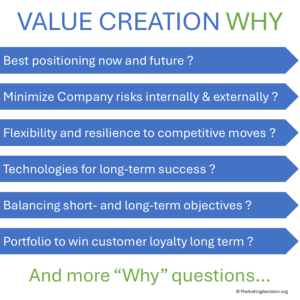 Which investments secure the best positioning now and in the future, in growing and profitable market segments?
These questions should be revisited regularly. Some investments may underperform or face delays, requiring adjustments to maintain alignment with strategic goals.
When applied to the business environment, they guide focus on the essential needs for:
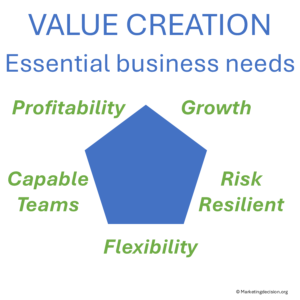 Profitability – by identifying profitable segments and developing solutions that both delight customers and protect margins.
Ultimately, the goal is sustainable, profitable growth, achieved by maintaining a clear focus on priorities and allocating resources to the most promising opportunities.
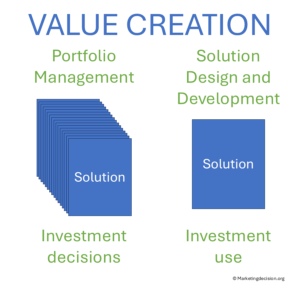 Value creation depends on the coordinated work of multiple teams. To ensure structure and efficiency, it is practical to organize it into two complementary processes:
Portfolio management facilitates investment decisions and budget allocation, while solution design transforms those investments into tangible offerings. When both processes are well connected, the organization can adapt quickly and make informed choices on priorities and trade-offs.
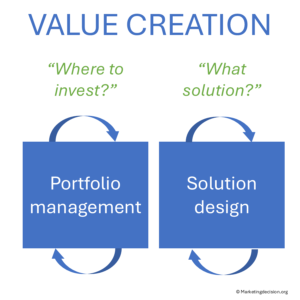 Portfolio management is at the core of value creation. It defines how companies decide where to invest and how to balance short- and long-term priorities. By establishing consistent review mechanisms, teams across functions can remain coordinated and transparent in their decision-making.
The tools presented in the Decision chapter – together with those outlined below – help structure these discussions, improve collaboration, and prepare the company to develop, deliver, and support solutions that win in the marketplace.
Value creation is a continuous process. Each review leads to new projects being launched, refined, or sometimes discontinued. These investment decisions shape future offerings and strengthen the company’s ability to grow profitably and sustainably.
Value creation always begins with understanding distinct customer segments. For segmentation foundations, refer to Customer Segmentation Principles.
Value creation starts with understanding customer needs and motivations. For this essential perspective, see our Customer Mix chapter.
Translating created value into price requires a structured approach. To place these ideas into a wider pricing context, visit our Value Pricing page.
Value creation becomes meaningful when sales teams can convey it clearly. For structured approaches to communicating and defending value, refer to our Value Selling page.
Value creation decisions are part of a broader solution logic. See our Solution Marketing chapter for the overall framework.

Explore tools designed to support solution design, positioning, and value creation across the marketing mix