
Channel Strategy: Building Effective Sales and Distribution Channels

Channel Strategy

Channel Strategy

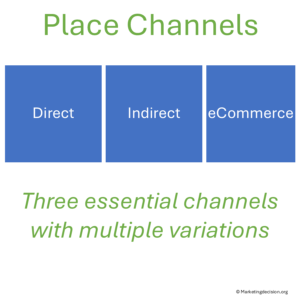
Direct, indirect, and e-commerce sales channel options

Selecting the right channel strategy is a key decision with long-term impact. Multiple sales and distribution channels can be considered – direct, indirect, e-commerce, or via dealers and distributors – either one at a time or simultaneously in a hybrid model. Each brings different advantages and disadvantages in terms of cost, flexibility, and capability to address all targeted customer segments.

A well-defined channel strategy supports the overall Go-to-Market approach and ensures that sales efforts are aligned with company objectives. Channel strategy helps teams decide how to reach customers effectively, consistently, and profitably. Each channel should be carefully evaluated, and when possible, new channel solutions should be tested and validated before full deployment.

Channel strategy is one dimension of the broader Place Mix Strategy, alongside headcount, territory design, skills and competencies, compensation, and sales enablement.

Strategic Business Questions: Defining the WHY of Channel Strategy

Beyond defining how products reach markets, a channel strategy should clarify why certain paths are chosen and how they serve the company’s broader objectives.

When revisiting your channel strategy, start by asking: Why do we operate through specific channels? What goals are we pursuing, and how do these choices serve our overall Go-to-Market direction?

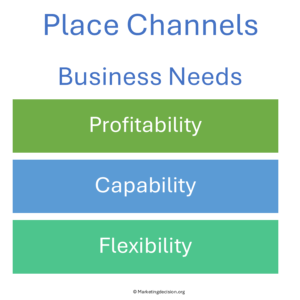
Answering these questions requires considering multiple business questions. These questions will often be specific to your market and should reflect your company’s strategy and priorities. They help translate the strategic intent into concrete issues that can be assessed and discussed.Channel strategy business needs including profitability, capability, and flexibility
Typical business questions may include:

  • What is the profitability associated with different sales organizations?
  • Will product pricing and margins remain sustainable?
  • How can sales operations provide a secure and reliable framework for transactions over time?
  • Is the sales organization flexible enough to adapt to changing market conditions, both short- and long-term?
  • How will the company’s image and brand integrity be represented and protected?
  • What actions are possible when sales conditions or performance do not meet company standards?
  • For indirect operations, how can performance be monitored and measured? What metrics ensure transparency and alignment with objectives?
  • How rapidly can the sales organization adjust to market shifts or customer demands?

These questions help assess the effectiveness of the Go-to-Market model and establish the strategic purpose of the decision. The WHAT concerns the choice of channels and organizational structures. The HOW concerns implementation, management, and adaptation over time. Together, they follow the Why, What, and How logic of the Marketing Decision Mix, which connects business objectives with marketing decisions and their implementation.
Scope the Analysis and Involve the Right Teams

Channel strategy is rarely a Sales-only question. Depending on the issue, useful perspectives may come from Sales, Marketing, Finance, Product, Technical, Channel, Regional, Customer Service, Operations, Human Resources, or Legal teams.

For each important question, define the product, customer segment, market, or situation concerned; the information and expertise required; and who should contribute to the analysis.

Structured facilitation can help when different functions assess the same situation differently. The purpose is to understand the information, assumptions, and priorities behind those differences, not to force premature agreement. The Project Scope Frame In Out and Decision Scorecards provide useful methods for structuring the discussion.

Benchmarking the Current Distribution Organization

Channel initiatives must start with a benchmark to evaluate the current organization and consider the advantages and disadvantages of a change in structure.

The channel benchmark should assess the current organization against the objectives, opportunities, and constraints that shaped it. The purpose is not to judge past decisions, but to understand existing capabilities, identify what works, and learn from experience.

Some strategies may pose serious risks – for instance, losing control over the customer base. This is particularly relevant when working with agents who act as independent sales representatives and, in many countries, hold rights to their customer relationships.

Assessing the current channel setup (AS-IS) helps teams identify what works and what may need adjustment before designing alternative distribution solutions. Quantitative evidence is valuable where available, but qualitative learning from customers, teams, partners, and previous decisions is also important.

For a broader assessment of the complete Go-to-Market organization, see the Channel Benchmark methodology.

Direct Sales Channels and Their Strategic Role

Direct sales does not necessarily mean field sales. Inside sales, key account management, digital sales, and self-service models can also be direct channels.

For a direct sales organization, multiple roles may be considered to support sales activities. Some roles are technical, such as product experts who can best articulate product benefits, while others require financial and commercial skills to close deals.

In technical businesses, several roles may contribute simultaneously to the sales discussion and deal closure. Additionally, direct sales may be structured by customer segments, product categories, or market regions, depending on the company’s objectives and coverage requirements.

Indirect Sales Channels: Coverage, Control, and Profitability

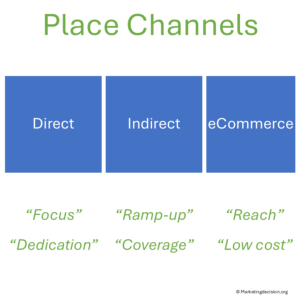
Indirect sales organizations often provide the advantage of an existing salesforce that can quickly ramp up to support your activity, reaching more customers faster than a direct organization could.

Indirect sales partners bring valuable expertise, leveraging their networks, logistics, and service capabilities to support sales operations in markets or segments that might otherwise be difficult to access.

However, these organizations also present disadvantages. Their sales teams are often active for multiple companies and may prioritize others if compensation schemes are more attractive. Indirect organizations may also be less effective for complex or high-technology products that require multiple customer visits or technical expertise.

In many cases, a combination of indirect distributors and a direct team of specialists can deliver the best results – distributors provide reach and flexibility, while direct teams ensure technical depth and consistent messaging.

Although distributors may appear more costly than a direct sales organization, they bring critical benefits such as speed, adaptability, and extended market coverage.

E-Commerce Channels and Digital Go-to-Market Strategies

Direct, indirect, and e-commerce sales channels compared by focus, coverage, and reachE-commerce is an essential channel for many markets and customer types. Beyond online catalogs or product pages, digital channels can deliver technical content, testimonials, and demonstrations that build confidence and simplify purchase decisions.

In some markets, developing multiple e-commerce channels may be relevant, especially when serving different customer segments with distinct needs and price points. Digital channels also provide valuable insights into buying behavior and customer preferences – essential for refining the overall Go-to-Market strategy.

Hybrid, Multichannel, and Omnichannel Channel Strategies

A hybrid channel strategy combines direct and indirect routes to market. Different products, customer segments, markets, or regions may justify different approaches. Direct and indirect channels can also operate simultaneously for the same product or market. A hybrid model can therefore be a deliberate strategic design rather than a compromise.
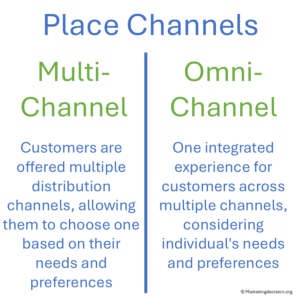
Comparison of multichannel and omnichannel sales strategies

When defining a channel strategy, it is also important to distinguish between multichannel and omnichannel approaches:

Multichannel implies multiple sales and distribution channels operating in parallel without integration. Customers, depending on their profiles and needs, choose between these channels independently.

Omnichannel, on the other hand, implies that customers enjoy an integrated and consistent experience across channels. When moving from one channel to another, they are recognized and supported seamlessly, improving satisfaction and loyalty.

A multichannel strategy may evolve toward an omnichannel approach when greater integration improves the customer experience and supports the business model.

When channels coexist or overlap, their respective roles should be clear. Pricing inconsistencies, unclear account ownership, competing incentives, or poorly defined responsibilities can create channel conflict. These risks should be anticipated through clear roles, responsibilities, and appropriate coordination.

Metrics to Optimize Sales Channel Performance

Whether managing direct or indirect channels, transparency, measurable performance, and regular evaluations are essential to maintain control and partnership alignment.
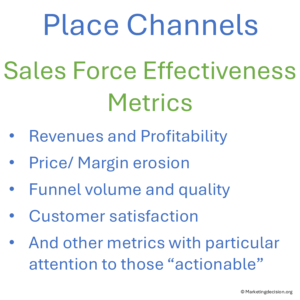
Sales and distribution performance metrics for evaluating channel strategy

Several sales and distribution metrics are essential to support these evaluations, and they vary by business type. Common indicators include:

  • Revenues per head
  • Profitability in currency amounts and percentages
  • Distribution of revenues per salesperson
  • Price and margin erosion
  • Sales coverage and visibility
  • Customer satisfaction and service effectiveness

Such metrics are often visualized using waterfall charts, both at market and individual salesperson levels. These charts illustrate the total market, the addressed market, the CRM-reported pipeline, and the orders won.

Additional indicators may include differences between orders and actual sales, as order cancellations and concessions can significantly impact financial performance.

Clear metrics not only enhance internal decision-making but also support mutual understanding in distributor partnerships, strengthening cooperation and accountability.
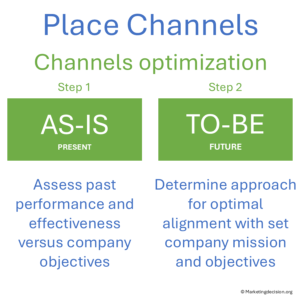
Channel Strategy Methodology: Assessing AS-IS and Designing TO-BE Scenarios

Assess the AS-IS

Regular assessment of AS-IS and TO-BE channel strategyIdentifying alternative approaches to the current Go-to-Market structure requires a clear assessment of the existing situation – the AS-IS.

For new products or markets, the AS-IS may be limited or hypothetical. In such cases, benchmarking competitors can provide valuable insights and serve as a reference.

For a broader assessment of the complete Go-to-Market organization, see the Channel Benchmark methodology.

Design and Compare TO-BE Scenarios

Once the current baseline is defined, multiple future-state (TO-BE) scenarios can be evaluated. Each scenario should be compared across common criteria such as efficacy, flexibility, reach, and capability to address both short- and long-term needs.

The criteria should reflect the business questions being addressed. They may be qualitative or quantitative, depending on the situation and the evidence available.

Scorecards are particularly effective tools for comparing these scenarios objectively, helping decision-makers visualize trade-offs and prioritize the most promising models.

Once a preferred scenario emerges, the TO-BE channel model should describe how the future channel organization is expected to work. Depending on the business, this may clarify:

  • Which customers and markets are addressed through each channel
  • The respective roles of direct, indirect, and digital channels
  • The capabilities required
  • Customer and account responsibilities
  • Partner roles
  • Expected market coverage
  • Channel economics
  • Performance expectations

Different products, customer segments, or geographies may justify different approaches. The objective is therefore not necessarily to create one universal channel model, but to develop a coherent channel architecture that supports the company’s priorities and can be understood by the people expected to implement it.

Plan the Transition From AS-IS to TO-BE

Selecting a better channel model does not make the current organization disappear. Existing customers, partners, contracts, sales responsibilities, compensation systems, capabilities, processes, and relationships create commitments that must be considered when changing the channel organization.
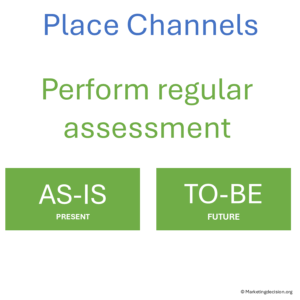
Channel strategy assessment comparing the current AS-IS organization with the future TO-BE modelToday’s channel strategy is partly constrained by yesterday’s channel decisions.

The transition from AS-IS to TO-BE therefore deserves as much attention as the target model itself.

A change in channel strategy may have implications for other dimensions of the Go-to-Market organization:

These implications should be identified early enough to influence company planning cycles, including budgets, organizational changes, compensation plans, communications, and implementation programs.

Test, Validate, and Adapt

Important channel changes can be tested before full deployment where practical. A new channel, partner model, customer approach, or geographic organization can sometimes be introduced progressively.

Testing helps validate assumptions, identify implementation issues, and adjust the model before broader deployment. Performance should then be assessed against the original objectives, using relevant financial, market, customer, operational, and strategic indicators.

The purpose of measurement is not only to report results. It is also to create the learning required for the next channel assessment.

Tools and Techniques to Support Channel Strategy

Channel strategy combines market understanding, organizational assessment, decision-making, implementation, and performance management.

No single tool can address all of these dimensions. The objective is not to use every technique, but to select the methods that help answer the specific questions management needs to resolve.

Business Need

Supporting Methodology or Tool

Assess the current go-to-market organization

Channel Benchmark

Understand market opportunities and competitive pressures

Market Analysis / Porter Five Forces

Assess risks and opportunities

Risks & Opportunities Matrix

Compare channel alternatives

Direct vs Indirect Sales Tool

Structure complex decisions and discussions

Decision Scorecards / facilitation techniques

Support organizational implementation

Place methodologies – Headcount, Territory Design, Competencies, Compensation, and Sales Enablement

Direct vs Indirect Sales Channel Tool

When defining a go-to-market strategy, companies must decide whether to rely on direct sales or indirect distribution channels. This choice affects how quickly markets can be accessed, how customer relationships are managed, and how solutions evolve over time.
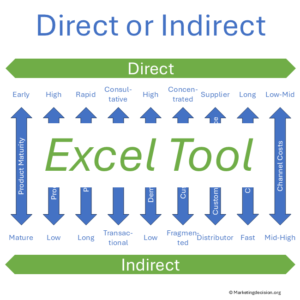
Direct vs indirect tool used to compare sales channel strategies

Organizations may favor indirect distribution for faster deployment through partners, or direct sales to build closer relationships and better understand customer needs and preferences.

The proposed Excel tool supports structured discussions and evaluations of criteria to guide decisions between these two approaches. Choosing between direct and indirect operations commits the company to long-term engagements.

This tool is designed to facilitate structured discussions among people bringing different expertise and perspectives to the decision. By addressing one factor at a time, teams can make assumptions and differences in assessment visible, identify opportunities and barriers that require further consideration, and build a stronger understanding of the alternatives before committing to a channel direction.

Frequently Asked Questions About Channel Strategy

What is a channel strategy?

A channel strategy defines how a company reaches, sells to, and supports its customers through direct, indirect, digital, or combined sales and distribution channels.

It should reflect business objectives, customer needs, market opportunities, available capabilities, and the economics of different routes to market.

Start by understanding the business objectives, market opportunities, and current channel organization.

Define the questions management needs to resolve, assess alternative channel models against business needs, and design the desired future organization.

The transition from the current AS-IS situation to the TO-BE model should then be planned, measured, and regularly reassessed.

With a direct sales channel, the company maintains direct responsibility for the customer relationship and transaction.

With an indirect channel, distributors, resellers, agents, integrators, or other partners participate in reaching or serving customers.

The appropriate model depends on factors such as customer preferences, market coverage, product complexity, selling effort, capabilities, economics, and the level of control required.

Yes. Direct and indirect channels can operate together as part of a hybrid channel model.

Different channels may serve different products, customers, segments, markets, or regions. They can also overlap, provided that responsibilities, customer ownership, pricing principles, and potential channel conflicts are appropriately managed.

Channel alternatives can be compared against criteria such as market reach, customer buying preferences, product complexity and maturity, selling effort, customer relationships, internal and partner capabilities, costs, margins, flexibility, digital readiness, and potential channel conflict.

The objective is to understand the trade-offs rather than identify a universally superior channel.

Channel strategy should be reviewed regularly and whenever significant changes occur in markets, products, customer behavior, company objectives, capabilities, technology, or partner relationships.

Reviews should take place early enough for important conclusions to influence budgets, organizational decisions, compensation plans, and other implementation programs.

Channel Strategy focuses specifically on the routes through which a company reaches, sells to, and supports customers.

Place Mix Strategy is broader. It connects channel decisions with other go-to-market dimensions such as headcount, territory design, skills and competencies, compensation, and sales enablement.

Summary: Regular Channel Strategy Assessments

At least once per business-planning cycle, the company’s Go-to-Market and channel strategy should be reassessed.

Evaluating how well the chosen model supports customer coverage, profitability, and flexibility helps ensure alignment between marketing, sales, and corporate objectives.

Building robust sales metrics and regularly comparing AS-IS and TO-BE scenarios enable better-informed decisions and a clearer understanding of market opportunities and organizational performance.

Channel strategy is part of the broader Place Mix Strategy. Its effectiveness also depends on market structure and competitive conditions, addressed in the Market Mix, and on customer buying behaviors and preferences, addressed in the Customer Mix.

The purpose of channel strategy is to design and continuously evolve the routes through which the company can reach its opportunities and serve its customers effectively and profitably.

© marketingdecision.org

Explore Marketing Tools and Templates

marketing tools and templates

Explore tools designed to support the topics covered in this section. Access the full collection or go directly to tools supporting channel strategy and distribution.

© 2026 MARKETING DECISION SOLUTIONS. All Rights Reserved.