
In the marketing mix, promotion plays a dual role. On one hand, it amplifies visibility, ensuring that offerings are recognized and understood. On the other, it translates positioning into action by connecting the company’s message to real customer motivations. Whether through advertising, public relations, direct communication, or digital platforms, the objective remains the same: to build a meaningful bridge between the company and its markets.

Communication is a strategic signal.
It expresses intent, commitment, and priorities.
Choosing to communicate – or choosing not to – shapes perception and expectations long before results can be measured.
This is where stepping back becomes useful – not to question the importance of communication, but to clarify why it deserves attention, effort, and investment in the first place.
Seen from this perspective, promotion or communication in marketing is less about execution and more about making the right choices early. Attention is scarce, resources are finite, and not every message should be amplified. Clear priorities help avoid dilution, reduce waste, and improve the consistency of marketing investment decisions over time.
Approaching promotion through its why helps organizations focus marketing communication strategy where it makes the biggest difference – before deciding what to say or how to deliver it.
The Why, What, and How framework introduced in the Decision chapter provides a structured way to frame marketing discussions – especially in promotion and communication.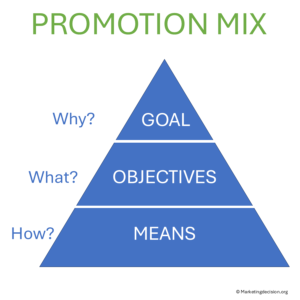
Using this framework helps everyone involved – from marketing to sales to management – share a common language. It connects strategic intent to operational decisions and improves clarity, alignment, and collaboration.
In communication, particular attention should be given to the why. Focusing on business questions that sharpen attention on real objectives helps ensure that promotional efforts remain aligned with tangible business goals and measurable outcomes.
When developing promotional or communication programs, the following strategic questions help clarify purpose and guide investment priorities:
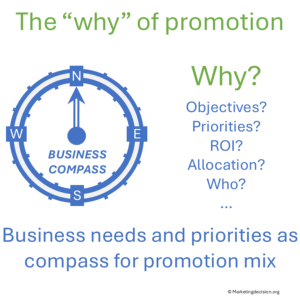
These questions are not simply a checklist. They act as a strategic compass, helping marketing and sales leaders remain accountable for performance and resource allocation while keeping the focus on what truly matters: creating value for both the company and its customers.
Promotion deserves strategic attention because it commits resources, attention, and credibility.
It makes some choices visible while leaving others in the background – and in doing so, it reinforces priorities, sometimes clearly and sometimes unintentionally.
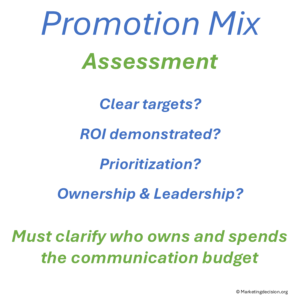 Using marketing to address the strategic questions outlined above helps organizations focus effort and investment, while ensuring accountability for performance and resource allocation.
Asking these questions helps ensure that marketing and sales leaders remain accountable for performance and resource allocation, while keeping attention on what truly matters.
This chapter introduces three sections that expand on promotion from a strategic why perspective:
Together, these sections provide a structured way to explore promotion more deeply, always starting with purpose before addressing objectives and execution.
This promotion framework is part of the broader marketing decision framework developed on marketingdecision.org.
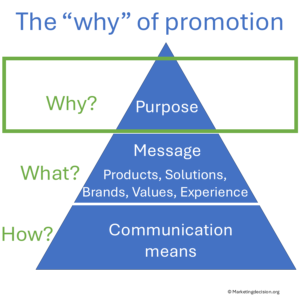 This chapter expands on how purpose and needs drive promotional decisions before defining objectives and means.
The “Why, What, and How” approach outlined on this site is a powerful tool for discussing marketing activities. This is particularly true for promotion and communication activities, where it is essential to articulate needs, objectives, and means. With multiple communication objects – the brand, the products, and even the people – the “Why, What, and How” becomes a wonderful key to understanding and organizing marketing activities.
The “Why” is the domain of purpose and needs. It serves as the platform for internal communication and management discussions, even before considering budgets and means, which are addressed with the “What” and “How.”
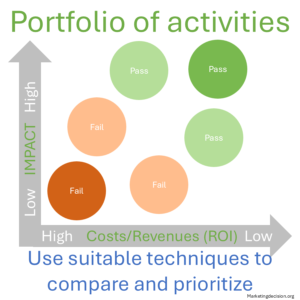 This section details how companies evaluate and compare their communication programs to allocate budgets effectively.
Companies often engage in numerous marketing initiatives, utilizing a variety of communication channels, including PR, direct internet communication, promotional activities, merchandising, and more.
To gain a comprehensive understanding of how priorities are set across various functions – mainly Marketing, Sales, Services, and others – it is crucial to develop a detailed portfolio of promotional and communication activities.
Clarity and transparency in promotion and communication programs offer multiple benefits, especially during periods of confusion about program prioritization. This leads to more effective budget allocation and better preparation for future investments.
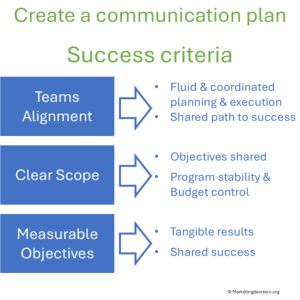 This final section shows how to transform objectives into measurable programs that align teams around company priorities.
Before developing a communication plan, review why there is a need for this plan and what factors will measure success. Before diving into the “What” and “How” of communication, ensure the “Why” is well articulated and visible for participants, stakeholders, and sponsors. Discuss needs and identify key questions like:
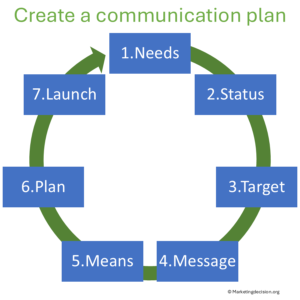 How can I increase brand visibility?
Organizing a communication plan involves many components and dimensions. It can be seen as a one-time isolated effort or a complex coordination across multiple teams and communication supports, always aligned with company objectives and priorities.

Explore tools designed to support the different areas of the marketing mix