

Understanding how a total market translates into actual sales is a key challenge for marketing and sales teams. Companies often analyze market size (Total Addressable Market – TAM, Serviceable Available Market – SAM) separately from sales funnel performance, making it difficult to identify where value is lost.
The Market Waterfall Analysis connects these perspectives by providing a structured view of volumes, from the total market down to final orders or sales. It enables teams to assess market visibility, sales coverage, and conversion performance within a single framework.
Engaging in discussions with Sales and Marketing teams is key to thoroughly assessing the company’s go-to-market performance. Specifically, crucial topics such as market visibility, market share, and market intelligence can best be addressed with the Market Waterfall Analysis.
| Market Waterfall Step | Common Business Concept |
|---|---|
| Total Market | Total Addressable Market (TAM) |
| Addressable Market | Serviceable Available Market (SAM) |
| Covered Market | Sales Coverage / Reach |
| Opportunities | Sales Pipeline |
| Orders | Closed Deals / Bookings |
| Sales | Revenue |

There are several key business questions that can be addressed with the Market Waterfall Analysis:
There is usually no 100% visibility. In many markets, private or public customers may renew contracts without tendering or consultation. You can estimate your share of market renewed without competition to evaluate the same for your competitors.

The Market Waterfall Analysis extends traditional market sizing approaches (such as TAM and SAM) by connecting them directly to sales coverage and conversion performance.
The Market Waterfall Analysis offers a comprehensive view of the market journey, from the total market perspective down to what is successfully captured at each step. This tool is particularly useful when working through distributors, as it allows for independent data collection and performance analysis. It provides valuable insights to discuss market presence, visibility, and competitive positioning.
For organizations with a direct salesforce, the Market Waterfall is an opportunity to evaluate performance against expectations, assess CRM utilization for visibility, and analyze sales coverage, expertise, and alignment with market opportunities.
In these discussions, it is essential to involve both Sales and Marketing teams to ensure collaboration and alignment.
Implementing a Market Waterfall can be challenging, whether due to limited reliable data or the difficulty in aligning Sales and Marketing teams on data sources and definitions.

In spite of these challenges, it remains a powerful transparency tool for improving market presence and visibility.
Key benefits include:
By identifying improvement areas, the Market Waterfall Analysis provides visibility and helps prioritize actions such as better CRM usage, new product introductions, or exploring additional distribution channels.
The Market Waterfall is more than just a tool – it is an investment in understanding your market, improving visibility, and driving coordinated strategic actions.
Even if data gaps exist, it is essential to capture confirmed data points (for example, from CRM systems) and estimate the remaining variables. Seek input from Sales and Marketing teams based on their field insights and market knowledge.

To ensure productive discussions, appoint a moderator who can guide the conversation toward clear performance improvements while keeping shared objectives in focus.
Use the Market Waterfall Analysis as a collaborative platform to develop actionable strategies, such as improving CRM usage, introducing new products, or expanding into new channels.
Actionable steps may include:
By prioritizing and assigning ownership to these actions, the Market Waterfall becomes an invaluable framework for assessing and enhancing market presence.
 When implementing the Market Waterfall, it is important to clarify the scope of measurement – whether it covers orders (what customers sign) or sales (what is ultimately delivered). Definitions vary by industry, but this distinction is crucial.
Measuring from orders to sales helps identify price or margin erosion factors that impact both revenue and profitability.
For an initial assessment, focus on the waterfall up to orders to understand market share and short-term improvement opportunities.
Later, include the steps between orders and sales to capture issues that affect the top line and margin, such as quality or delivery delays.
Ultimately, the Market Waterfall is a powerful tool for visualizing contributions from the total market down to actual sales, helping teams align insights and actions across functions.
The Market Waterfall provides a structured view of how a total market (including Total Addressable Market – TAM and Serviceable Available Market – SAM) translates into opportunities, orders, and sales.
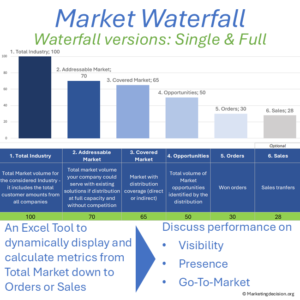
It helps organizations connect market size, sales funnel performance, and go-to-market execution within a single framework.
This tool is particularly useful when working through distributors, as it enables independent data collection and supports detailed analysis of market visibility, coverage, and competitive positioning.
For organizations with a direct salesforce, the Market Waterfall provides an opportunity to evaluate performance against expectations, assess CRM utilization, and analyze sales coverage, expertise, and alignment with market opportunities. In these discussions, it is essential to involve both Sales and Marketing teams to ensure alignment and drive actionable insights.
Use this waterfall tool to evaluate the progression from total market to captured sales, for a single segment or across multiple segments.

Explore tools designed to support market analysis across the marketing mix